

Haskell online is a practical choice for an AI-integrated B2B SaaS MVP when you pair a local GHCup-managed toolchain with GHC, Cabal, Haskell Language Server (HLS), and a focused pilot with an experienced engineer. Two paths forward:
- Pilot now: Install GHCup, configure VS Code with HLS, and run a fixed-price pilot scoped to one working endpoint lasting several weeks. Requires at least one engineer with functional programming experience on your team.
- Evaluate first: Work through the decision checklist in Section 5, assess your team's type-system fluency and your ML library dependencies, then decide.
Neither path requires a full team retraining before you see real output.
Table of Contents
- What Haskell gives you and what it costs for B2B SaaS and AI features
- How to set up a professional Haskell online development environment
- Best online resources and a practical learning path for engineers
- Checklist: is Haskell the right choice for this MVP or AI integration?
- Practical integration patterns: using Haskell with ML stacks and existing services
- How to hire Haskell engineers or contract a focused pilot
- How Hanadkubat approaches Haskell and AI projects
- Key Takeaways
- Why Haskell's reputation for difficulty is half the story
- Fixed-price Haskell and AI integration pilots with Hanadkubat
- Authoritative resources and further reading
- FAQ
What Haskell gives you and what it costs for B2B SaaS and AI features
Haskell's static type system and purely functional semantics are the core value proposition. For B2B SaaS, that means fewer runtime surprises, easier reasoning about failure modes, and multicore performance that scales without the usual concurrency bugs.
Technical strengths relevant to SaaS and AI:
- Strong static types catch integration errors at compile time, not in production
- Pure functions make unit testing AI pipeline components straightforward
- Lightweight threads and STM (Software Transactional Memory) handle high-concurrency inference serving cleanly
- Lazy evaluation lets you process large data streams without loading everything into memory
Primary costs and risks:
- Learning curve is real: engineers fluent in Python or TypeScript need a few months before writing idiomatic Haskell
- The ML library ecosystem is thinner than Python's; no Haskell equivalent of PyTorch or Hugging Face Transformers exists out of the box
- Hiring is harder: the pool of production-ready Haskell engineers is smaller than for mainstream languages
- Build times with GHC can be longer than teams expect on first setup
The honest trade-off: Haskell pays dividends in correctness and long-term maintainability. It costs you speed-to-first-demo and hiring flexibility. For a correctness-sensitive SaaS feature — audit logging, financial calculations, data pipeline integrity — that trade is often worth it. For a fast-moving consumer MVP where the ML stack is Python-first, it usually is not.
How to set up a professional Haskell online development environment
GHCup is the officially recommended installer and toolchain manager for professional Haskell development. It handles GHC, Cabal, and HLS in one place, which matters when you need reproducible builds across a team.
Installation sequence:
| Step | Tool | Purpose |
|---|---|---|
| 1 | GHCup | Installs and manages GHC versions, Cabal, and HLS |
| 2 | GHC | The Glasgow Haskell Compiler — compiles and runs your code |
| 3 | Cabal | Dependency and build management for multi-module projects |
| 4 | HLS | Language server: type hints, go-to-definition, inline errors |
| 5 | VS Code + Haskell extension | Editor integration consuming HLS |
Local toolchain vs. browser playgrounds:
Browser-based compilers like OneCompiler or OnlineGDB are fine for testing a single function or following a tutorial. They cannot manage GHC versions, Cabal dependencies, or multi-module builds. play.haskell.org does not guarantee persistent storage, so snippets can disappear. For any team project, GHCup locally is the only sensible baseline.
Pro Tip: Pin your GHC version in a cabal.project file and commit it to your repository. This prevents "works on my machine" failures when a team member or CI runner picks up a different GHC minor version.
Best online resources and a practical learning path for engineers
A multi-source approach works better than any single resource. Learn You a Haskell for Great Good! is the most readable entry point; pair it with hands-on exercises and the result sticks faster.
Curated resources:
- Learn You a Haskell for Great Good! — free, approachable, covers types and monads with humor
- The Haskell Programming Language official docs — authoritative reference for language features
- University of Glasgow Functional Programming in Haskell (FutureLearn) — structured academic course with video lectures
- Haskell MOOC — self-paced, moves from basics to intermediate features with exercises
- Exercism Haskell track — a comprehensive set of exercises with mentor feedback; the fastest route to idiomatic code
- MIT CSAIL Haskell course materials — covers GHC, algebraic data types, and monads at a rigorous level
- Online compilers (OneCompiler, OnlineGDB) — for quick experiments only, not team projects
Practical learning path:
- Syntax and basics — work through Learn You a Haskell chapters 1–6
- Types and algebraic data types — University of Glasgow course weeks 1–3
- Monads and effects — Learn You a Haskell chapters 12–14, then Haskell MOOC exercises
- Tooling — install GHCup, configure HLS in VS Code, build a small Cabal project
- Idiomatic patterns — submit solutions on Exercism and request mentor review; this step separates engineers who know the syntax from those who write maintainable production code
Mentorship and code review move teams faster than isolated practice. An Exercism mentor will catch anti-patterns that no tutorial flags.
Checklist: is Haskell the right choice for this MVP or AI integration?
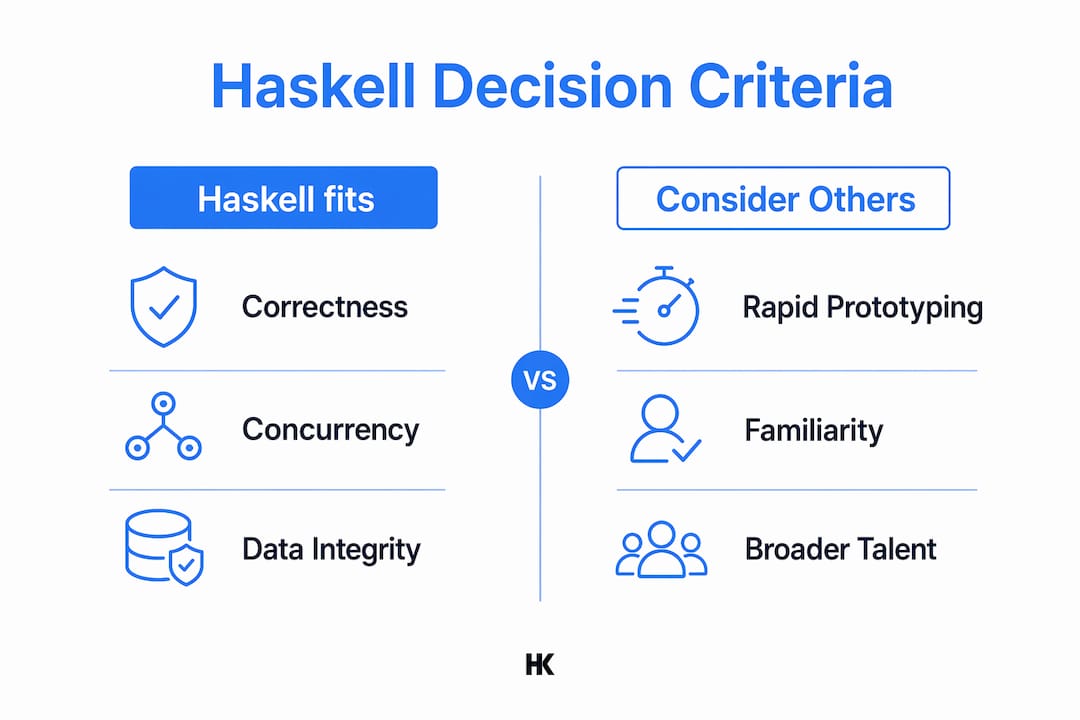
| Criterion | Haskell fits | Consider another language |
|---|---|---|
| Problem type | Correctness-critical logic, data pipelines, financial or audit features | Rapid UI prototyping, heavy ML model training |
| ML library dependency | You can call Python services via HTTP or FFI | You need native PyTorch/TensorFlow integration |
| Concurrency needs | High-throughput, multicore inference serving | Single-threaded scripting or low-volume jobs |
| Team readiness | At least one engineer with FP or Haskell experience | Entire team is Python/JS-only with a 6-week deadline |
| Hiring timeline | 4+ weeks available to source and vet candidates | Need to hire and ship within 2–3 weeks |
| Regulatory fit | EU data residency, GDPR-aware architecture, audit trails | No specific compliance requirements |
| Timeline | 8+ weeks for MVP, correctness matters more than speed-to-demo | 4-week MVP, speed-to-market is the primary constraint |
When Haskell fits fewer than four of these criteria, prototype in a language your team already knows, then refactor the correctness-critical components later.
Practical integration patterns: using Haskell with ML stacks and existing services
The most common production pattern is a Haskell microservice sitting alongside a Python ML stack, communicating over HTTP. This keeps each component in its strongest language without forcing a full rewrite.

Architecture options:
| Pattern | When to use it | Notes |
|---|---|---|
| Haskell HTTP microservice | Business logic, data validation, API gateway | Servant or Warp libraries; clean REST or GraphQL surface |
| FFI to C/Python | Performance-critical numerical code | Complex to maintain; prefer HTTP unless latency is sub-millisecond |
| Message queue bridge | Async ML inference jobs | RabbitMQ or Kafka; decouples Haskell and Python release cycles |
| Polyglot monorepo | Mixed-language team, shared CI | Requires discipline in app architecture boundaries |
Deployment and observability notes:
- GHC-compiled binaries produce small, fast Docker images; a typical Haskell service image runs 50–80 MB after multi-stage builds
- Use
+RTS -Nflags to enable multicore runtime; without this, GHC defaults to single-threaded execution - Prometheus metrics via the
ekgorprometheus-haskelllibraries integrate with standard observability stacks - For AI tasks where no native Haskell library exists, call a Python FastAPI service; keep the Haskell layer responsible for correctness and the Python layer for model inference
How to hire Haskell engineers or contract a focused pilot
Sourcing is the hardest part. The Haskell talent pool is real but concentrated in specific communities.
Where to find candidates:
- Exercism Haskell track — contributors who mentor others are production-ready by definition
- Haskell community forums (Discourse at discourse.haskell.org, Reddit r/haskell) — post a specific problem, not a generic job ad
- Functional programming Slack communities (FP Slack, Haskell Foundation channels)
- Targeted contracting platforms with FP filters (Toptal, Gun.io) — specify "production Haskell" explicitly
- Referrals from Haskell conference attendees (ZuriHac, Haskell Symposium)
Interview checklist:
- Give a type-system exercise: ask them to model a domain with algebraic data types and explain their choices
- Code review sample: hand them 50 lines of non-idiomatic Haskell and ask what they would change and why
- Small refactor task: convert an IO-heavy function to use a monad transformer stack
- Design discussion: how would they structure a Haskell service that calls a Python inference endpoint?
Pilot engagement pattern: A 2–4 week fixed-price pilot with three acceptance criteria works well for risk-limited evaluation: (1) a working HTTP endpoint with documented behavior, (2) a performance baseline under realistic load, and (3) written integration notes covering deployment and monitoring. This gives you real evidence before committing to a full build. Delivery failures in early-stage technical projects often trace back to scope ambiguity, not language choice — a structured delivery approach mitigates that regardless of the stack.
How Hanadkubat approaches Haskell and AI projects
Hanadkubat is the engineering practice of Hanad Kubat, a Vienna-based senior engineer with production experience at BMW, Deutsche Bahn, and Bundesrechenzentrum Austria (government-grade EU infrastructure). He has built and shipped his own SaaS products end-to-end.
What this means in practice:
- Fixed-price pilots scoped to 2–4 weeks with defined deliverables, not open-ended hourly engagements
- AI integration work starts at a fixed upfront price per sprint, with RAG cost-per-query benchmarks and production monitoring included
- EU AI Act and GDPR-aware architecture by default; EU-resident inference for sovereignty-conscious clients
- Clients work directly with the engineer writing the code, not a project manager relaying requirements
On Haskell specifically: The language earns its place in correctness-critical SaaS components — audit pipelines, financial logic, data integrity layers. For those use cases, the type system catches entire categories of bugs before they reach production. For pure speed-to-market, a Python-first stack with a Haskell microservice for the sensitive layer is often the right call.
Key Takeaways
Haskell is a strong fit for correctness-critical SaaS components when your team has functional programming experience and your timeline allows 8+ weeks for an MVP.
| Point | Details |
|---|---|
| Toolchain starts with GHCup | Install GHCup first; it manages GHC, Cabal, and HLS for reproducible team builds. |
| Online editors have hard limits | Browser playgrounds work for experiments; production projects need a local, version-pinned GHCup environment. |
| Learning path needs mentorship | Exercism's 107-exercise Haskell track with mentor feedback is the fastest route to idiomatic, production-ready code. |
| Integration pattern matters | A Haskell HTTP microservice alongside a Python ML stack is the most practical polyglot architecture for AI-integrated SaaS. |
| Hanadkubat offers fixed-price pilots | A 2–4 week pilot with Hanadkubat delivers a working endpoint, performance baseline, and integration notes at an upfront price. |
Why Haskell's reputation for difficulty is half the story
The conventional wisdom is that Haskell is too academic for production SaaS. That framing misses where the language actually earns its keep. The difficulty is front-loaded: the first month is genuinely hard. After that, the type system starts doing work that would otherwise fall to tests, documentation, and code review. Teams that push through the initial curve report fewer production incidents in the components they rewrote in Haskell, not more.
The real risk is not the language. It is adopting it without an experienced engineer on the team from day one. A team of Python developers learning Haskell on the job while shipping a product will write slow, un-idiomatic code that looks functional but behaves imperatively. That is the failure mode worth avoiding, and it is entirely preventable with the right pilot structure.
Fixed-price Haskell and AI integration pilots with Hanadkubat
If you have read this far and the checklist points toward Haskell, the fastest way to validate that decision is a scoped pilot with someone who has shipped production systems at this level before.
Hanadkubat runs fixed-price 2–4 week pilots that deliver three concrete outputs: a working Haskell endpoint integrated with your existing stack, a documented performance baseline under realistic load, and written integration notes your team can own after the engagement ends. No hourly billing, no scope creep, no junior team relaying your requirements. AI integration projects start from €4,500 per sprint; MVP builds start at a fixed upfront price. Both are quoted upfront.
Book a discovery call at hanadkubat.com to scope your pilot and get a fixed quote within 48 hours.
Authoritative resources and further reading
- GHCup — Get started with Haskell: The official entry point. Use this to install GHC, Cabal, and HLS. Start here before anything else.
- Learn You a Haskell for Great Good!: Free, readable, and the best first book for engineers new to functional programming.
- University of Glasgow — Functional Programming in Haskell: Structured academic course; good for teams that want video lectures alongside reading.
- Haskell MOOC: Self-paced, moves from basics to intermediate concepts with exercises. Good for structured solo study.
- Exercism — Haskell track: 107 exercises with optional mentor feedback. The most direct path to idiomatic code.
- MIT CSAIL Haskell course: Rigorous introduction covering GHC, algebraic data types, and monads; useful for engineers who want academic depth.
- OneCompiler — Haskell: Quick experiments and sharing snippets. Not for production work.
- OnlineGDB — Haskell compiler: Run/debug feedback for algorithmic experiments; same limits as other browser editors.
- play.haskell.org: The official Haskell playground. Useful for trying ideas; note that snippets are not guaranteed to persist.
FAQ
What is GHCup and why do CTOs need it?
GHCup is the officially recommended installer for the Haskell toolchain, managing GHC, Cabal, and HLS in one place. Teams use it to pin compiler versions and ensure reproducible builds across developers and CI environments.
Can you learn Haskell online without installing anything?
Yes, browser-based compilers like OneCompiler and play.haskell.org let you run Haskell code immediately. They are useful for learning syntax but cannot manage dependencies or multi-module projects, so a local GHCup setup is necessary for any real project.
How long does it take an experienced engineer to become productive in Haskell?
An engineer fluent in a statically typed language typically needs 2–4 months of deliberate practice, including mentored code review, to write idiomatic Haskell at production quality. The Exercism Haskell track with mentor feedback is the fastest structured path.
Is Haskell a good fit for AI-integrated SaaS MVPs?
Haskell fits well when correctness, data integrity, or high-concurrency inference serving are priorities and your team has at least one functional programming engineer. For ML-heavy workloads requiring native Python library access, a polyglot architecture with Haskell handling business logic and Python handling model inference is more practical.
What does a fixed-price Haskell pilot with Hanadkubat include?
A 2–4 week pilot delivers a working HTTP endpoint, a performance baseline under realistic load, and written integration notes. Pricing is fixed upfront; details are at hanadkubat.com.