
TL;DR:
- Fixed-price engagements are ideal for well-defined SaaS and AI projects, ensuring predictable cost and scope before development begins. They include acceptance criteria, CI/CD, and EU compliance built into the architecture, with fixed prices from €4,500 for AI sprints and from €18,000 for MVPs. When scope is unclear or requirements evolve, time-and-materials or in-house teams are more suitable options.
For DACH and EU B2B SaaS teams, the fastest reliable path to production is a tightly scoped fixed-price engagement: either a 2-week AI sprint (€4,500) or a full MVP build (from €18,000, delivered in 4–12 weeks). Both come with acceptance criteria, CI/CD, and EU-compliant architecture baked in from day one.
TL;DR: Fixed-price works when scope is clear. You get a defined timeline, a capped budget, and deliverables tied to acceptance tests. Time-and-materials works when scope is genuinely unknown. Most early-stage SaaS and AI integration projects are scopeable.
- Scope discipline: A fixed price forces both sides to define done before writing a line of code.
- Predictable cost: No invoice surprises. The price is the price.
- Production-grade deliverables: Every milestone ships with acceptance tests, not just working demos.
Table of Contents
- What does "building software" mean in this guide?
- When does fixed-price make sense versus retainers or hiring in-house?
- What does production-grade SaaS actually require?
- How do you write a brief a vendor can price reliably?
- Key Takeaways
- Why fixed-price production delivery is the only model worth defending
- Fixed-price MVPs and AI sprints, shipped in weeks
- Useful sources
- FAQ
What does "building software" mean in this guide?
"Building software" here means developing and shipping SaaS products, MVPs, and production AI integrations. It does not mean CAD tools, BIM platforms, or construction design software. That distinction matters because most search results conflate the two.
This guide is written for:
- B2B SaaS CTOs and technical founders evaluating fixed-price engagements
- DACH Mittelstand IT directors scoping AI integration or MVP projects
- Non-technical startup founders who need a production-ready product without hiring a full team
It is not written for engineering students, hobbyist developers, or teams evaluating open-source frameworks for internal tooling. The focus throughout is procurement and delivery of custom software solutions at production quality.
Pro Tip: If you are a non-technical founder, read the scoping section before you talk to any vendor. The brief template there will save you two weeks of back-and-forth.
When does fixed-price make sense versus retainers or hiring in-house?
The decision comes down to how well you can define the outcome before work starts.
| Engagement model | Best for | Watch out for |
|---|---|---|
| Fixed-price sprint/MVP | Clear scope, defined acceptance criteria, time-boxed delivery | Scope creep kills the model; changes cost extra |
| Time-and-materials | Open-ended platform work, ongoing ops, evolving requirements | Budget overruns common without strong PM discipline |
| In-house hire | Long-term product ownership, daily iteration, team culture | 3–6 month ramp-up, full salary + benefits overhead |
Fixed-price is the right call for MVP validation, short AI sprints, and well-scoped integrations. A focused B2B SaaS MVP typically takes 4–12 weeks at fixed price. If a build runs past 6 months, scope is usually too large and should be cut before work continues. Time-and-materials makes sense for open-ended platform evolution or when requirements change weekly. In-house hiring pays off only when you need daily iteration over 12+ months.
According to Vajra Global's AI governance research, 73% of enterprise leaders cite data privacy and security as top AI concerns. That procurement scrutiny shortens sales cycles when your vendor can show a fixed scope, a DPA, and EU data residency from the start.
Recommended next steps by buyer type:
- Non-technical founder: Start with a €1,500 strategy sprint to validate scope before committing to a full build.
- CTO at a DACH Mittelstand: Run a 2-week AI sprint to prove a single production feature before a larger integration project.
- Technical founder: Use fixed-price for the MVP, then move to a retainer or in-house team once product-market fit is confirmed.
What does production-grade SaaS actually require?
Production is not a demo. The gap between "it works on my machine" and "it runs in production for paying customers" is where most early-stage builds fail. Here is what to insist on.
Architecture and data:
- Multi-tenant or single-tenant decision made at scope freeze, not retrofitted later. Early architecture choices materially affect procurement and long-term costs.
- EU-resident inference for AI features where GDPR or client contracts require it.
- RAG patterns with grounding for document workflows. AI integration patterns for business document workflows show how grounding reduces hallucination risk in enterprise contexts.
Operations:
- CI/CD pipeline from day one (GitHub Actions, GitLab CI, or equivalent).
- Observability: structured logs, metrics, and alerting before production rollout.
- Canary releases for AI features where output quality is hard to predict at scale.
Security and compliance:
- SSO via SAML or OIDC for any B2B product. Enterprise buyers will not sign without it.
- TLS 1.3 in transit, AES-256 at rest.
- EU AI Act Art. 50 transparency obligations apply to many AI features; GDPR Art. 22 requires safeguards for automated decisions with significant effects. Build the AI risk register early. Enterprise procurement increasingly asks for it, and building it after the fact costs more than building it during the sprint.
- Microsoft's Azure Well-Architected guidance recommends mapping every AI initiative to a measurable business outcome and keeping humans in the loop for high-risk outputs.
Pro Tip: For any AI feature that affects pricing, credit decisions, or access control, design a human review step before the output reaches the end user. This is not just good governance. Under GDPR Art. 22, it may be legally required.
How do you write a brief a vendor can price reliably?
A brief that gets a reliable fixed-price quote covers seven things: the desired outcome, acceptance criteria, non-functional requirements (uptime, latency, concurrent users), third-party integrations, data handling and residency requirements, support SLA post-launch, and IP ownership.
Vendor questions that reveal actual competence:
- What does your deployment pipeline look like on day one?
- How do you handle observability: what gets logged, what triggers an alert?
- Walk me through a failure mode. What breaks first and how do you recover?
- Where does data get processed? Can you provide a DPA for EU data?
- If the underlying model changes or gets deprecated, what is your update process?
Red flags to walk away from:
- No acceptance tests in the contract. "Working software" is not an acceptance criterion.
- Vague uptime SLA or no SLA at all.
- No CI/CD mentioned in the proposal.
- Unclear data residency or no DPA offered.
- Scope defined as a list of features rather than outcomes.
Non-technical founders will find the product development guide for non-technical founders useful before entering any vendor conversation.
Pro Tip: Ask the vendor to show you a past acceptance test document. If they cannot produce one, they have not been doing acceptance testing.
Key Takeaways
Fixed-price software development works when scope is defined upfront, acceptance criteria are written before code is written, and EU compliance is treated as an architecture decision, not an afterthought.
| Point | Details |
|---|---|
| Scope before you build | Write acceptance criteria and non-functional requirements before any vendor quotes a price. |
| Fixed-price fits clear scope | Use fixed-price for MVPs and AI sprints; switch to time-and-materials only when requirements are genuinely open-ended. |
| EU compliance is architecture | EU AI Act Art. 50 and GDPR Art. 22 obligations must be designed in from day one, not retrofitted. |
| Production requires CI/CD and observability | Any vendor without a deployment pipeline and structured logging on day one is not production-ready. |
| Hanadkubat delivers fixed-price | A 2-week AI sprint at €4,500 or a full MVP from €18,000 in 4–12 weeks, both with acceptance criteria and EU-compliant architecture. |
Why fixed-price production delivery is the only model worth defending
The conventional wisdom says fixed-price is risky for the vendor and therefore rare. That is true when scope is vague. When scope is tight, the risk flips: time-and-materials is riskier for the buyer, because the vendor has no incentive to finish.
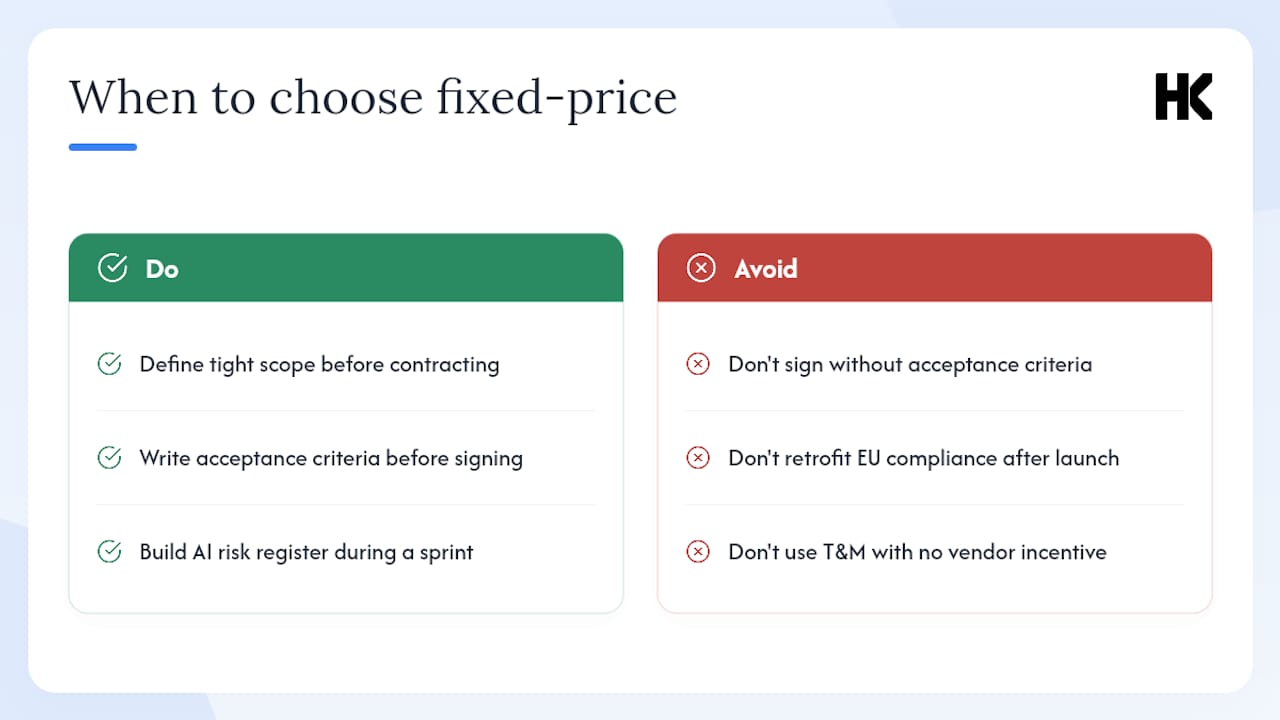
The projects that go wrong are almost never the ones with clear acceptance criteria. They are the ones where "done" was never defined. A vendor who resists writing acceptance criteria before the contract is signed is telling you something important about how they plan to run the engagement.
The other thing most articles miss: EU compliance is not a legal checkbox you add at the end. GDPR data residency, EU AI Act risk categorization, and ISO 42001 alignment all affect architecture decisions made in week one. Retrofitting them after launch costs more than the original build. The AI risk register that enterprise procurement now routinely requests takes a few days to build during a sprint and weeks to reconstruct after the fact.
*— Hanad
Fixed-price MVPs and AI sprints, shipped in weeks
If you have a scoped idea and need production-grade software without a six-month agency engagement, Hanadkubat offers two direct paths.
A 2-week production AI sprint at €4,500 ships one production-ready AI feature with CI/CD, observability, and EU-compliant architecture. A fixed-price MVP from €18,000 delivers a working B2B SaaS product in 4–12 weeks, with SSO, RBAC, audit logs, and a defined support window included. Both engagements are quoted upfront. You work directly with the engineer writing the code, not a project manager relaying messages to a junior team.
Pedigree: engineering work delivered for BMW, Deutsche Bahn, and Bundesrechenzentrum Austria. SaaS products built and shipped end-to-end. Vienna-based, DACH-active, EU compliance fluent.
To start, submit a scoped brief at hanadkubat.com and get a fixed quote within 48 hours.
Useful sources
- Build an AI Strategy for your SaaS Business — Microsoft Azure Well-Architected Framework | Microsoft Learn
- AI Risk Register: EU AI Act, ISO 42001, and GDPR Art. 22 — What SaaS Founders Need to Document | ComplyKit
- AI Governance for B2B SaaS: Reducing Risk in 2026
- Hanad Kubat — fixed-price SaaS MVP & production AI integration services
FAQ
What is a fixed-price AI sprint?
A fixed-price AI sprint is a 2-week engagement that ships one production-ready AI feature for a defined price. Hanadkubat's sprint runs at €4,500 and includes CI/CD, observability, and EU-compliant architecture.
How long does building a SaaS MVP take?
A focused B2B SaaS MVP typically takes 4–12 weeks at fixed price. If a build runs past 6 months, scope is usually too large and should be cut before work continues.
What EU compliance requirements apply to AI features in SaaS?
EU AI Act Art. 50 transparency obligations and GDPR Art. 22 automated-decision safeguards apply to many AI features. Both must be addressed in architecture decisions made at the start of the project, not after launch.
How do I know if my project is scopeable enough for fixed-price?
If you can write acceptance criteria, define non-functional requirements, and list all third-party integrations before the contract is signed, your project is scopeable. If requirements change weekly, time-and-materials is the more honest model.
What does a production-ready SaaS MVP include?
At minimum: SSO (SAML or OIDC), RBAC, audit logs, a CI/CD pipeline, structured observability, TLS 1.3 in transit, AES-256 at rest, and a defined support window post-launch.