
Why stability matters in apps: the direct hit to users and revenue
App stability means one thing in practice: your app runs without crashing, freezing, or slowing to a crawl across every device, OS version, and network condition your users encounter. It is not a nice-to-have engineering metric. It is the floor beneath every other product decision you make.

The numbers are unambiguous. Apps with 99.99%–100% uptime carry a median App Store rating of 4.70, while apps that dip below 99% uptime land at 4.15. That gap is the difference between organic growth and a slow slide into irrelevance. A 1% drop in stability score translates to nearly a full star lost in app store ratings, which directly compresses organic discovery and conversion.
User tolerance is shrinking fast. In 2026, 83.4% of users rate app stability as 'Extremely' or 'Very Important', and 15.4% uninstall after a single crash, underscoring the retention-critical nature of stability. One bad session, and they are gone.
- User retention: Instability drives churn faster than missing features ever will.
- App store ratings: Ratings fall measurably with each percentage point of stability lost.
- Revenue: Fewer downloads, lower engagement, and lost in-app purchases follow poor ratings directly.
- Brand trust: Stability is a strategic business asset that reduces emergency engineering costs and regulatory risk in sectors like fintech and healthcare.
- Competitive position: Trust built through reliability cannot be replicated by shipping more features.
Table of Contents
- What actually causes instability in modern apps
- How to actually improve app stability
- Where app stability is heading
- The Application Stability Index: measuring what actually matters
- Key Takeaways
- FAQ
What actually causes instability in modern apps
Most instability does not come from obvious bugs. It comes from the interaction between your code and the environment it runs in, and that environment is messier than any staging setup captures.
- Memory management: Out-of-memory (OOM) terminations are among the most damaging failure modes for long-running sessions, and Firebase Crashlytics and standard native tools miss them entirely. You need custom telemetry to detect OOM events at all.
- Third-party libraries: Every dependency you add is a stability contract you did not write. Library updates, deprecations, and undocumented behavior changes introduce failure modes outside your direct control.
- Network conditions: Intermittent connectivity does not just slow things down. It creates silent failures, especially in real-time features where a dropped connection may never surface as a visible error.
- OS and device fragmentation: Android alone runs across thousands of device configurations. An app that passes QA on five test devices can still crash on a mid-range handset running a carrier-modified OS build.
- Real-time features: Chat, live updates, and collaborative tools introduce backpressure and session state problems that batch-request architectures never face. A silent connection drop in a WebSocket session can corrupt state without triggering any crash report.
- Hangs and slowdowns vs. crashes: ANR (Application Not Responding) events and UI jank degrade the user experience just as badly as crashes do, but they rarely appear in crash dashboards. Users experience them as the app "being broken" even when no exception is thrown.
How to actually improve app stability
The teams that ship stable apps consistently do not rely on heroics before release. They build stability into the process.
- Automated and risk-based testing: Test every critical path automatically. Prioritize test coverage by the business impact of failure, not by code complexity alone.
- CI/CD pipelines: Continuous integration catches regressions before they reach users. A weekly release cadence is now the norm, with apps updating an average of four times per month. That frequency only works safely with automated gates.
- Real-time monitoring and telemetry: You cannot fix what you cannot see. Instrument your app to surface crash rates, ANR events, and OOM terminations in production, not just in testing.
- Deterministic system design: Deterministic systems produce consistent outputs given the same inputs, which makes failures reproducible and debugging dramatically faster. Non-deterministic behavior is where latent bugs hide for months.
- Memory and connection lifecycle management: Audit how your app allocates and releases memory. For real-time apps, backpressure management and session resumption are not optional. They are what separates apps that degrade gracefully from apps that silently corrupt user state.
- Reconnection and session resumption logic: Build explicit reconnection flows for every real-time feature. Assume the connection will drop. Handle it.
- Fix prioritization by user impact: Not every bug deserves a hotfix. Focus engineering time on errors that affect the most users or the highest-value interactions. The reliability of your release process is itself a form of product quality. For teams scaling fast, the app stabilization strategies that work at small scale often need rethinking as user load grows.
Where app stability is heading
Stability is becoming a product differentiator, not just an engineering baseline. The teams treating it as a long-term trust asset are building competitive moats that feature velocity alone cannot close.
- Observability over monitoring: The shift is from reactive alerting to continuous visibility into system behavior. Teams want to understand why something failed, not just that it failed.
- AI-assisted failure detection: Predictive models that flag anomalies before they become user-visible crashes are moving from research into production tooling. Automated triage that routes issues to the right engineer without a human in the loop is already in use at larger organizations.
- Real-time and distributed architectures: As more apps adopt WebSockets, event-driven backends, and edge computing, the failure surface grows. Stability engineering for these architectures requires different mental models than traditional request-response apps.
- User experience metrics beyond crash rates: Mood-loyalty signals, session abandonment patterns, and perceived performance are becoming part of how product teams measure stability's business impact. A crash-free session that still felt slow is a stability failure in the user's mind.
- Platform-level solutions: Both Apple and Google are investing in platform tooling that surfaces stability signals earlier in the development cycle, reducing the gap between what developers see in testing and what users experience in production.
The Application Stability Index: measuring what actually matters
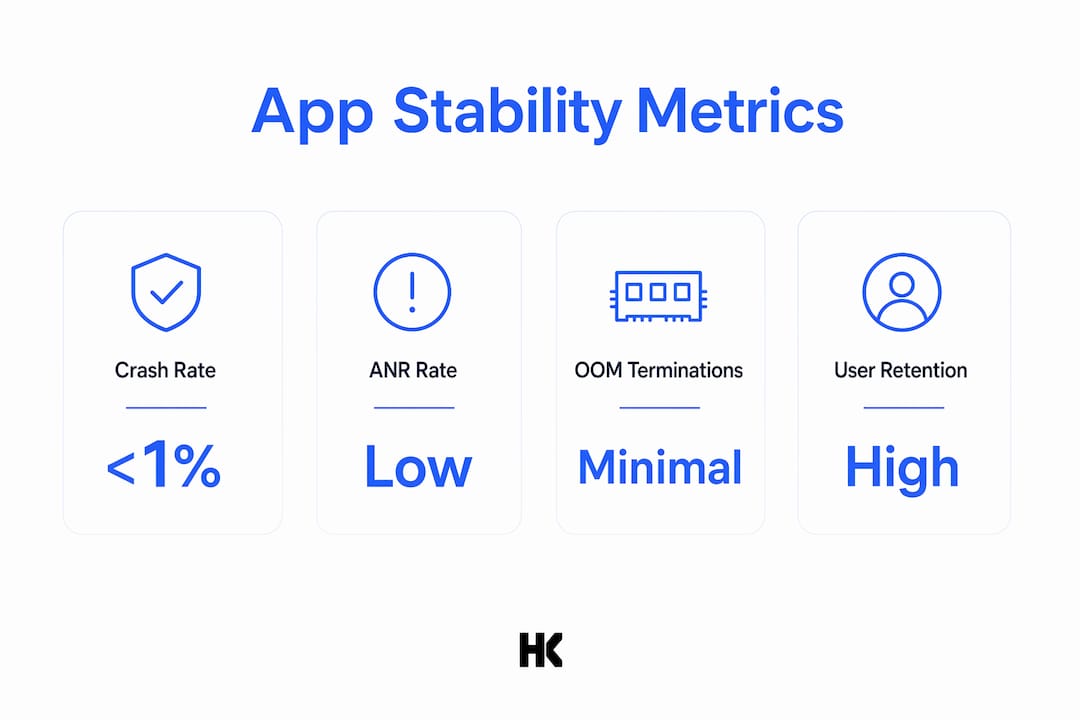
Isolated metrics mislead. A crash rate below 1% looks healthy until you realize your ANR rate is climbing and your OOM events are invisible to your tooling. Fragmented indicators like MTTR or test pass rates can give a false sense of stability. A composite score gives you a more honest picture.
The Application Stability Index (ASI) aggregates multiple signals into a single benchmark. Across ten verticals, travel and hospitality led with a median ASI of 99.90%, while media and entertainment sat at the bottom at 99.65%. The overall median was 99.8%.

| Metric | What it measures | Healthy threshold |
|---|---|---|
| Crash rate | Crashes per user session | Below 1% (Amazon); below 1% daily users (Google Play) |
| ANR rate | Main thread unresponsive events | — |
| OOM terminations | Out-of-memory kills | Requires custom telemetry; not captured by default tools |
| Delivery success rate | Messages or events delivered in real-time apps | Track per session, not just per request |
| Session crash-free rate | Sessions completed without a crash | Target 99.8%+ based on ASI median |
Pro Tip: Native crash tools like Firebase Crashlytics do not capture OOM terminations. Implement a custom OOM death handler using Android's onLowMemory callback or iOS's applicationDidReceiveMemoryWarning to get accurate data. Without it, your stability score is incomplete by design.
Tracking ASI over time gives release teams a defensible signal for go/no-go decisions. A score trending down across two consecutive releases is a clear flag to hold, regardless of what the feature checklist says. For a practical implementation path, the developer's guide to app stabilization covers the tooling setup in detail.
Key Takeaways
App stability directly determines app store ratings, user retention, and revenue, with a 1% drop in stability score costing nearly a full star in ratings.
| Point | Details |
|---|---|
| Stability drives ratings | Apps with 99.99%–100% uptime earn a median rating of 4.70 vs. 4.15 for those below 99%. |
| Single crashes lose users | 15.4% of users uninstall after one crash; 83.4% say stability is 'Extremely' or 'Very Important', showing tolerance for instability is at an all-time low. |
| OOM events are invisible by default | Standard tools miss out-of-memory terminations; custom telemetry is required to track them. |
| Composite scores beat isolated metrics | The ASI median across verticals is 99.8%; fragmented indicators like MTTR alone can mislead release decisions. |
| Deterministic design speeds fixes | Systems that produce consistent outputs given the same inputs make failures reproducible and debugging faster. |
FAQ
What is app stability?
App stability measures how reliably an application runs without crashes, freezes, ANR events, or OOM terminations across real-world devices and network conditions. It is typically expressed as a percentage of crash-free sessions.
How does app stability affect user retention?
Directly and fast. In 2026, 15.4% of users uninstall after a single crash, and 83.4% rate app stability as 'Extremely' or 'Very Important.' Instability consistently produces lower app store ratings, which reduces organic downloads and long-term retention.
How do you improve application stability?
Combine automated testing with CI/CD pipelines, real-time production monitoring, deterministic system design, and explicit memory and connection lifecycle management. Prioritize fixes by user impact, not by engineering convenience.
Why do mobile apps need their own stability metrics?
Mobile apps face unique failure modes, including OOM terminations, ANR events, OS fragmentation, and intermittent connectivity, that web-focused metrics do not capture. A composite measure like the ASI gives a more accurate picture than any single signal.