

TL;DR:
- Prioritizing speed to market allows SaaS companies to capture revenue faster and gather critical customer feedback. Achieving early deployment builds a data advantage and reinforces competitive positioning through structural benefits. However, speed must be guided by clear decisions to avoid accelerating toward incorrect solutions and increasing risk.
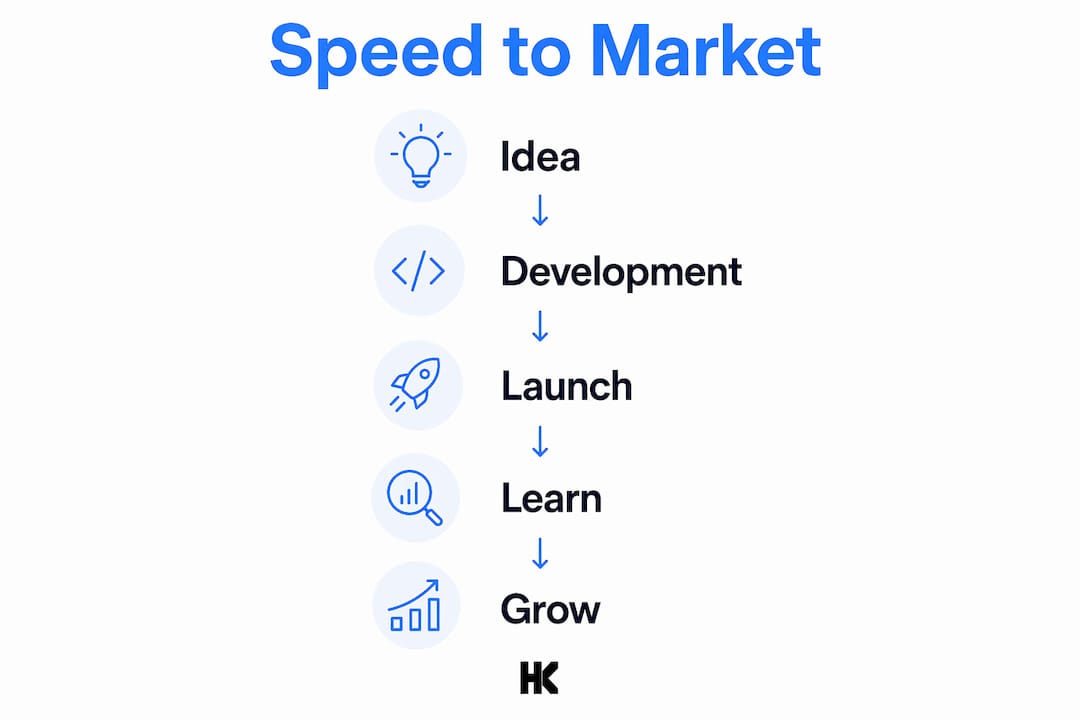
Speed to market is defined as the time between a product idea and its delivery to paying customers, and prioritizing it is the single most direct lever B2B SaaS founders have over competitive position. For AI-integrated products, this matters even more. Market life cycles are shortening, and product life cycles shorten the window for capturing revenue before competitors close the gap. The cost of delay is not abstract. A six-month late launch can erase roughly 33% of after-tax profit, while overspending 50% on development costs only about 3.5% of profit. That asymmetry alone answers why prioritize speed to market before any other question about product strategy.
What are the key benefits of prioritizing speed to market in SaaS?
The most direct benefit of quick market entry is earlier revenue, but the compounding effect is faster learning. Every week a product sits in development is a week without real customer feedback. That feedback is the only reliable signal for whether your AI feature solves an actual problem or a hypothetical one.

Launching six months late costs approximately 33% of after-tax profit. That figure dwarfs the 3.5% profit loss from a 50% budget overrun. The implication is clear: protecting the schedule matters more than protecting the budget.
First-mover advantage is real, but conditional. Early entry creates lasting gains only when converted into structural advantages like network effects, high switching costs, or exclusive data access. Without those defenses, being first just means you educate the market for better-funded followers.
Speed to market without structural advantage is market education at your own expense. The goal is not to be first. The goal is to be first and build a moat before the second entrant arrives.
For B2B SaaS teams building AI features, the structural advantage often comes from proprietary training data, customer-specific fine-tuning, or deep workflow integration that generic tools cannot replicate. Getting into production early starts accumulating that data advantage immediately. Teams that wait for a "perfect" product delay the one thing that compounds: real usage data.
- Earlier revenue capture reduces burn rate and extends runway without additional fundraising.
- Faster feedback loops let teams validate or kill assumptions before they become expensive architecture decisions.
- First-mover data advantage in AI products compounds over time as models improve on real usage patterns.
- Investor signaling improves when traction exists at the time of fundraising conversations.
Does speed alone guarantee better results?
Speed alone does not guarantee better results. Speed amplifies decision quality but does not improve decisions themselves. If your product definition is fragmented or your target customer is unclear, moving faster only accelerates the path to a wrong answer.
The concept worth naming here is "speed of relevance." It means closing decision gaps early, before execution begins, so that the velocity you apply is pointed at the right problem. Teams that govern the early product definition phase with shared context and clear decision criteria achieve faster and more relevant time to market than teams that simply push harder on delivery.
Pro Tip: Before starting a sprint, write a one-sentence product decision statement: "We are building X for Y customer to solve Z problem, and we will know it works when we see W metric." If your team cannot agree on that sentence in under 30 minutes, you are not ready to accelerate.
The table below shows how decision readiness affects the outcome of speed-focused execution.
| Decision readiness level | Effect of accelerating execution |
|---|---|
| High: clear customer, problem, and success metric | Speed compounds advantage and reduces time to validated learning |
| Medium: customer defined, problem partially validated | Speed surfaces gaps faster, enabling course correction |
| Low: unclear customer or unvalidated problem | Speed accelerates resource burn toward a wrong outcome |
Organizations that govern the early definition phase with shared context and decision support consistently outperform those that treat speed as a purely execution-layer problem. The lesson for SaaS founders is that the decision phase deserves as much rigor as the build phase.
What practical strategies accelerate product launch while managing risk?
The most effective approach combines short decision sprints, AI-assisted workflows, and iterative release methods. Each tactic targets a different source of delay without introducing fragility.
-
Run one-week decision sprints before each build cycle. The goal is to validate one core assumption per sprint, not to build features. A sprint that kills a bad assumption in five days saves four weeks of development. For AI integration work, this means testing whether a RAG system actually retrieves relevant context before building the full pipeline.
-
Use AI to remove low-value work from the critical path. Automated code review, test generation, and documentation drafting free engineering time for architecture decisions that require human judgment. Hanadkubat ships production AI features in 2-week sprints partly because the surrounding tooling handles repetitive tasks that would otherwise consume senior engineering hours.
-
Release with canary deployments and feature flags. Canary releases and feature flagging let teams expose new functionality to a controlled subset of users before full rollout. This approach catches integration failures early and gives product teams real usage data without risking the full customer base.
-
Track four KPIs to measure delivery health. Cycle time, lead time, deployment frequency, and change fail rate together show whether your process is actually getting faster or just feeling faster. Deployment frequency rising while change fail rate stays flat is a healthy signal. Deployment frequency rising while change fail rate climbs means you are shipping instability.
Pro Tip: Feature flags are not just a deployment tool. They are a product experimentation tool. Use them to run A/B tests on AI feature behavior with real users before committing to a final implementation.
For teams building AI features under EU AI Act or GDPR constraints, canary releases also provide a controlled environment to validate compliance behavior before broad exposure. Shipping to 5% of users first gives you time to confirm that data handling, consent flows, and inference logging meet regulatory requirements.
How does speed to market affect fundraising and valuation?
Launch timing directly affects investor perception and valuation milestones. Founders should launch once additional development months will not push the product into a higher valuation category or meaningfully change investor perception. Waiting beyond that point is pure opportunity cost.
Time is the scarcest founder asset. Capital can buy more engineering hours. Capital cannot buy back the six months spent polishing a product that customers have not yet validated. Using capital to accelerate learning, through earlier hiring or faster infrastructure, creates leverage that compounds through each fundraising round.
The Minimum Desirable Product (MDP) concept is more useful than the classic MVP framing for this reason. An MVP asks "what is the least we can build?" An MDP asks "what is the least we can build that a customer would actually pay for and tell others about?" The MDP framing forces a quality floor while still preserving speed.
- Traction beats polish in early investor conversations. A product with 20 paying customers and rough edges is more fundable than a polished product with zero revenue.
- Valuation milestones are tied to proof points, not development completeness. Shipping earlier starts the clock on accumulating those proof points.
- Capital deployed on learning (user research, early sales, infrastructure) compounds faster than capital deployed on pre-launch feature development.
- Delayed launches extend the pre-revenue period, increasing dilution risk in subsequent rounds.
For DACH-based SaaS founders, this dynamic is especially relevant. EU investors increasingly expect GDPR-compliant architecture and EU AI Act awareness from day one. Shipping early with compliant infrastructure signals engineering maturity, not just speed.
Key Takeaways
Speed to market is the highest-leverage variable in B2B SaaS product strategy because it determines when learning, revenue, and competitive positioning begin to compound.
| Point | Details |
|---|---|
| Delay cost is asymmetric | A six-month late launch costs roughly 33% of after-tax profit versus 3.5% for a 50% budget overrun. |
| Speed multiplies decision quality | Accelerating execution with unclear product decisions speeds up failure, not success. |
| Iterative releases reduce risk | Canary releases and feature flags let teams ship fast while limiting exposure to instability. |
| MDP over MVP | Minimum Desirable Product sets a quality floor that makes early launches fundable and referrable. |
| Four KPIs prove delivery health | Cycle time, lead time, deployment frequency, and change fail rate together show real velocity. |
Speed is a tool, not a culture
I have worked with teams at BMW and Deutsche Bahn where the cost of a delayed release was measured in millions per week. I have also worked with early-stage SaaS founders where a two-week delay meant a competitor captured the first enterprise contract. The pressure to move fast is real in both contexts, but the mistake I see most often is treating speed as a value rather than a tool.
Speed without a validated decision framework is just expensive noise. The teams I have seen ship well, consistently, are not the ones that work the longest hours. They are the ones that spend the first day of every cycle agreeing on exactly what they are trying to learn, and then they move very fast toward that specific answer.
For AI-integrated SaaS products, this discipline matters even more. An AI feature that ships fast but solves the wrong problem generates bad training data, erodes user trust, and creates technical debt that is harder to unwind than a conventional feature. The rapid launch process that actually works is one where the decision phase is tight and the execution phase is fast. Not both phases fast, and not both phases slow.
My recommendation: treat your first two weeks of any product cycle as a decision audit, not a build sprint. If you cannot articulate the customer, the problem, and the success metric with precision, you are not ready to accelerate. Once you can, move as fast as your infrastructure allows.
— Hanad
Hanadkubat resources for faster SaaS product launches
Founders and product teams who want to reduce time to market without accumulating technical debt have a clear path forward. Hanadkubat works directly with B2B SaaS teams in the DACH region and internationally, shipping production-ready AI features in 2-week sprints and fixed-price MVP builds in 4–12 weeks.
The SaaS MVP development service at Hanadkubat includes a €1,500 strategy sprint to scope and validate your product idea before a single line of code is written. That sprint is the decision audit described above, applied to your specific product. For teams already in development, the B2B SaaS launch tactics guide covers lean workflows and iterative release methods in detail. Every engagement is direct: you work with Hanad, not a project manager.
FAQ
Why does a six-month product delay cost so much profit?
A six-month late launch can cost approximately 33% of after-tax profit because the product misses its revenue window while fixed costs continue. Budget overruns, by comparison, cost far less in profit terms.
What is the difference between speed and speed of relevance?
Speed of relevance means closing product decision gaps before execution begins. Raw shipping speed without clear decisions amplifies mistakes rather than results.
When should a SaaS founder launch instead of waiting?
Founders should launch once additional development time will not push the product into a higher investor valuation category. Traction and user learning are more valuable than additional polish at that stage.
What KPIs measure time to market effectively?
Cycle time, lead time, deployment frequency, and change fail rate together give product teams a complete picture of delivery velocity and stability.
How do canary releases help with fast product launches?
Canary releases expose new features to a small percentage of users before full rollout. This approach catches failures early and generates real usage data without risking the entire customer base.