
TL;DR:
- Rapid deployment involves pushing software changes quickly through automated pipelines, enabling releases within minutes or hours. It provides a competitive edge by allowing faster responses to market demands but requires strong automation, monitoring, and risk controls to minimize system volatility. Effective use depends on organizational discipline, proper strategy selection, and a cultural shift toward continuous, safe delivery.
Rapid deployment is defined as the practice of pushing software or system changes to production environments within minutes or hours rather than days or weeks, enabled by cloud-native CI/CD pipelines and continuous delivery workflows. The industry standard term is continuous deployment, and understanding the distinction between that and rapid deployment meaning in broader IT contexts matters for every decision-maker planning a release strategy. Teams that ship faster respond to market demands faster. That competitive edge is the core reason rapid deployment has moved from a startup practice to an enterprise requirement.
What is rapid deployment in software, and how does it work?
Rapid deployment in software engineering involves pushing code changes to production within minutes rather than days, made possible by cloud-native CI/CD pipelines and continuous delivery. This is a significant shift from legacy release cycles that ran on quarterly or monthly schedules. The practical effect is that a bug fix or a new feature can reach end users the same day it clears automated testing.

The role of rapid deployment goes beyond speed alone. It changes who controls the release schedule. Faster release cycles shift schedule control from customers to suppliers, particularly in SaaS environments. That shift means your product team, not your client's IT department, decides when updates go live.
Rapid deployment also separates two concepts that legacy teams often conflate: deployment and release. Deployment means moving code to a live environment. Release means making a feature visible to users. Keeping these distinct is the foundation of every modern deployment strategy.
What are the common rapid deployment strategies used today?
Rapid deployment strategies range from fully automated continuous deployment to more controlled approaches like blue-green deployments and canary releases. Each method carries a different risk profile, and the right choice depends on your application's complexity and your team's tolerance for failure.
The main strategies in use today:
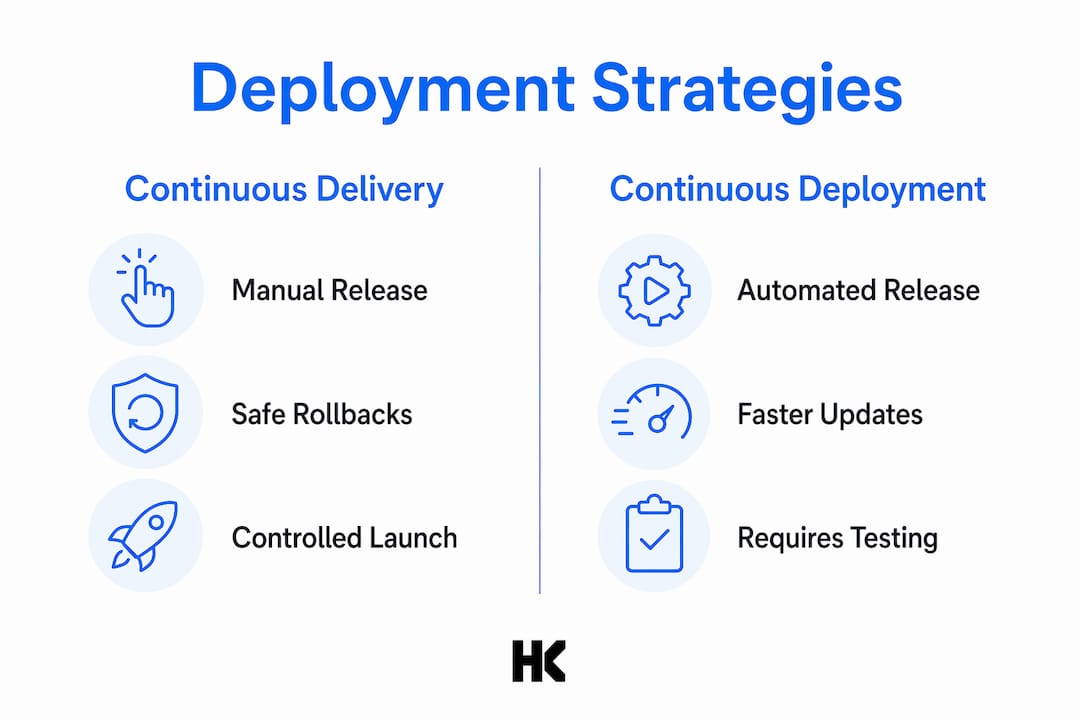
- Continuous deployment: Code that passes automated tests ships to production automatically. This removes all manual gates and requires a high level of testing maturity.
- Continuous delivery: Code is always in a deployable state, but a human approves the final push to production. This suits teams that need audit trails or regulatory sign-off.
- Blue-green deployments: Two identical production environments run in parallel. Traffic switches from the old version (blue) to the new version (green) instantly. Rollback is a single traffic redirect.
- Canary releases: A new version rolls out to a small percentage of users first. The team monitors behavior before expanding the rollout. This limits blast radius when something goes wrong.
- Pre-packaged rapid deployment solutions: Standardized configuration bundles accelerate complex enterprise software implementations by reducing custom setup work. These are common in large-scale ERP and CMS deployments.
The trade-offs between these methods are real. Continuous deployment maximizes speed but demands mature automated testing. Blue-green and canary approaches add safety but require more infrastructure. Selecting a deployment method based on urgency, risk tolerance, and application complexity is the framework that separates disciplined teams from reactive ones.
Pro Tip: If your team is new to rapid deployment, start with continuous delivery rather than full continuous deployment. You get most of the speed benefits while keeping a human checkpoint until your automated test coverage reaches a level you trust.
How does rapid deployment balance speed with operational risks?
Speed and risk move together. Rapid deployment raises system volatility, and teams that ignore this pay for it during incidents. A 2025 cloud deployment incident required more than 7 hours of recovery time, a direct consequence of insufficient rollback automation. That number should anchor every conversation about how fast is fast enough.
The most effective risk controls in rapid deployment are:
- Feature flags: These decouple deployment from release, letting you ship code to production without exposing it to users. You control the rollout at the feature level, not the infrastructure level.
- Automated rollback: When a deployment degrades performance metrics, the system reverts automatically without waiting for a human to notice and act.
- Real-time monitoring: Alerts fire within seconds of a deployment, not minutes. Without this, you are flying blind.
- Staged rollouts: Combine canary releases with feature flags to limit user exposure while gathering real production data.
Effective rapid deployment depends on automation maturity, cultural readiness, and solid rollback and monitoring practices to maintain service reliability under fast release schedules. Speed without these controls is not rapid deployment. It is just risk accumulation.
The distinction between deployment and release is the single most underused risk control available. Teams that ship code to production but hold it behind a feature flag can move fast without exposing users to untested behavior. This is not a workaround. It is the correct architecture for managing deployment risk at scale.
Pro Tip: Treat your rollback procedure as a first-class feature, not an afterthought. Test it in staging every sprint. A rollback you have never practiced will fail when you need it most.
What is the role of automation and CI/CD pipelines in enabling rapid deployment?
Automation is not optional in rapid deployment. It is the mechanism that makes the entire model work. Continuous deployment extends continuous integration to automated production releases, removing manual processes and enabling rapid feedback loops between code commit and user impact.
The core components of a CI/CD pipeline that supports rapid deployment:
- Source control integration: Every commit triggers the pipeline automatically. No manual build kicks.
- Automated testing layers: Unit, integration, and end-to-end tests run in sequence. A failure at any layer blocks the deployment.
- Artifact management: Build artifacts are versioned and stored. This makes rollback a matter of redeploying a known-good artifact, not rebuilding from source.
- Deployment automation: The pipeline pushes to staging and production environments without human intervention, following the strategy your team has configured.
- Observability integration: Observability-driven development connects deployment events to monitoring dashboards, so the team sees deployment health within seconds of a push.
| Pipeline stage | Primary purpose | Failure impact |
|---|---|---|
| Automated testing | Catch regressions before production | Blocks deployment |
| Artifact versioning | Enable fast rollback | Reduces recovery time |
| Staged rollout | Limit user exposure | Reduces blast radius |
| Observability alerts | Detect degradation instantly | Speeds incident response |
Optimizing CI/CD pipelines beyond deployment itself, especially by integrating observability-driven development, is what separates teams that sustain rapid deployment from teams that burn out maintaining it. The pipeline is not just a delivery mechanism. It is your primary quality gate.
How can organizations practically implement rapid deployment?
Implementing rapid deployment is a process decision before it is a technology decision. Teams that buy tooling before fixing their release process end up with faster chaos. The right sequence matters.
For a rapid launch process that holds up in production, work through these steps:
- Assess team readiness first. Rapid deployment requires engineers who write tests as a default, not as an afterthought. If test coverage is below a level your team trusts, fix that before accelerating release frequency.
- Choose your strategy based on risk tolerance. A payment processing service and a marketing landing page do not share the same risk profile. Use canary releases or blue-green deployments for high-stakes services. Use continuous deployment for lower-risk components.
- Adopt pre-packaged solutions for enterprise complexity. Pre-packaged rapid deployment solutions bring predictability by using proven setup patterns. For complex enterprise systems, this reduces the time spent on configuration and accelerates adoption.
- Build your rollback before your deploy. Define the rollback procedure, automate it, and test it before you ship the first rapid deployment. This is the step most teams skip and most regret.
- Instrument everything from day one. Monitoring added after the fact misses the baseline data you need to detect regressions. Set up observability before the first deployment, not after the first incident.
For SaaS teams specifically, the benefits of rapid deployment compound over time. Faster iteration means faster learning from real users. That feedback loop is the actual competitive advantage, not the deployment speed itself.
Key Takeaways
Rapid deployment works when speed, automation maturity, and risk controls advance together. Teams that accelerate release frequency without matching investment in testing, monitoring, and rollback procedures accumulate risk faster than they ship value.
| Point | Details |
|---|---|
| Deployment vs. release | Separating these two concepts with feature flags is the most underused risk control in rapid deployment. |
| Strategy selection | Choose continuous deployment, canary, or blue-green based on each service's risk profile, not a single team-wide policy. |
| Automation is the foundation | CI/CD pipelines with automated testing, artifact versioning, and observability make rapid deployment sustainable. |
| Rollback is a feature | Automated rollback procedures must be tested regularly. A 7-hour recovery incident is the cost of skipping this. |
| Enterprise pre-packaging | Standardized deployment bundles reduce setup time for complex systems and bring predictability to large-scale rollouts. |
The part most teams get wrong about rapid deployment
Most teams treat rapid deployment as a tooling problem. They adopt a CI/CD platform, configure a pipeline, and declare themselves done. What they miss is that the tooling is the easy part.
The hard part is cultural. Engineers need to write tests before they write features. Product managers need to accept that a feature behind a flag is still shipped, even if users cannot see it yet. Leadership needs to stop measuring progress by release announcements and start measuring it by deployment frequency and mean time to recovery.
I have seen this pattern repeatedly in DACH enterprise environments, where engineering teams are technically strong but organizationally structured around quarterly release trains. The pipeline exists. The automation exists. But the approval process still takes three weeks, which defeats the entire purpose.
The other thing teams consistently underestimate is observability. You cannot run rapid deployment without knowing within seconds whether a deployment degraded performance. Monitoring added as an afterthought, after the first production incident, is always incomplete. The baseline data you need to detect regressions does not exist yet.
My honest view: rapid deployment is not a destination. It is a discipline. The teams that sustain it are the ones that treat rollback procedures, test coverage, and monitoring with the same seriousness they give to feature development. The teams that treat it as a speed contest end up with faster incidents.
— Hanad
How Hanadkubat supports faster, safer deployment for B2B SaaS teams
Shipping fast without breaking production is an engineering problem, not just a process one. Hanadkubat works directly with B2B SaaS CTOs and technical founders in the DACH region and EU to build production-ready systems that support rapid release cycles from day one.
That means CI/CD-aligned architecture, automated monitoring, and GDPR-aware infrastructure built for EU-resident inference. Fixed-price sprints of €4,500 deliver production AI features in 14 days. For teams with fragile codebases or stuck pipelines, rescue engagements start from €4,500. Every engagement is direct: you work with the engineer writing the code, not a project manager. See the full service breakdown at hanadkubat.com.
FAQ
What is rapid deployment in simple terms?
Rapid deployment is the practice of releasing software changes to production in minutes or hours rather than days. It relies on CI/CD pipelines, automated testing, and monitoring to make frequent releases safe.
Is rapid deployment effective for enterprise software?
Rapid deployment is effective for enterprise software when paired with the right strategy. Blue-green deployments and canary releases manage risk at scale, and pre-packaged deployment solutions reduce setup complexity for large systems.
What is the difference between continuous delivery and continuous deployment?
Continuous delivery keeps code in a deployable state but requires human approval before production. Continuous deployment removes that gate entirely and ships automatically when tests pass.
How do feature flags support rapid deployment?
Feature flags decouple deployment from release, letting teams ship code to production without exposing it to users. This reduces risk without slowing down the deployment pipeline.
What are the biggest risks of rapid deployment?
The primary risks are cascading failures from untested code and slow incident recovery when rollback procedures are not automated. Real-time observability and pre-tested rollback automation are the two controls that matter most.