
TL;DR:
- Launch readiness is an evidence-based state of product, team, and operational preparedness before release. It requires verified checks across five core areas, including product stability, marketing alignment, operational plans, risk management, and team sign-offs. Conducting structured assessments and treating launch as a system prevents common failures and ensures a successful product release.
Launch readiness is the verified state of preparedness across your product, team, and operations before you ship to customers. It is not a feeling or a calendar date. It is documented evidence that your product is stable, your team is aligned, your risks are named, and your support systems are in place. Documented launch readiness processes increase SaaS product launch success by 45%. That number reflects a simple truth: teams that write things down and verify them ship better than teams that assume.
What is launch readiness, and what does it actually cover?
Launch readiness is the formal term for a product team's verified ability to ship and support a release. The industry also calls this "go-live readiness" or "release readiness," and the concepts are interchangeable. What matters is the word verified. Planning is not readiness. A Jira board full of closed tickets is not readiness. Readiness means you have checked each critical area and have evidence to prove it.
Launch readiness covers five core dimensions.
Product readiness means your build is stable, critical bugs are resolved, and beta testing is complete. Beta testing with 20–50 target users reduces critical launch-day bugs by 60%. That is not a minor improvement. It is the difference between a clean launch and a support queue that overwhelms your team on day one.

Sales and marketing readiness means your messaging is finalized, your positioning is clear, and your collateral is published. Vague claims at launch do not convert. You need one sentence that explains what your product does and who it is for, with no room for interpretation.
Operational readiness covers billing, customer support workflows, documentation, and rollback plans. Assigning rollback ownership before launch is as important as defining launch day activities. Most teams plan the go-forward path and ignore the exit.
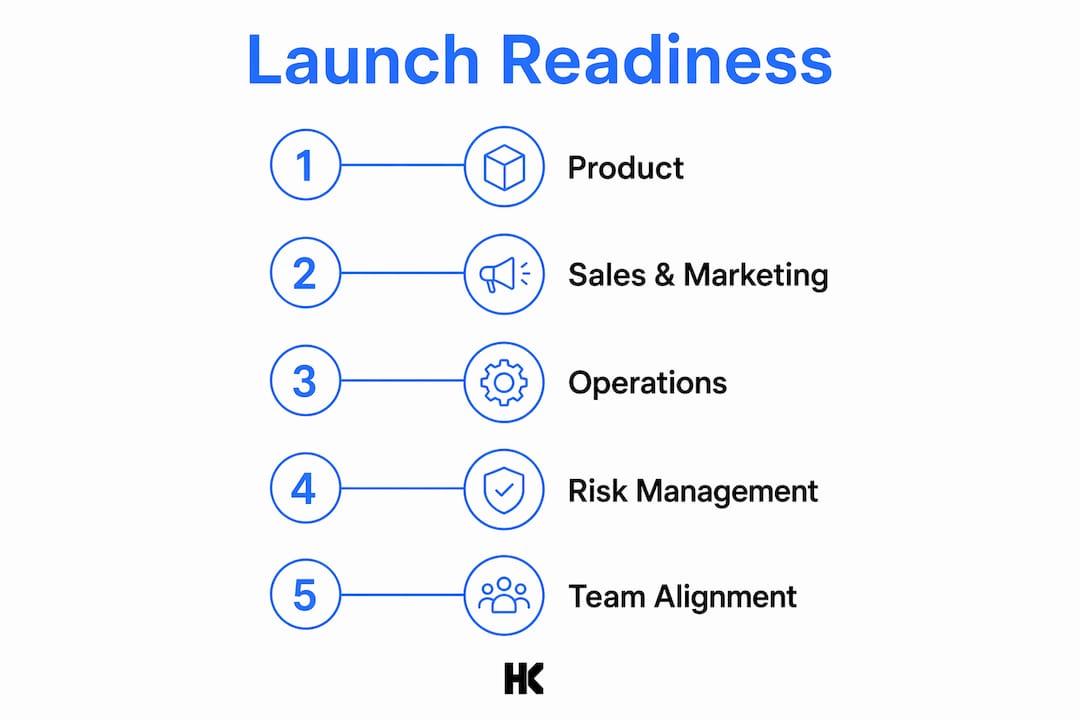
Risk management readiness means your known risks are documented, accepted by leadership, and communicated to the team. Launch readiness does not mean zero risk. It means a consciously accepted and communicated risk profile based on real data.
Team alignment means every functional lead has reviewed their area and signed off. No assumed approvals. No verbal agreements. Written sign-offs only.
Pro Tip: Build a single shared document that lists each readiness dimension, the owner, the evidence required, and the sign-off status. Update it daily in the final two weeks before launch.
How to conduct a launch readiness assessment
A launch readiness assessment is a structured review that produces a Go or No-Go decision. The goal is not to find reasons to delay. The goal is to surface real gaps before customers do.
The standard process follows these steps:
-
Assign a Directly Responsible Individual (DRI) for each readiness area. One person owns each category. Not a team. Not a committee. One person who is accountable for the evidence. Shadow dependencies, where teams assume others own critical tasks without explicit assignment, are the most common cause of last-minute launch failures.
-
Build a checklist by category. Cover QA sign-off, user documentation, support team training, analytics instrumentation, billing flow verification, and rollback procedures. Each item needs a status (complete, in progress, blocked) and an owner.
-
Test in production, not just staging. Staging environments mask critical integration problems. Test the full production happy path, including real payment processing, at least 10 days before launch. If your payment flow breaks in production, you want to know on day minus 10, not day zero.
-
Capture evidence, not opinions. Each checklist item should link to a test result, a screenshot, a document, or a recorded session. "I think it works" is not evidence.
-
Hold a formal Go/No-Go meeting. The standard Go/No-Go meeting occurs 72 hours before launch and requires sign-off across QA, documentation, operational support, and marketing teams. This meeting is not a status update. It is a decision gate. Each DRI presents their evidence and declares Go or No-Go.
Pro Tip: If any DRI declares No-Go, the launch does not proceed. Document the reason, assign a fix, and reschedule the meeting. Never override a No-Go with social pressure.
How to prepare for launch: the four-phase timeline
A comprehensive launch strategy spans 4–8 weeks pre-launch for validation, 1–2 weeks for launch preparation, and 4–8 weeks post-launch for feedback and iteration. Each phase has a distinct focus.
| Phase | Timing | Primary focus |
|---|---|---|
| Pre-launch | 4–8 weeks before | Validation, beta testing, market research |
| Launch prep | 1–2 weeks before | Final QA, team training, asset publishing |
| Launch day | Day zero | Coordinated execution, monitoring, rapid response |
| Post-launch | 4–8 weeks after | Feedback collection, iteration, measurement |
Pre-launch: validate before you build momentum
This phase is where you confirm that the product solves a real problem for real users. Run beta testing with 20–50 target users to validate workflows, collect testimonials, and surface bugs before they reach paying customers. Validate your SaaS idea and positioning with actual users, not internal assumptions.
Launch prep: close every open loop
The final 1–2 weeks are for finishing, not starting. Complete QA, train your support team, publish documentation, and verify that your analytics events fire correctly. Set your North Star metric now. The biggest post-launch mistake is not defining a success metric before launch, which causes teams to mistake vanity traffic for real product validation. Decide in advance whether you are measuring activated users, qualified demos, or paid conversions.
Launch day: execute and monitor
Assign a launch commander who owns real-time coordination. Monitor error rates, payment success rates, and support ticket volume. Have your rollback procedure ready and the person who owns it on call.
Post-launch: measure and iterate
Post-launch is not a wind-down. It is the first real feedback loop. Collect user feedback systematically, compare results against your pre-defined success metrics, and ship the first iteration within the 4–8 week window. Teams that treat post-launch as part of readiness ship better second versions.
What are the most common launch readiness failures?
Most launch failures trace back to a small set of repeatable mistakes. Recognizing them in advance is the fastest way to avoid them.
-
Confusing activity with readiness. A full sprint of closed tickets does not equal a ready product. Most launch failures result from confusing busywork with true readiness. Readiness requires measurable evidence, not a busy team.
-
Shadow dependencies. Two teams each believe the other owns a critical task. Nobody owns it. This surfaces at 11pm on launch day. Explicit DRI assignment is the only fix.
-
Staging-only testing. Staging environments do not replicate production behavior. Payment processors, third-party integrations, and real user data behave differently in production. Test in production at least 10 days before launch.
-
Positioning drift. Your product description changes slightly every time a different team member writes about it. By launch day, your website, your sales deck, and your onboarding email say three different things. Define a single, clear differentiation sentence and enforce it across every channel.
-
No post-launch metrics. Teams that launch without a defined North Star metric spend the first month arguing about whether the launch succeeded. Define your success criteria before the Go/No-Go meeting, not after.
Pro Tip: Run a pre-mortem two weeks before launch. Ask the team: "If this launch fails, what was the most likely cause?" The answers will surface your real risks faster than any checklist.
Key takeaways
Launch readiness is a verified, evidence-based state of preparedness across product, team, operations, and risk, not a date on a calendar or a count of closed tickets.
| Point | Details |
|---|---|
| Readiness requires evidence | Each checklist item needs a test result, document, or recorded proof, not an opinion. |
| DRI assignment prevents gaps | Assign one named owner per readiness area to eliminate shadow dependencies. |
| Test in production early | Run the full production happy path, including payments, at least 10 days before launch. |
| Define success metrics pre-launch | Set your North Star metric before the Go/No-Go meeting to avoid measuring vanity traffic. |
| Go/No-Go is a decision gate | Hold a formal meeting 72 hours before launch with written sign-offs from all functional leads. |
Why I think most teams treat launch readiness as a checklist problem when it is a systems problem
I have shipped SaaS products end-to-end, and I have seen the same failure mode repeat across teams of every size. The team works hard, closes tickets, and feels ready. Then launch day arrives and something breaks that nobody owned. A payment webhook. A support escalation path. A rollback procedure that existed in a doc nobody had read.
The issue is not effort. The issue is that launch readiness requires treating the launch as a system, not a collection of parallel tasks. Every component connects to every other component. A bug in your billing flow affects your support queue. A gap in your documentation affects your activation rate. When you treat readiness as a checklist, you check boxes in isolation. When you treat it as a system, you trace dependencies.
The founders I work with who launch well share one habit: they define what "ready" looks like in writing before they start the final sprint. Not a vague goal. A specific, measurable state. "Zero P0 bugs. Payment flow tested in production. Support team trained. Rollback owner assigned. North Star metric defined." When you can read that list and check every item with evidence, you are ready. When you cannot, you are not, regardless of how busy the team has been.
Speed matters in SaaS. But shipping a broken product to your first paying customers costs more time than a two-week delay. The teams that move fastest long-term are the ones that build the readiness habit early.
— Hanad
Hanadkubat's approach to SaaS launch readiness
Building a product that is technically ready is only half the work. The other half is making sure your team, your operations, and your risk profile are equally prepared.
Hanadkubat has built and shipped SaaS products end-to-end, with engineering experience from BMW, Deutsche Bahn, and Bundesrechenzentrum Austria. That background informs a direct, evidence-based approach to SaaS product launches that covers product stability, team alignment, and post-launch measurement. If your team is preparing for a release and needs a structured process, hanadkubat.com covers both MVP builds and AI integration with fixed prices and clear timelines.
FAQ
What is launch readiness in simple terms?
Launch readiness is the verified state of being fully prepared to ship a product, covering product stability, team alignment, operational support, and documented risk acceptance. It is proven with evidence, not assumed.
What should a launch readiness checklist include?
A launch readiness checklist should cover QA sign-off, production environment testing, support team training, documentation, analytics instrumentation, billing flow verification, rollback procedures, and written sign-offs from all functional leads.
How long before launch should you start a readiness assessment?
Start the formal readiness assessment at least two weeks before launch. The Go/No-Go decision meeting should occur 72 hours before the planned launch date, with all DRIs presenting evidence.
What is a Go/No-Go meeting?
A Go/No-Go meeting is a formal decision gate held 72 hours before launch where each functional lead reviews their readiness evidence and declares Go or No-Go. A single No-Go declaration stops the launch until the issue is resolved.
What is the difference between launch readiness and a launch plan?
A launch plan describes what you intend to do. Launch readiness describes what you have verified is done. Plans are forward-looking. Readiness is evidence-based and present-tense.