

TL;DR:
- Engineering standards set technical requirements that ensure safety, quality, and interoperability in engineering projects. They help reduce defects, speed up compliance, and promote shared technical language within teams. When incorporated into regulations, standards become enforceable, supporting compliance and legal accountability.
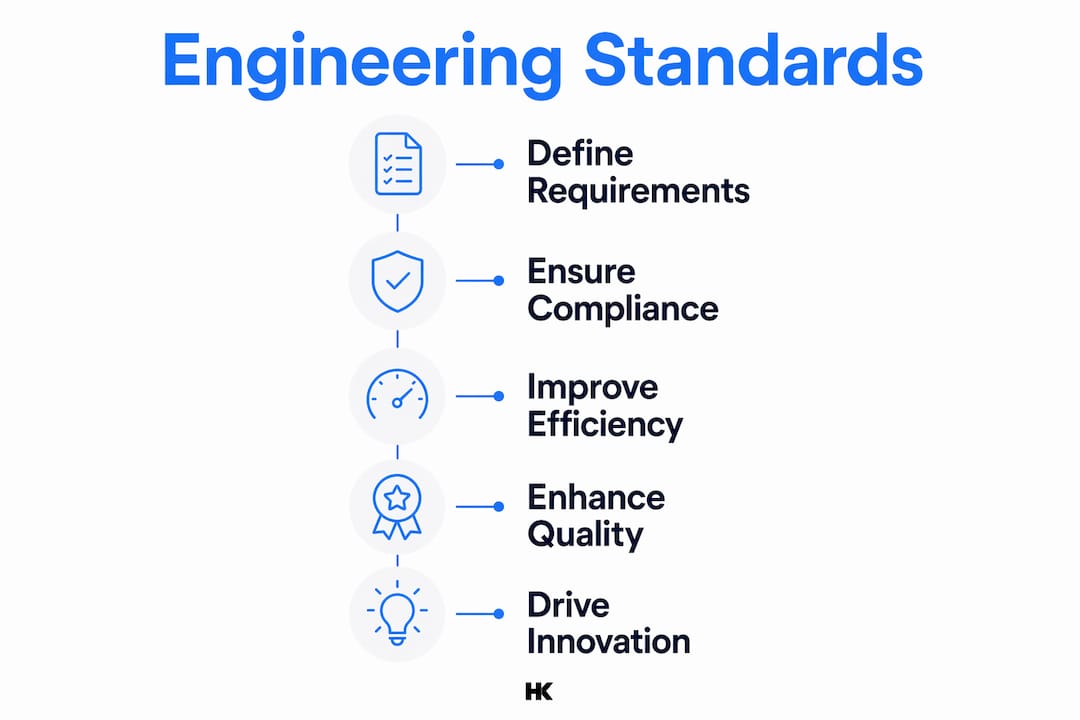
Engineering standards are defined as documented agreements that establish technical requirements, specifications, and procedures to ensure safety, quality, and interoperability across engineering projects. The role of engineering standards in software development is not optional background knowledge for engineering managers. It is the foundation that separates teams shipping reliable products from teams shipping expensive problems. Organizations like ASTM, ASME, and ISO have codified decades of engineering knowledge into frameworks that directly reduce defects, speed up compliance audits, and give distributed teams a shared technical language. Understanding how these frameworks work, and where they carry legal weight, is the difference between proactive quality management and reactive firefighting.
What is the role of engineering standards in product quality?
Engineering standards set the baseline criteria for materials, design processes, and performance thresholds that a product must meet. Without that baseline, every team member applies their own judgment, and judgment varies. Standards eliminate that variability at the source.

More than 12,000 ASTM standards are currently used worldwide to support performance consistency and safety across industries. That number reflects how thoroughly the engineering community has documented what "good" looks like across thousands of specific contexts. When your team adopts a relevant ASTM or ISO standard, you are not writing quality criteria from scratch. You are inheriting a tested specification.
In software engineering, this shows up in coding standards, API design guidelines, security frameworks like ISO/IEC 27001, and accessibility requirements like WCAG. Each of these defines what acceptable output looks like before a single line of code is written. Teams that define these criteria early catch defects at the design stage, where fixing them costs a fraction of what it costs post-deployment.
- Consistency across contributors: Standards give every engineer on the team the same definition of "done," regardless of seniority or background.
- Reduced defect rates: Agreed-upon specifications catch design gaps before they become production bugs.
- Faster code review: Reviewers check against a known standard rather than debating subjective preferences.
- Audit readiness: Documented adherence to a recognized standard is evidence, not just a claim.
- Onboarding speed: New engineers learn the standard, not the undocumented tribal knowledge of a specific team.
Pro Tip: When adopting a standard for the first time, map it against your existing process before rewriting anything. Most teams already meet 60–80% of a standard's requirements informally. Identifying the gaps first saves weeks of unnecessary rework.
Standards let engineering teams avoid reinventing the wheel and speed up development by building on established best practices. That is not a soft benefit. It is a direct reduction in engineering hours spent solving problems that others have already solved and documented.
How do engineering standards work in compliance and regulatory environments?
Standards carry no automatic legal weight. A standard published by ASME or ISO is voluntary until a jurisdiction or regulatory body incorporates it by reference into a code or regulation. At that point, it becomes mandatory and enforceable.
Standards often carry no legal weight until incorporated by reference into jurisdictional codes. This distinction matters enormously for engineering managers working in regulated industries or EU markets. GDPR, the EU AI Act, and sector-specific regulations in financial services and healthcare all reference technical standards as the mechanism for demonstrating compliance. Meeting the standard is how you prove you meet the regulation.
Codes and standards embody decades of accumulated engineering wisdom from failures and incidents. Treating them as bureaucratic overhead misses the point entirely. They exist because something broke, someone was harmed, and the engineering community documented what must never happen again.
OSHA's Process Safety Management regulation, 29 CFR 1910.119, requires RAGAGEP compliance with documentation evidencing adherence to applicable codes and standards. That documentation requirement is the part most teams underestimate. Saying your team follows a standard is not enough. You need version-controlled records showing which version of which standard applied at which point in the project lifecycle.
Version control for standards is not a bureaucratic detail. Using outdated or superseded standards can create legal and certification risks, particularly in disputes involving products developed under those versions. A product built to a 2019 version of a standard may face liability questions if a 2023 revision addressed the exact failure mode in question.
Pro Tip: Assign one person on your team to own standards version tracking. That person monitors publication updates from ASTM, ISO, or relevant bodies and flags when a standard your team uses has been revised or superseded. This is a two-hour-per-month task that prevents multi-week compliance remediation projects.
- Confirm which standards apply to your product and jurisdiction before design begins.
- Record the specific version of each standard in your project documentation.
- Set calendar reminders to check for standard revisions at least annually.
- Cross-reference construction-phase standards with any in-service or maintenance standards that apply post-deployment.
How do engineering standards support team efficiency and innovation?
The common objection to standards is that they slow teams down. The evidence points the opposite direction. Standards provide a stable foundation for innovation, enabling teams to move faster by building on proven practices rather than starting from scratch. The key word is "foundation." Standards define the floor, not the ceiling.
Consider how this works in practice for a B2B SaaS team building a new API integration. Without a shared standard, the team debates authentication patterns, error response formats, and versioning conventions before writing a single endpoint. With a standard like OpenAPI Specification or REST API design guidelines from a recognized body, those decisions are already made. The team spends its time on the business logic that actually differentiates the product.
Here is how standards directly improve team efficiency across the engineering lifecycle:
- Shared technical language: Engineers from different disciplines or companies can collaborate without a lengthy alignment phase because the standard defines terms precisely.
- Faster onboarding: New team members learn the standard, which is documented and stable, rather than decoding undocumented team conventions.
- Reduced duplication: Teams adopt proven patterns rather than building equivalent solutions independently, which is a direct reduction in wasted engineering hours.
- Cross-team interoperability: When two teams or two companies need to integrate their systems, a shared standard removes the negotiation overhead entirely.
- Safer experimentation: Standards serve as foundations and guides for risk management during rapid technological shifts, which means teams can experiment on top of a stable base without destabilizing core functionality.
The balance between standards and innovation is real but manageable. Standards should govern the parts of your system where consistency and safety are non-negotiable. They should not govern the parts where differentiation is the goal. Engineering managers who draw that line clearly get both the efficiency benefits of standards and the creative freedom that drives product growth. For more on how this plays out in enterprise-grade SaaS engineering, the distinction between constrained and unconstrained design spaces is a recurring theme.
What best practices should engineering managers follow to implement standards?
Implementing standards effectively requires more than distributing a PDF to the team. The gap between "we have a standard" and "we follow a standard" is where most quality problems live.
Over 40% of surveyed industry practitioners confirm that integrating standards education is critical for maintaining competitive quality. Training is not a one-time event. Standards evolve, teams change, and the regulatory context shifts. A standards implementation program needs to be a living part of your engineering culture, not a checkbox in the onboarding checklist.
- Document which standards apply and why: Create an internal registry that maps each standard to the specific product area, regulation, or risk it addresses.
- Train teams on relevant standards and updates: Schedule quarterly reviews of any standard your team uses actively, and brief the team on material changes.
- Use version control for standards documents: Store the specific version of each standard alongside the project documentation it governs.
- Align standards adoption with project scope: Not every standard applies to every project. Applying irrelevant standards creates overhead without benefit.
- Build feedback loops: Engineers working with a standard daily will spot gaps and ambiguities that managers reviewing it quarterly will miss. Create a channel for that feedback to reach the person responsible for standards governance.
Pro Tip: Treat your internal standards registry the same way you treat your dependency manifest. Every entry should have a version number, a last-reviewed date, and an owner. If it does not have those three fields, it is not being managed. It is just being stored.
The software technical specification process is a natural integration point for standards. When a specification references the applicable standard by name and version, every engineer who reads that spec knows exactly what criteria the output must meet before review begins.
| Implementation area | Recommended practice |
|---|---|
| Standards registry | Maintain a versioned internal list of all applicable standards with assigned owners |
| Team training | Run quarterly briefings on standard updates relevant to active projects |
| Documentation | Reference standard name and version in every technical specification and design document |
| Compliance tracking | Log evidence of adherence at each project milestone, not just at final review |
| Feedback process | Create a structured channel for engineers to flag gaps or conflicts in applied standards |
For a broader view of how these practices fit into engineering best practices for software teams, the principles above align directly with what high-performing teams do consistently.
Key Takeaways
Engineering standards define the technical floor for quality, safety, and compliance, and teams that treat them as living governance tools consistently outperform teams that treat them as static checklists.
| Point | Details |
|---|---|
| Standards are legally activated | A standard becomes mandatory only when incorporated by reference into a regulation or code. |
| Version control prevents liability | Using a superseded standard in a product can create legal risk in disputes and audits. |
| Standards accelerate teams | Shared specifications eliminate alignment debates and reduce duplicated engineering effort. |
| Training must be ongoing | Standards evolve; quarterly team briefings on updates prevent silent compliance drift. |
| Documentation is the evidence | Recorded adherence to a named, versioned standard is what survives a compliance audit. |
Standards are not the enemy of speed
Engineering managers often inherit a false choice: move fast or follow standards. After working inside organizations like BMW and Deutsche Bahn, and building SaaS products end-to-end, I have seen both sides of that tradeoff up close.
The teams that treated standards as obstacles were not actually moving faster. They were deferring the cost. Every undocumented design decision, every informal convention that lived only in one engineer's head, became a liability the moment that engineer left or the product needed to scale. The rework cost was always higher than the upfront cost of doing it right.
The teams that used standards well did something specific: they applied standards to the parts of the system where failure is expensive and left the rest open for experimentation. That is not a compromise. That is good engineering judgment. Quality leaders must treat standards as dynamic tools for continuous improvement, not as compliance checklists. That framing is exactly right. A standard you review once and file away is not protecting you. A standard you actively maintain, train against, and update when the regulation changes is the one that actually reduces your risk.
The EU AI Act and GDPR have made this even more concrete for teams in the DACH region. Compliance is not a legal team problem anymore. It is an engineering architecture problem. The teams that understand which standards apply, which version governs their current product, and where the gaps are will spend far less time in remediation than the teams that find out during an audit.
— Hanad
How Hanadkubat approaches engineering standards for B2B SaaS teams
Engineering standards work best when they are built into the architecture from the start, not retrofitted after a compliance gap surfaces.

Hanadkubat works with B2B SaaS teams and technical founders across the DACH region and EU to build products that meet quality and compliance requirements from day one. That includes EU AI Act compliance, GDPR-aware architecture, and production-ready engineering practices grounded in recognized standards. Whether you need an AI audit with a prioritized roadmap (€1,500) or a full MVP build from €18,000, the work is done at fixed prices and shipped in weeks. Explore the full range of engineering and AI services at hanadkubat.com.
FAQ
What is the difference between a code and a standard?
A standard defines technical requirements or specifications, while a code is a set of rules that often incorporates standards by reference to make them legally enforceable within a jurisdiction.
Why do engineering standards matter for software development?
Standards like ISO/IEC 27001 and WCAG define measurable quality and security criteria that software teams use to reduce defects, pass compliance audits, and build interoperable systems.
How do standards become legally mandatory?
Standards carry no automatic legal force. They become mandatory when a regulatory body or jurisdiction incorporates them by reference into a law, regulation, or code, as OSHA does with RAGAGEP under 29 CFR 1910.119.
What happens if a team uses an outdated standard?
Using a superseded standard can create legal and certification risks, particularly in disputes involving products built under that version, which is why version tracking is a core compliance practice.
How often should engineering teams review their standards?
Teams should review applicable standards at least annually and run internal briefings whenever a standard they use actively is revised or superseded by the issuing body.