
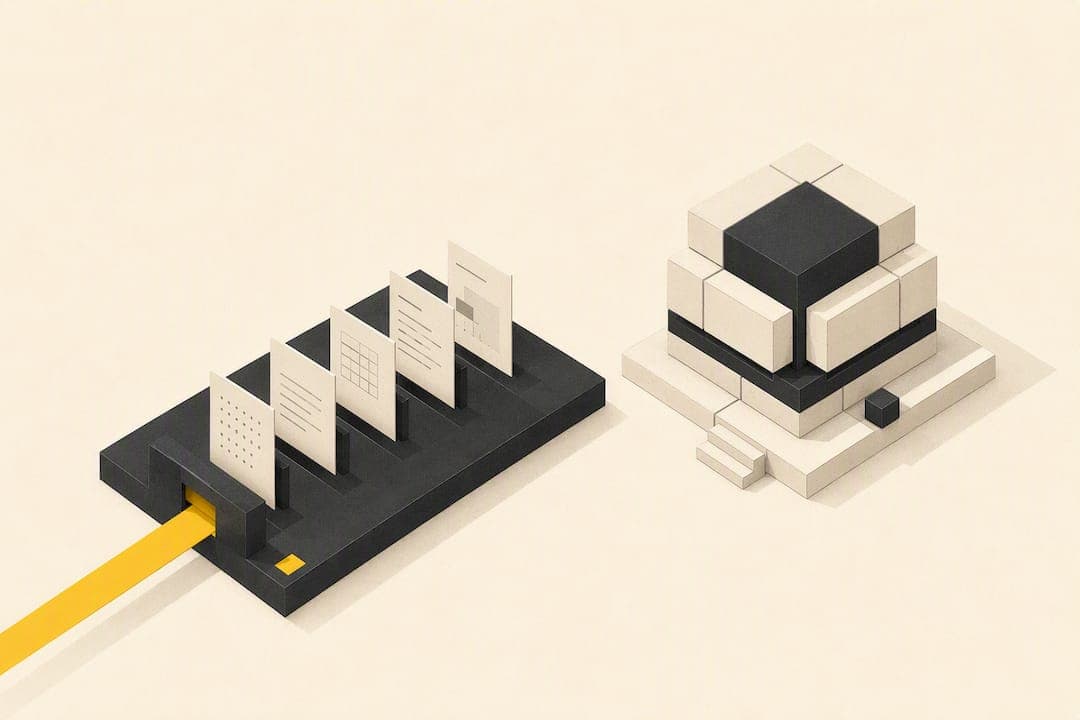
Pick RAG when your answers need to cite current, changeable facts and you don't have labeled training data. Pick fine-tuning when you need consistent tone, tight latency, or a narrow task repeated at high volume with stable underlying knowledge. Most production systems that survive contact with real users end up combining both, and that's not a compromise. It's the mature default.
TL;DR:
- RAG is ideal when answers depend on frequently changing data, as updates to the knowledge base can be made in minutes, not hours or days.
- Fine-tuning is better suited for stable knowledge, where a consistent tone and high-volume, low-latency responses are necessary, but it requires significant training time.
- Combining both approaches in hybrid systems can leverage the strengths of each, especially for tasks involving both changing facts and stable behavioral patterns.
- Cost, latency, security, and update speed are critical factors influencing whether RAG or fine-tuning is the more practical choice for a given application.
- Starting with RAG allows rapid deployment and continuous improvement based on real user logs before considering the more costly and complex fine-tuning option.
Table of Contents
- RAG vs Fine-Tuning: The Core Technical Difference
- How Does RAG Work in Practice?
- How Does Fine-Tuning Language Models Work?
- RAG vs Fine-Tuning: Cost, Latency, and Security Trade-Offs
- A Decision Checklist for RAG vs Fine-Tuning
- When Should You Combine RAG and Fine-Tuning?
- Shipping This: A Practical Checklist From Building Production Systems
- What Engineering Teams Get Wrong About This Decision
- Get Production-Ready AI Without an Agency Layer
- Sources
- FAQ
RAG vs Fine-Tuning: The Core Technical Difference
The distinction comes down to where the knowledge lives. RAG keeps knowledge outside the model and pulls it in at query time. Fine-tuning bakes knowledge into the model's weights during training. Everything else in this comparison, cost, latency, security, maintenance, flows from that one architectural choice.
Retrieval-Augmented Generation (RAG) connects a language model to an external knowledge source at inference time. A query gets embedded, matched against a vector database, and the relevant chunks get stuffed into the prompt before the model generates a response. Nothing about the base model changes. RAG connects LLMs to external data at query time with no retraining required, which is why it's the default choice when information changes weekly or daily.
Fine-tuning adjusts the model's internal parameters using a labeled dataset of examples. The model learns a style, a domain vocabulary, or a task pattern and keeps that behavior baked in permanently. Fine-tuning works best when the underlying knowledge is stable and query volume justifies the upfront training cost.
Here's the one-line version worth pinning above your desk:
- RAG: knowledge lives outside the model, refreshed at inference time.
- Fine-tuning: knowledge lives inside the model, fixed at training time.
- RAG changes what the model knows; fine-tuning changes how the model behaves.
- You can update a RAG index in minutes; retraining a model takes hours to days.
That last point matters more than most teams give it credit for. If your product answers questions about pricing, policy, or inventory, and those things change on any regular cadence, baking that knowledge into weights means you're retraining every time the business changes its mind.
How Does RAG Work in Practice?
RAG architecture has five moving parts, and each one is a place where a project quietly breaks.
- Ingestion. Documents get pulled from wherever they live (a CMS, a support wiki, a database) and normalized into plain text.
- Chunking. Text gets split into passages small enough to embed meaningfully but large enough to carry context.
- Embedding. Each chunk gets converted into a vector using an embedding model, then stored in a vector database.
- Retrieval. At query time, the user's question gets embedded and matched against stored vectors using similarity search.
- Prompt assembly. The top-matching chunks get inserted into the prompt alongside the user's question, and the model generates a response grounded in that retrieved text.
Chunking is where most teams get sloppy. Oversize chunks drag irrelevant context into the prompt and dilute the signal. Undersize chunks bloat your index and hurt retrieval precision. The right move is sizing chunks around the typical span of a real question and measuring precision@k during indexing, not guessing a round number like 500 tokens because it felt safe.
Vector database operations bring their own headaches: index freshness (how fast a new document becomes searchable), scaling behavior as your corpus grows past a few hundred thousand chunks, and re-embedding costs when you switch embedding models. RAG also gives you something fine-tuning structurally cannot: document-level access control, since you can mask sensitive documents before retrieval ever happens.
Pro Tip: Log every retrieval, not just every generation. When a RAG system hallucinates, the retrieved chunks almost always tell you why: either the right document never got indexed, or it got indexed but never surfaced. You can't debug what you didn't log.
How Does Fine-Tuning Language Models Work?
Fine-tuning starts with data, not code. You need a dataset of input-output pairs, usually in JSONL format, that demonstrate the exact behavior you want. Hold back 10 to 20 percent as an evaluation set you never train on, or you'll have no honest way to tell if the model actually improved.
Two flavors matter here:
- Full fine-tuning updates every parameter in the model. It gives you the most control but demands serious GPU memory and a longer training cycle.
- Parameter-efficient fine-tuning (PEFT/LoRA) freezes most of the model and trains a small set of additional parameters. PEFT methods cut memory and compute requirements dramatically compared to full fine-tuning, which is why almost every team without a dedicated ML infrastructure group should start there.
For a small engineering team, LoRA is usually the only sane entry point. Full fine-tuning on a foundation model is a project for teams with multi-GPU clusters and someone whose entire job is babysitting training runs.
The risks are real and specific. Overfitting on a narrow dataset produces a model that's brilliant on your test cases and brittle everywhere else. Catastrophic forgetting is worse: the model loses general capabilities it had before you fine-tuned it, sometimes in ways that don't show up until a user asks something slightly off-script. Building automated evals before you invest in tuning is not optional homework, it's the only way you catch regressions before your users do.
Governance gets harder too. A fine-tuned model is a new artifact with its own version history, its own audit trail, and its own retraining schedule every time the source data shifts.
RAG vs Fine-Tuning: Cost, Latency, and Security Trade-Offs
The trade-offs split cleanly into six categories, and the numbers change how you should be thinking about this decision.
- Cost structure. RAG has low upfront cost (build a pipeline) but a per-query runtime cost (retrieval + longer prompts). Fine-tuning has high upfront cost (training runs, GPU time) but often lower per-query cost since prompts stay short.
- Latency. RAG adds a retrieval hop before generation even starts, which can add real latency at high query volume. A fine-tuned model with a short, fixed prompt is usually faster at inference.
- Grounding and hallucination. RAG can cite its sources; a fine-tuned model cannot point to where a fact came from. Fine-tuned models lack traceability and can hallucinate facts unchecked, which is a serious problem in regulated or high-stakes domains.
- Update cadence. RAG indexes refresh in minutes. Retraining a fine-tuned model to reflect new information takes hours to days, sometimes longer with review cycles.
- Security. RAG supports per-user document masking at query time. Fine-tuning has no equivalent, once knowledge is in the weights, it's in the weights for every user.
- Staffing. RAG needs strong data engineering and search tuning skills. Fine-tuning needs ML training expertise and eval discipline.
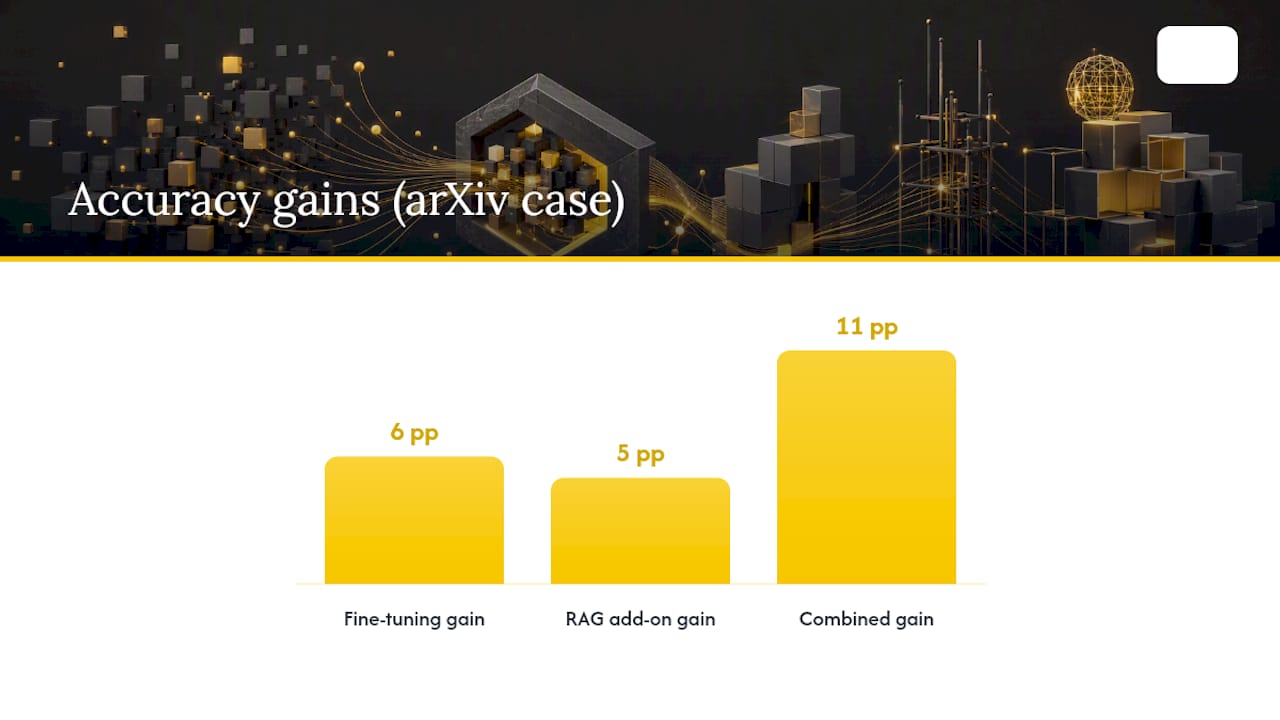
The number that changes the calculus: an arXiv case study on agricultural QA found fine-tuning alone delivered roughly a 6 percentage-point accuracy improvement, and adding RAG on top delivered another 5 points. The gains were cumulative, not competing. That single data point is why "RAG vs fine-tuning" is often the wrong framing entirely.
If your app must guarantee that certain users never see certain documents, RAG isn't a preference, it's close to mandatory, since fine-tuning offers no mechanism for that kind of gating after training.
A Decision Checklist for RAG vs Fine-Tuning
Run through these questions in order before writing a line of infrastructure code.
- Does your information change weekly or faster? If yes, start with RAG. Retraining a model every week is not a workflow, it's a treadmill.
- Do you have labeled examples of the exact behavior you want? If no, RAG is your only realistic option right now, since fine-tuning needs that data to exist first.
- Do answers need citations or an audit trail? If yes, RAG wins outright, fine-tuned weights can't point to a source.
- Is latency at high query volume your bottleneck? If yes, lean toward fine-tuning or a smaller retrieval footprint.
- Do you need per-user or per-document access control? If yes, RAG is close to required.
- Is your team small with limited ML infrastructure? Start with RAG for quick wins, then use retrieval logs to spot the high-volume, narrow flows that justify fine-tuning later.
The MVP move for almost everyone: ship RAG first. It's auditable, it's reversible, and it tells you exactly which questions your users actually ask, which is the dataset you'll need if fine-tuning ever becomes worth the investment.
When Should You Combine RAG and Fine-Tuning?
Hybrid architectures, sometimes described under the acronym RAFT (retrieval-augmented fine-tuning), pair a fine-tuned generator with a RAG retrieval layer. The fine-tuned model handles tone, format, and domain-specific reasoning patterns. The retrieval layer handles facts that change.
- A support bot fine-tuned on your company's writing style, fed live ticket data through RAG.
- A legal drafting tool fine-tuned on contract structure, retrieving current statute text through RAG rather than memorizing it.
- A routing layer that sends narrow, high-volume queries to a fine-tuned path and everything else to a general RAG path.
Hybrid setups earn their complexity when you have both a stable behavioral pattern worth baking in and a fact base that keeps moving. Oracle's guidance frames combining fine-tuning with RAG as a common production pattern, not an edge case.
Where hybrid adds unnecessary weight is early-stage products still finding their query patterns. Monitoring two systems, a retrieval pipeline and a training pipeline, doubles your operational surface area. Don't take that on until RAG alone has told you where the friction actually is.
Shipping This: A Practical Checklist From Building Production Systems
A minimal viable RAG setup doesn't need a sprawling vector database on day one. Embed your top 100 documents, run semantic search with a single embedding model, assemble a short context window, and add 5 to 10 lightweight automated evals before you expand the index or touch fine-tuning at all.
- Start with PEFT/LoRA, not full fine-tuning, unless you have dedicated ML infrastructure and a team whose job is training runs.
- Test precision@k on retrieval before you ever look at generation quality, a broken retriever makes a great model look bad.
- Measure answer fidelity against source documents, not just fluency, and track latency separately from accuracy.
- Document your chunking strategy and embedding model choice in the handover notes; the next engineer needs to know why chunks are 400 tokens and not 800.
Pro Tip: Before you fine-tune anything, pull three months of real user queries from your RAG logs. The patterns you see there, not your assumptions about what users need, should decide whether fine-tuning is worth the training cost.
Building this correctly the first time matters more than most teams admit, which is why understanding production-ready patterns is critical From vibe-coded to production-ready. A production evaluation setup that catches regressions before shipping saves weeks of firefighting later.
What Engineering Teams Get Wrong About This Decision
The conventional advice treats RAG and fine-tuning as competing philosophies, and that framing wastes engineering time. The real question was never "which one." It's "what does this specific query pattern need," and most production systems need different answers for different parts of the same product.
Where I think teams go wrong most often: they reach for fine-tuning to fix a problem that's actually a prompting or retrieval problem. A model that gives inconsistent answers usually has a retrieval quality issue, not a weights issue. Fine-tuning a bad retrieval pipeline just makes it confidently wrong instead of visibly wrong.
The other mistake is treating RAG as the "easy" option and never revisiting it once shipped. Chunking decisions made in week one calcify into technical debt by month six, because nobody logs retrieval quality until something breaks in front of a customer.
Start with RAG, measure relentlessly, and let the query logs tell you if fine-tuning earns its cost. That's not a hedge. It's the only sequencing that avoids paying for the expensive option before you know if you need it.
— Hanad Kubat
Get Production-Ready AI Without an Agency Layer
Hanad Kubat offers AI consultancy services covering RAG systems, fine-tuning decisions, LLM cost optimization, and production evaluation, built to hold up under real traffic and regulatory requirements.
Every engagement is fixed price and fixed scope, frozen at kickoff. So, there are no surprise invoices when retrieval turns out messier than expected. If your prototype validated the idea but the AI features are the part that has to be right, start with an AI integration engagement and get a scoped plan before you commit engineering months to the wrong architecture.
Sources
- RAG vs Fine Tuning: Enterprise Decisions for AI Models and AI Systems
- Comparing Retrieval Augmented Generation and fine-tuning - AWS Prescriptive Guidance
- RAG vs. Fine-Tuning: How to Choose
FAQ
What Makes a Model "a RAG"?
A model isn't inherently RAG or not. RAG describes the architecture around the model: retrieval, a vector database, and prompt assembly at inference time, not a property baked into the model's weights.
Is Fine-Tuning Still Relevant With Long-Context Models?
Yes. Longer context windows reduce some cases for RAG but don't replace fine-tuning's ability to change tone, format consistency, and domain-specific reasoning patterns baked into weights.
What Is Better Than RAG?
Nothing is universally better, it depends on the constraint. Fine-tuning outperforms RAG when the task needs stable, repeatable behavior at high volume with low latency, while RAG wins for current facts and citation needs.
Can I Switch From RAG to Fine-Tuning Later?
Yes, and it's a common path. Query logs from an existing RAG system are the best source for identifying which narrow, high-volume flows justify the cost of fine-tuning.
Does RAG Work With Small Language Models?
RAG works with models of any size, and it often matters more for smaller models, since retrieval compensates for the world knowledge a smaller model simply doesn't have room to memorize.