
TL;DR:
- Engineering standards for startups focus on outcome-driven rules that quickly prevent failures and improve delivery. Implementing simple CI gates, checklists, and security policies from day one can deliver measurable benefits quickly. Scaling standards gradually based on growth signals helps maintain velocity without overburdening the team.
Engineering standards for startups are outcome-focused rules that protect delivery velocity while reducing the risk of production failures, security incidents, and onboarding drag. You don't need a 40-page style guide. You need three things you can ship this week:
- Add a CI quality gate (lint + unit tests + a dependency scan) to every pull request.
- Mandate a PR checklist with five required fields: what changed, why, how to test, rollback plan, and security notes.
- Write a one-page security policy covering secrets management, third-party access, and AI tool usage.
That's your starting point. Everything else builds on it.
TL;DR — categories to tackle first:
- Code style and linting (automated, day one)
- Testing (unit and integration before E2E)
- CI/CD quality gates (block merges on failures)
- Dependency and license checks (catch vulnerabilities early)
- Infrastructure as code (no manual provisioning)
- Security scanning and secrets policy (non-negotiable from day one)
- Observability and SLOs (add at growth stage)
- Documentation and ADRs (lightweight, decision-focused)
Table of Contents
- Why should you define engineering standards for startups now?
- What are the core categories of engineering standards to define first?
- How do you define standards, get buy-in, and document decisions?
- How should you use automation to enforce standards?
- What changed
- Why (link to ticket or decision)
- How to test
- Rollback plan
- Security notes (credentials, data access, third-party calls)
- What standards should you adopt at each startup stage?
- How do you govern standards and decide who owns what?
- How do you measure compliance and handle exceptions?
- What do concrete templates and example standards look like?
- What does a realistic rollout timeline and cost look like?
- A senior engineer's 2-week sprint plan to ship standards
- Key Takeaways
- Why lean standards beat comprehensive ones every time
- Fixed-price standards implementation for startups
- Useful sources and further reading
- FAQ
Why should you define engineering standards for startups now?
The honest trade-off: standards cost time to create and maintain. In the first 90 days of a product, that cost often exceeds the benefit. But the moment you have two engineers merging to the same branch, a production incident that took four hours to diagnose, or a new hire who spent a week figuring out how to run the project locally, the math flips. Standards start paying back faster than you expect.
The practical benefits of lightweight startup engineering guidelines are specific and measurable. Faster onboarding because the setup is documented and automated. Fewer production incidents because the CI pipeline catches the obvious mistakes before they reach users. Predictable releases because the deploy process is scripted, not tribal knowledge. Cleaner security questionnaires when enterprise customers ask how you handle secrets or access control.

The risk of over-standardizing is just as real. A five-person team that spends two sprints writing a governance framework instead of shipping features has made a bad trade. Premature process is one of the most common velocity killers at the MVP stage. The fix is to keep standards minimal, reversible, and tied to a measurable outcome. If you can't name the incident or metric that the standard prevents, defer it.
Decision signals: when to add more process
- A production incident traced back to a missing check that automation could have caught
- PR review queue consistently longer than 24 hours
- Standups running past 20 minutes because of unclear ownership or repeated context-setting
- A new engineer takes more than two days to make their first commit
What are the core categories of engineering standards to define first?
Software engineering standards map to the same intent as physical engineering standards like ASTM or IEEE: consistent, repeatable practices that reduce failure rates and make work transferable between people. For software startups, the categories below cover the full surface area.
- Code style and linting. MVP: pick one linter config and commit it. Growth: enforce it in CI. Scale: add custom rules for your domain patterns.
- Testing (unit, integration, E2E). MVP: unit tests on core business logic only. Growth: integration tests on API boundaries. Scale: E2E on critical user paths.
- CI/CD quality gates. MVP: block merges on lint failures and failing unit tests. Growth: add coverage thresholds. Scale: add performance regression gates.
- Dependency and license checks. MVP: run a dependency scanner in CI. Growth: add license policy (no GPL in commercial code). Scale: automate upgrade PRs.
- Infrastructure as code. MVP: at minimum, script your local dev setup. Growth: all cloud resources in IaC. Serverless-first plus IaC reduces manual ops significantly.
- Security scanning and secrets policy. Non-negotiable from day one. Per the AEEF Quick Start: no secrets in AI tools, basic security scanning in CI, and a one-page AI policy. These are must-not-skip items.
- Observability and SLOs. MVP: basic error logging and uptime monitoring. Growth: structured logs, traces, and one SLO per critical path. Scale: full observability platform with alerting.
- PR and review process. MVP: at least one reviewer, no self-merges. Growth: add a PR template. Scale: add CODEOWNERS.
- Documentation and ADRs. MVP: a README that gets a new engineer running in under 30 minutes. Growth: add Architecture Decision Records for major choices. Scale: a developer portal.
- AI tooling guardrails. If your team uses AI coding assistants, require human review of all AI-generated code and prohibit pasting credentials or customer data into any AI tool.
How do you define standards, get buy-in, and document decisions?
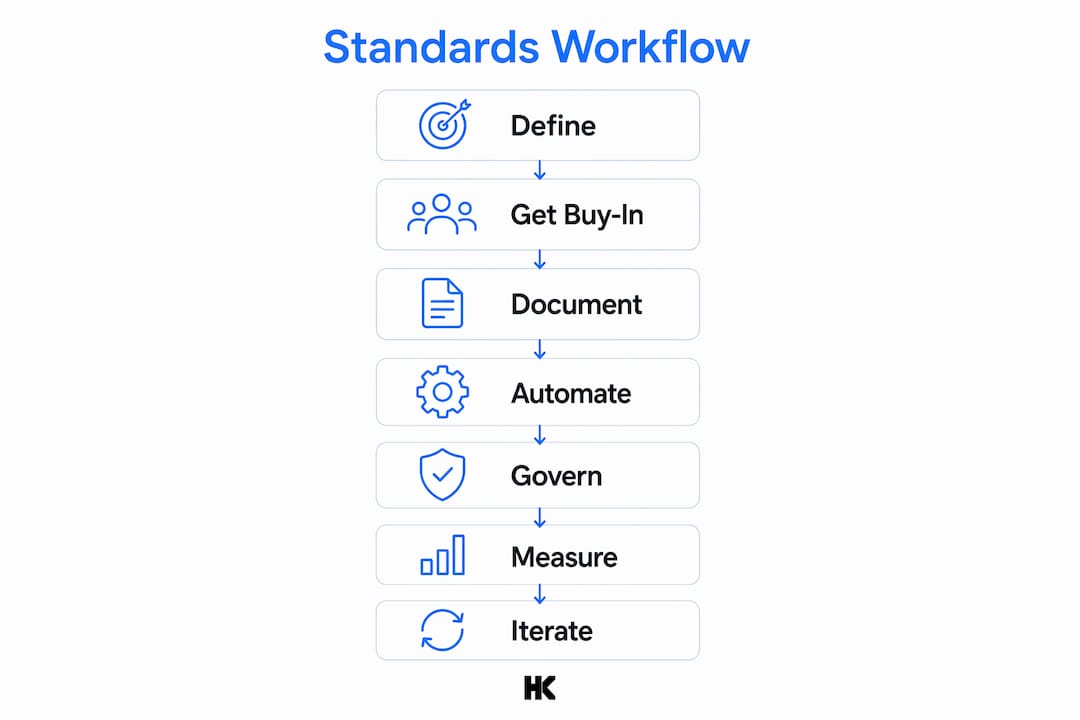
Start with evidence, not opinion. Before writing a single standard, spend one sprint measuring your current pain points: look at your last five production incidents, your average PR cycle time, and how long it took your last new hire to ship their first feature. Pick the top three areas where a standard would have prevented a real cost. That's your backlog.
The lightweight process that works for most teams under 20 engineers:
- Identify the pain. Pull incident logs, PR metrics, and onboarding feedback. Name the specific problem.
- Write a one-page RFC. State the problem, the proposed standard, the success metric, and the rollback condition. One page. No architecture diagrams.
- Trial for 2–4 sprints. Apply the standard to new work only. Don't retrofit everything.
- Scorecard review. Check the pass/fail rate on automated gates and one human metric (PR cycle time, incident count). If it improved, formalize. If it didn't, roll back.
- Formalize or discard. A standard that doesn't move a metric doesn't belong in your handbook.
Minimal RFC template fields:
- Problem statement (one sentence)
- Proposed standard (what the rule is)
- Automation gate (how it's enforced without human policing)
- Success metric (what number improves)
- Rollback condition (when to remove it)
- Owner (who maintains it)
Running the first buy-in meeting. Bring data, not preferences. Show the incident that the standard would have caught. Show the PR queue length from last month. Engineers who disagree with a standard on principle usually agree with the data that motivated it. Resolve disputes with metrics, not authority. This approach aligns with lean product development principles: measure first, then act.
How should you use automation to enforce standards?
Manual policing doesn't scale past five engineers. The goal is to make the right thing the default path and the wrong thing require deliberate effort to override.
Minimum viable CI pipeline for an early-stage startup:
- Lint (code style, formatting)
- Unit tests
- Dependency vulnerability scan
- Secret scan (block commits containing credentials)
- Build artifact
- Deploy to staging with feature flags
That's six steps. Each one catches a specific class of failure. Adding more steps before you've validated these six is premature.
Tooling categories to cover (use the category, then pick the tool that fits your stack):
- Linters and formatters: language-specific (ESLint, Ruff, Prettier, etc.)
- Static analysis: SAST tools that catch security anti-patterns
- Dependency scanners: check for known CVEs in your dependency tree
- Secret scanners: scan commits and PRs for accidentally committed credentials
- IaC linters: validate Terraform, Pulumi, or CDK configs before apply
- Test runners: your existing framework, with coverage reporting
- Observability hooks: structured log emission from CI and from the app
Minimal PR template (required fields for every PR):
## What changed
## Why (link to ticket or decision)
## How to test
## Rollback plan
## Security notes (credentials, data access, third-party calls)
Pro Tip: Automate your scorecard. Run a weekly script that queries your CI system for gate failure rates, PR cycle time, and deployment frequency. Post the output to a shared Slack channel. Teams that see the number improve stop arguing about whether the standard is worth it.

What standards should you adopt at each startup stage?
The right standard at the wrong stage creates friction without benefit. Teams of around 7 people optimize collaboration; once you grow past that, coordination costs rise and the standards that were informal need to become explicit.
Stage definitions:
- MVP: 1–5 engineers, pre-product-market fit, shipping to validate
- Growth: 6–20 engineers, post-PMF, scaling features and team
- Scale: 20+ engineers or first enterprise customers with compliance requirements
| Stage | Owner | Minimum automation | Add next |
|---|---|---|---|
| MVP | Tech lead or founder | Lint + unit tests + secret scan in CI | Dependency vulnerability scan |
| Growth | Tech lead + team | All MVP gates + coverage threshold + IaC linting | Observability SLOs + CODEOWNERS |
| Scale | Platform owner or team | All Growth gates + SAST + E2E on critical paths | Internal developer portal + compliance audit trail |
Decision signals that trigger moving to the next stage:
- PR queue consistently over 24 hours (add review process formalization)
- Two or more incidents from the same root cause (add the gate that catches it)
- Standups running past 20 minutes on coordination topics (split the team or clarify ownership)
- First enterprise customer asking for a SOC 2 or security questionnaire (formalize your security standards now)
- Hiring past 10 engineers (add IaC and a developer onboarding doc)
For teams thinking about fast MVP delivery, the key is to keep the MVP stage standards genuinely minimal. Three automated checks and a PR template is enough. Don't add observability SLOs until you have users generating real traffic patterns worth measuring.
How do you govern standards and decide who owns what?
Governance at a startup doesn't mean a committee. It means one person can answer "who do I ask to change this rule?" without a meeting.
Three ownership models, by team size:
- Fully team-owned (1–8 engineers). Every engineer owns every standard. The tech lead has final say on disputes. No platform team. This works until you have more than two repos or more than one product surface.
- Embedded platform owners (8–20 engineers). One or two engineers with a platform inclination own the CI pipeline, IaC templates, and shared tooling. They're still shipping product features; platform work is roughly 20–30% of their time.
- Small central platform team (20+ engineers). A dedicated team of two to four engineers owns the developer experience. Platform engineering at this scale makes sense when the cost of inconsistent environments and duplicated tooling exceeds the cost of a small team maintaining them.
Ownership matrix for a 1–20 engineer team:
| Standard category | Owner |
|---|---|
| Code style and linting | Any senior engineer (set once, automate) |
| CI/CD pipeline | Tech lead or DevOps-inclined engineer |
| Security scanning | Tech lead with security awareness |
| IaC templates | Platform-inclined engineer or tech lead |
| Testing standards | QA lead or senior engineer |
| ADRs and documentation | Feature team lead, reviewed by tech lead |
Platform decision checklist:
- How often do infra configs change? (More than monthly = needs an owner)
- How many repos share the same CI pattern? (More than three = centralize the template)
- Do you have the hiring capacity for a platform engineer? (If not, embed the responsibility)
- What's the cost of inconsistency? (One bad deploy from a misconfigured environment is usually the trigger)
Change approval: lightweight RFC plus a two-week trial. The tech lead holds exception authority. Exceptions require a documented ADR with a sunset date, not a verbal agreement.
End-to-end ownership by founding engineers is the default model at the MVP stage. The shift to embedded platform owners happens naturally when the same infra questions come up in every sprint.
How do you measure compliance and handle exceptions?
A standard without a metric is a suggestion. Pick KPIs you can pull from your existing CI and version control system without building a dashboard from scratch.
Measurable KPIs for startup engineering standards:
- Deployment frequency. How often do you ship to production? Weekly is healthy for a growth-stage team. Daily is the target at scale.
- Mean time to restore (MTTR). How long from incident detection to resolution? Track this per quarter.
- PR cycle time. Time from PR opened to merged. Over 24 hours consistently signals a review process problem.
- Automated gate failure rate. Percentage of PRs that fail at least one CI gate. High failure rates mean either the code quality is low or the gate is miscalibrated.
- Tech-debt backlog changes. Are you adding more items than you're closing? A growing backlog is a signal to revisit your standards.
Modern success metrics for AI-native and serverless architectures shift the focus from lines of code to orchestration quality and validated system behavior. If you're building with LLMs or serverless functions, add evaluation pass rate and cold-start frequency to your watchlist.
Minimal weekly scorecard (automated):
- Gate failure rate this week vs. last week
- Deployment frequency this week
- Average PR cycle time
- Open exceptions count
Exceptions process:
- Engineer submits a one-paragraph exception request naming the standard, the reason, and the risk.
- Tech lead approves with a time limit (maximum 30 days).
- Exception is documented as an ADR with a sunset date.
- At sunset, either the standard is updated or the exception is removed. No silent renewals.
Iterate standards quarterly, not monthly. Use retrospective data and incident post-mortems as the primary input. A standard that generated zero gate failures in 90 days either works perfectly or is testing the wrong thing.
What do concrete templates and example standards look like?
Copy these directly. Adapt the specifics to your stack.
PR checklist (required on every PR):
- What changed (one sentence)
- Linked ticket or ADR
- How to test locally
- Rollback plan (or "N/A — feature flagged")
- Security notes (new credentials, data access, external calls)
- Screenshots or logs for UI/API changes
Minimal CI pipeline structure (pseudocode, stack-agnostic):
on: pull_request
jobs:
  quality:
    steps:
      - lint
      - unit-tests (fail if coverage drops below threshold)
      - dependency-scan (fail on critical CVEs)
      - secret-scan (fail on any credential pattern)
  build:
    needs: quality
    steps:
      - build-artifact
  deploy-staging:
    needs: build
    steps:
      - deploy with feature flag disabled
ADR template (one page):
# ADR-[number]: [Decision title]
Date: [YYYY-MM-DD]
Status: [Proposed | Accepted | Deprecated]
Context: [What problem are we solving?]
Decision: [What did we decide?]
Consequences: [What gets better? What gets harder?]
Owner: [Name]
Review date: [YYYY-MM-DD]
Runbook skeleton for common incidents:
# Incident: [Name]
Symptoms: [What the user or monitor sees]
Likely causes: [Top 3 in order of frequency]
Diagnosis steps: [Commands or checks to run]
Resolution: [Steps to fix]
Escalation: [Who to page if unresolved in 30 minutes]
Post-mortem link: [URL]
One-page AI policy (required items per AEEF Quick Start):
- All AI-generated code requires human review before merge
- No credentials, API keys, or customer PII in AI tool prompts
- Approved AI tools list (name the tools; everything else requires approval)
- Data classification: what data can be sent to external AI APIs
- Incident response: what to do if a secret is accidentally sent to an AI tool
Pro Tip: Store all templates in a /standards directory at the root of your main repo. Link to it from your README. Engineers who can find the template in 30 seconds actually use it; engineers who have to ask where it is don't.
What does a realistic rollout timeline and cost look like?
Most teams underestimate the setup time and overestimate the ongoing maintenance cost. The initial sprint is the expensive part. After that, automated gates run for free.
| Phase | Duration | Effort | What gets done |
|---|---|---|---|
| Pilot | a few weeks | 1 engineer at partial time | CI pipeline, PR template, secret scan, one ADR |
| Adoption | about one month | 1 engineer at reduced time | Team training, scorecard setup, exception process |
| Enforcement | a few months | Ongoing, minimal time commitment | Iterate based on gate failure data and retros |
Typical tooling costs for a small startup:
- Open-source linters, test runners, and secret scanners: $0
- CI platform (GitHub Actions, GitLab CI, etc.): included in most plans at small team sizes
- Dependency scanning: open-source options available; commercial tools range from free tiers to a few hundred dollars per month
- IaC tooling (Terraform, Pulumi): free for small teams; enterprise tiers for compliance audit trails
Cost reduction tactics:
- Reuse your existing CI platform before adding a new tool
- Start with open-source scanners (OWASP Dependency-Check, Trivy, Gitleaks) before evaluating commercial alternatives
- Hire fixed-price external help for the initial pipeline setup rather than pulling a senior engineer off product work for two weeks. When evaluating outsourced engineering providers, check for stage-fit and delivery track record, not just hourly rate.
- Generalist engineers handle standards setup well at the MVP and growth stages; specialist hires make sense around the 10–15 engineer mark when recurring domain problems appear.
The enforcement phase is where most teams stall. The fix is a weekly five-minute scorecard review, not a monthly all-hands. Small, frequent feedback loops keep standards from becoming shelfware.
A senior engineer's 2-week sprint plan to ship standards
This is a reproducible plan. One lead engineer, two weeks, usable standards and automation at the end.
Week 1: Discovery and setup
- Day 1–2: Pull last 90 days of incident logs, PR cycle time, and deployment frequency. Identify the top three pain points.
- Day 3: Write the RFC for the top-priority standard. Share with the team for async feedback (24-hour window).
- Day 4: Set up the CI pipeline with lint, unit tests, secret scan, and dependency scan. Use your existing CI platform.
- Day 5: Commit the PR template and ADR template to the
/standardsdirectory. Update the README with a link.
Week 2: Trial and review
- Day 6–7: Apply the new gates to all new PRs. Do not retrofit old branches.
- Day 8: Run the first scorecard. Note gate failure rate and PR cycle time.
- Day 9: Hold a 30-minute retro with the team. Adjust any gate that's generating false positives.
- Day 10: Document the decision in an ADR. Set a 30-day review date. Ship.
Metrics watchlist during the trial:
- Gate failure rate (target: under 15% of PRs failing on first push after week one)
- PR cycle time (target: trending down from baseline)
- Deployment frequency (should not decrease; if it does, a gate is miscalibrated)
- Engineer complaints (qualitative; more than two complaints about the same gate means revisit it)
Outsourcing matrix:
| Task | In-house | Fixed-price external help |
|---|---|---|
| RFC writing and team buy-in | Yes | No |
| CI pipeline initial setup | If you have the capacity | Yes, if it pulls a senior engineer off product |
| IaC templates | If you have IaC experience | Yes, for initial scaffolding |
| Security policy writing | Tech lead drafts | Legal or security consultant reviews |
| Scorecard automation | Yes | No |
For teams operating across jurisdictions, particularly those serving US enterprise customers or EU-based users, compliance awareness matters early. GDPR data handling, EU AI Act categorization for AI-assisted features, and SOC 2 readiness all benefit from being designed into your standards from the start rather than retrofitted. Hanadkubat's engineering work spans both US and DACH/EU contexts, with direct experience in government-grade infrastructure (Bundesrechenzentrum Austria, Deutsche Bahn, BMW) that informs how compliance requirements translate into practical engineering decisions.
Key Takeaways
The highest-impact move for any early-stage startup is to automate the three gates (lint, unit tests, secret scan) in CI before writing a single page of governance documentation.
| Point | Details |
|---|---|
| Start with three CI gates | Lint, unit tests, and secret scan in CI block the most common failure classes with minimal setup time. |
| Keep standards reversible | Every standard needs a rollback condition and a success metric; if it doesn't move a number, remove it. |
| Match stage to process | MVP teams need three checks and a PR template; growth teams add coverage thresholds and IaC linting; scale teams add SAST and a developer portal. |
| Measure weekly, iterate quarterly | A five-minute weekly scorecard (gate failure rate, PR cycle time, deployment frequency) catches drift before it becomes a problem. |
| Hanadkubat for fixed-price setup | Hanadkubat delivers the full CI pipeline, PR templates, scorecard, and ADR framework in a fixed-price, 2-week sprint for teams that want standards without pulling a senior engineer off product work. |
Why lean standards beat comprehensive ones every time
The conventional wisdom in engineering circles is that more process equals more reliability. It doesn't. What it equals is more coordination overhead, slower decisions, and engineers who spend time maintaining the process instead of shipping the product.
The teams that get this right share one trait: they treat every standard as a hypothesis. The hypothesis is "this rule will reduce incident X or improve metric Y." If it does, keep it. If it doesn't, remove it. That's it. There's no sunk-cost argument for a standard that isn't working, and there's no shame in rolling back a process that turned out to be premature.
The other thing most articles get wrong is the sequencing. They recommend building a comprehensive framework before writing a line of product code. That's backwards. The right sequence is: ship something, observe where it breaks, add the standard that prevents that specific break. Standards derived from real incidents stick. Standards derived from best-practice lists get ignored.
One nuance worth naming: if you're serving US enterprise customers or operating under GDPR for EU users, some standards aren't optional regardless of stage. A one-page secrets policy and basic security scanning in CI are non-negotiable from day one, not because of process preference but because a single credential leak or a failed security questionnaire can kill a deal or a company. The lean approach doesn't mean skipping security. It means skipping everything else until you've covered security.
Fixed-price standards implementation for startups
Spending two weeks pulling a senior engineer off product work to set up CI pipelines and write ADR templates is a real cost. Hanadkubat offers a fixed-price engagement that covers exactly this: CI pipeline setup, PR templates, scorecard automation, security scanning configuration, and a one-page AI policy, delivered in a 2-week sprint.
What's included: a working CI pipeline with lint, unit tests, dependency scan, and secret scan; a PR template and ADR template committed to your repo; a weekly scorecard script; and a 30-minute handoff session so your team owns it from day one. The engagement is fixed-price, scoped upfront, and delivered directly by Hanad, not a project manager or junior team.
This fits teams at the MVP or early growth stage that want standards in place before their first enterprise customer asks for a security questionnaire, or before a production incident makes the case for them. If your codebase is already fragile and you need a rescue engagement alongside the standards work, that's also available from €4,500.
Get a fixed-price quote at hanadkubat.com and have a working pipeline in two weeks.
Useful sources and further reading
Quick-start templates and frameworks:
- AEEF Startup Quick-Start Guide — non-negotiable controls for early-stage teams, including AI policy items and security scanning requirements
- ISO/IEC 29110-5-1-1:2025 — software engineering guidelines specifically for very small entities (VSEs) and startups under 25 people
- ISO/IEC FDIS 29110-5-1-4 — the Advanced profile for VSEs that want to sustain and grow as a competitive software business
Organizational structure and team sizing:
- Early-Stage Startup Engineering Teams: A Scalable Structure Guide — research-backed guidance on team size, coordination costs, and when to add process
- How to Build an Engineering Team for a Startup: 0 to 20 Engineers — generalist-first hiring and specialist timing
CI, security tooling, and best practices:
- Startup Engineering Best Practices: How to Build Scalable Systems — serverless-first, IaC, and modern success metrics
- OWASP Top Ten — the baseline security standard for web application development
- Engineering Standards for Modern Practices (Accuris) — mapping from traditional engineering standards to software equivalents
Platform engineering and governance:
- Does platform engineering make sense for startups? — honest cost/benefit analysis for small teams considering a platform function
- Software Engineering Principles for Startups (DEV Community) — practical delivery principles for solo and small teams
FAQ
What is the 80/20 rule in engineering standards?
The 80/20 rule in engineering standards means roughly 20% of your checks (lint, unit tests, secret scan) will prevent a large portion of your most common failures. Start with the highest-impact, lowest-effort gates before adding anything else.
What are some examples of engineering standards for software startups?
Common examples include coding style guides enforced by linters, test coverage thresholds enforced in CI, secrets management policies, dependency vulnerability scanning, and Architecture Decision Records for major technical choices. These are the software equivalents of physical engineering standards like ASTM or IEEE.
What are the core principles of engineering ethics relevant to startups?
The IEEE and NSPE codes of engineering ethics share a common core: public safety first, honest representation of capabilities, avoiding conflicts of interest, and maintaining competence. For software startups, the practical translation is: don't ship features you know are insecure, document your architectural decisions honestly, and flag technical debt before it becomes a customer risk.
How do you establish engineering standards without slowing down a small team?
Start with automation, not documentation. A CI gate that blocks a bad merge takes 30 seconds to fail and requires no human policing. Write the one-page RFC, trial it for two sprints, and measure whether it moved a metric. If it didn't, remove it. The ship-over-structure principle applies: add process only when a specific pain signal appears, not preemptively.
When should a startup hire a dedicated platform engineer?
Around the 20-engineer mark, or earlier if you have more than three repos sharing the same CI pattern and no one owns the inconsistencies. Before that point, embed platform responsibilities in a generalist engineer at roughly 20–30% of their time. Dedicated platform hires before you have the scale to justify them reduce product velocity without a proportional reliability gain.