
A public relations director owns an organization's entire PR strategy: narrative development, media relations, crisis communications, and executive visibility. In the United States, the role typically sits one level below a Chief Communications Officer (CCO) or reports directly to the CEO in organizations without a CCO layer. Salary-wise, expect a wideband depending on sector and company size, with the BLS OEWS median for public relations managers at $146,910 and aggregator data showing a different picture (more on that gap below).
Table of Contents
- What does a public relations director actually do?
- Where do PR directors work and who do they report to?
- What skills and qualifications do employers expect?
- What does a PR director earn in the United States?
- How do you become a public relations director?
- Sample job description and KPIs for a PR director
- How do PR director, PR manager, and CCO differ?
- How to answer PR director interview questions
- Key Takeaways
- What the PR director role actually demands
- Authoritative sources and further reading
- FAQ
What does a public relations director actually do?
The title covers more ground than most job postings suggest. At the strategic level, a PR director shapes the organization's public narrative, decides which stories get pitched and which stay internal, and advises executives on reputation-critical decisions. That last part matters: directors are often in the room when a product recall, leadership change, or regulatory issue lands, and their job is to translate risk into a communications response before the news cycle does it for them.
Strategic duties:
- Develop and own the annual PR strategy, including narrative pillars and message architecture
- Position executives as credible public voices through media training and thought leadership programs
- Manage relationships with analysts, industry associations, and key journalists
Tactical duties:
- Oversee press release drafting, approval, and distribution
- Serve as primary spokesperson or assign and prep secondary spokespeople
- Manage reactive media inquiries and proactive story placements
Operational duties:
- Lead an in-house PR team (typically 2–10 people at mid-size companies) and manage external agency relationships
- Own the PR budget, including agency retainers, event spend, and monitoring tools
- Report PR outcomes to the C-suite using metrics tied to business goals
A concrete example of each: strategically, a director might reframe a company's ESG narrative ahead of an investor day. Tactically, they personally brief a Wall Street Journal reporter before a product launch. Operationally, they run a quarterly agency review to decide whether to renew a $30,000-per-month retainer.
Where do PR directors work and who do they report to?
The employer mix is broader than most people assume. PR directors work in-house at corporations, nonprofits, government agencies, and universities. Some lead communications practices at PR agencies or boutique consultancies. The sector shapes the role significantly: a tech company's PR director spends heavily on product launches and analyst relations, while a hospital system's director focuses on community trust and crisis response.
Common employer types by sector:
- Technology and SaaS companies (product PR, executive visibility, investor relations adjacency)
- Financial services and insurance (regulatory communications, reputation management)
- Healthcare and life sciences (patient communications, FDA-related media)
- Nonprofits and higher education (donor relations, community affairs)
- Government and public agencies (public information, policy communications)
- PR agencies (client account leadership, new-business development)
Reporting lines depend on company size. At large enterprises, the PR director typically reports to a CCO or VP of Communications. At mid-size companies, the role often reports to the CMO, which creates tension when marketing and PR priorities diverge. At startups and early-stage companies, the director may report directly to the CEO and function as the de facto head of all external communications. That last scenario usually means broader scope but thinner resources.
Team size also varies. A director at a Fortune 500 company might lead a team of 8–12 with dedicated specialists in media relations, internal comms, and digital PR. At a Series B startup, the same title might mean managing one coordinator and two agency partners.
What skills and qualifications do employers expect?
The BLS notes that public relations managers typically need at least a bachelor's degree in communications, journalism, public relations, or a related field, plus several years of progressively responsible experience. For director-level roles, "several years" usually means 7–12 years in practice, with at least 3–4 of those in a management capacity.
Hard skills employers screen for:
- Media strategy and earned media placement
- Executive media coaching and spokesperson preparation
- Crisis communications planning and response
- Measurement and analytics (share of voice, sentiment, media quality scoring)
- Strong writing across formats: press releases, op-eds, briefing documents, talking points
Soft skills that separate candidates:
- Judgment under pressure (especially during crises)
- Ability to influence without authority across legal, HR, and marketing
- Comfort presenting to boards and C-suite executives
- Stakeholder management across internal and external audiences
Credentials: The APR (Accreditation in Public Relations), awarded by PRSA, is the most recognized credential in the field. It is optional, but it signals commitment to the profession and can tip a promotion decision when two candidates are otherwise comparable. Advanced degrees (an MBA or a master's in communications) help most in corporate or agency environments where business fluency is expected alongside PR expertise.
Pro Tip: When moving from PR manager to director, lead with measurable reputation outcomes rather than activity metrics. "Managed 200 press releases" loses to "Reduced negative sentiment by 18 points following a product recall through a coordinated 72-hour response." Cross-functional program ownership, such as leading a crisis response that involved legal, HR, and the CEO's office, signals director-level readiness more than any single media placement.
What does a PR director earn in the United States?
The answer depends heavily on which data source you use, and understanding why they differ is itself useful for salary negotiations.
The BLS OEWS data for public relations managers (job code 11-2032) provides the most methodologically consistent U.S. benchmark. ZipRecruiter lists an average annual pay for PR director at $103,920 as of July 2026. The gap between BLS and aggregator figures reflects different methodologies: BLS surveys employers directly across all industries, while job aggregators pull from posted salaries and self-reported data with different sampling biases.
| Percentile | Annual Salary (BLS OEWS, 11-2032) |
|---|---|
| Median | $146,910 |
| 75th percentile | approximately $196,000 |
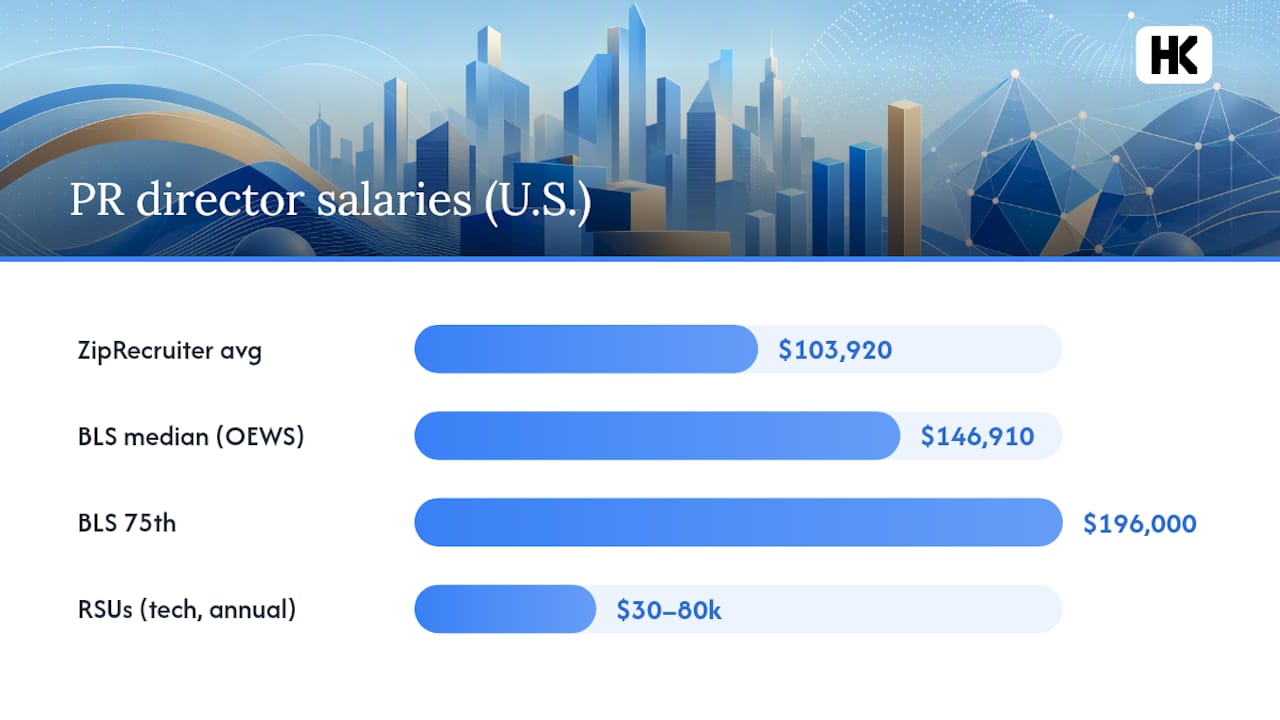
Source: CompSignal / BLS OEWS data for public relations managers
Key factors that move pay within that range: company size (enterprise pays more), sector (tech and financial services pay above median; nonprofits and education pay below), public vs. private company status, and geography (New York, San Francisco, and Boston consistently run 20–40% above national median). Equity is increasingly part of the package at tech companies, where a director might receive RSUs worth $30,000–$80,000 annually on top of base salary.
When benchmarking an offer, cross-reference BLS OEWS data with at least one aggregator and one industry-specific salary survey. Recruiters trust BLS for floor-setting; they use aggregator data to argue market rate. Knowing both gives you the full range to negotiate from.
How do you become a public relations director?
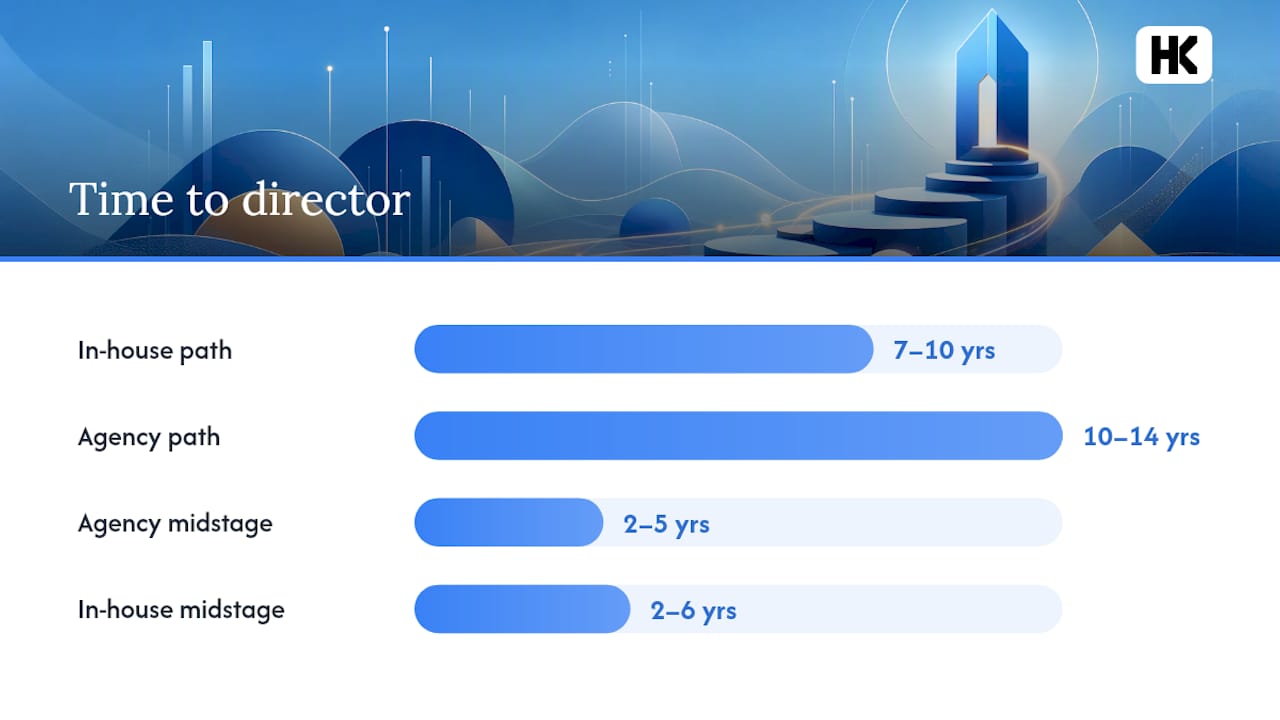
In-house career paths tend to move faster than agency ladders, where titles are more granular and progression more incremental. That said, agency experience in the first 5 years builds media relationships and sector breadth that in-house roles rarely replicate. The most common paths to director look like this:
Agency path (typically 10–14 years to director):
- Account coordinator or assistant account executive (0–2 years)
- Account executive, then senior AE (2–5 years)
- Account supervisor or director of accounts (5–9 years)
- PR director or VP (9–14 years)
In-house path (typically 7–10 years to director):
- PR coordinator or communications specialist (0–2 years)
- PR manager or senior manager (2–6 years)
- Director of public relations (6–10 years)
Stage-by-stage evidence employers look for:
- Years 0–3: Demonstrated writing quality, media placement track record, and ability to manage multiple projects without dropping details.
- Years 3–7: Cross-functional program ownership, team leadership (even informally), measurable outcomes tied to business goals, and at least one high-stakes communications situation handled well.
- Years 7+: Strategic narrative ownership, executive relationships, budget management, and a clear point of view on the organization's reputation.
12–24 month action plan for managers targeting director:
- Request ownership of one strategic initiative, not just execution tasks.
- Build a relationship with at least two senior journalists in your sector.
- Volunteer to lead the next crisis or high-stakes communications response.
- Document outcomes in business terms: revenue protected, sentiment recovered, coverage quality improved.
- Pursue APR certification or a relevant executive education program.
- Ask your manager explicitly: "What would director-level performance look like from me in the next 12 months?"
Sample job description and KPIs for a PR director
Sample job description paragraph: The Director of Public Relations leads the organization's earned media strategy, manages a team of communications professionals, and serves as a senior advisor to the executive team on reputation-critical matters. This role owns media relations, crisis communications, and executive visibility programs, and reports to the Chief Communications Officer.
Typical responsibilities on a job posting:
- Develop and execute annual PR strategy aligned to business objectives
- Manage relationships with national and trade media
- Lead crisis communications planning and response
- Coach executives for media appearances and speaking engagements
- Oversee PR agency relationships and budget
KPIs hiring managers actually use:
- Share of voice: percentage of media coverage in your category vs. competitors
- Sentiment score: ratio of positive to neutral to negative coverage, tracked monthly
- Message pull-through: percentage of coverage that includes key messages verbatim or paraphrased
- Media quality score: weighted metric combining outlet tier, placement type, and audience reach
- Crisis response time: minutes from incident identification to first public statement
- Executive visibility: number of bylines, speaking slots, and broadcast appearances per quarter
Translating qualitative PR outcomes into measurable achievements is a skill in itself. "Secured 45 pieces of tier-1 coverage" is weaker than "Achieved 38% share of voice in Q3, up from 22% in Q2, following a coordinated product launch campaign." The second version gives a hiring manager something to verify and compare.
How do PR director, PR manager, and CCO differ?
Marketing managers focus on persuading customers to buy; PR managers focus on persuading the public to trust. The director role sits between the manager and the CCO in most org charts, but the boundaries blur depending on company size.
| Role | Strategic ownership | Team size | Typical U.S. compensation |
|---|---|---|---|
| PR Manager | Executes strategy set by director or CCO | 0–3 direct reports | — |
| PR Director | Owns PR strategy; advises C-suite | 2–10 direct reports | Median $146,910 (BLS OEWS); ZipRecruiter avg $103,920 (July 2026) |
| CCO / VP Communications | Owns all communications (PR, internal, IR) | Entire comms function | — |
The director role is a genuine stepping stone to CCO, but only when the director has demonstrated cross-functional leadership beyond earned media: internal communications, investor relations adjacency, or executive communications programs. Directors who stay narrowly focused on media relations often plateau at the director level.
Which role to pursue based on your goals:
- If you want deep subject-matter expertise (crisis, ESG, investor relations): stay at director level longer and specialize.
- If you want organizational leadership and P&L exposure: move toward CCO or VP as fast as your track record allows.
- If you are currently a senior PR manager: the director title is the right next step, and the gap is usually about strategic ownership, not years of service.
How to answer PR director interview questions
Most director-level interviews test three things: strategic thinking, leadership under pressure, and the ability to connect PR outcomes to business results. The questions below come up consistently.
Common questions and answer frameworks:
-
"Walk me through a crisis you managed." Use STAR (Situation, Task, Action, Result), but weight the Result heavily. Quantify the outcome: coverage volume, sentiment recovery, timeline from incident to resolution.
-
"How do you measure PR success?" Name specific metrics (share of voice, sentiment, message pull-through) and explain how you tie them to business objectives. Avoid vague answers about "brand awareness."
-
"How do you manage relationships with senior executives who resist media training?" Show you can influence without authority. Describe a specific situation where you built trust with a reluctant executive by making the preparation low-friction and outcome-focused.
-
"Tell me about a time you disagreed with legal or HR on a communications decision." Interviewers want to see judgment, not compliance. Describe how you made your case with evidence, respected the final decision, and maintained the relationship.
Numbered prep steps for the interview:
- Prepare three specific examples of measurable PR outcomes you owned.
- Know the company's recent media coverage: what is the narrative, and where are the gaps?
- Have a 90-day plan ready: what would you prioritize in your first three months?
- Prepare one contrarian observation about the company's current communications approach.
- Know your compensation floor before the conversation starts.
Key Takeaways
A public relations director owns PR strategy, media relations, crisis communications, and executive visibility. In the United States, the BLS OEWS median salary for PR managers is $146,910, while aggregator data (ZipRecruiter) shows $103,920 as of July 2026, due to methodology differences. A typical career path involves 7–12 years before reaching the title.
| Point | Details |
|---|---|
| Median U.S. salary | BLS OEWS median for PR managers is $146,910; ZipRecruiter avg is $103,920 (July 2026). |
| Experience required | Most director roles require several years of experience, including some in a management capacity. |
| Fastest path to director | In-house paths typically reach director level faster than agency paths, though timelines vary. |
| Top credential | APR from PRSA is the most recognized optional certification; it can tip promotion decisions. |
| Salary data sources | Cross-reference BLS OEWS with at least one aggregator; BLS sets the floor, aggregators reflect market rate. |
What the PR director role actually demands
Most career guides describe the PR director role as a natural progression from manager: more strategy, more budget, more visibility. That framing undersells how different the job actually is. The manager role is largely about execution quality. The director role is about judgment under ambiguity, and those are not the same skill.
The professionals who struggle most at director level are the ones who were promoted because they were excellent tacticians. They know how to place a story. They do not yet know how to tell a CEO that the story should not be placed at all, or how to hold that position when the CEO disagrees. That kind of judgment takes time to develop, and it rarely shows up on a resume.
The other thing most guides miss: career acceleration in PR is often less about the brand name on your resume and more about the quality of your immediate manager and the visibility of your work. A strong manager at a mid-tier firm who gives you real ownership of a crisis response will advance your career faster than a weak manager at a top-tier firm who keeps you on press release drafting. Choose your next role based on who you will learn from, not just the company name.
For founders and technical leaders who need to build their own public narrative, the same principle applies. Founder communication is a skill that compounds, and the earlier you treat it as a strategic function rather than a marketing afterthought, the better your outcomes at every funding stage.
Authoritative sources and further reading
These are the sources used throughout this article. Each serves a different purpose when you are doing your own research.
-
U.S. Bureau of Labor Statistics — Public Relations and Fundraising Managers: The primary source for employment projections, duties, education requirements, and the most methodologically consistent U.S. salary data. Use this to set a compensation floor and verify job description language.
-
CompSignal / BLS OEWS Salary Data for PR Managers (11-2032): Presents BLS OEWS percentile salary figures in a clean format. Use this when you need the full percentile distribution, not just the median.
-
ZipRecruiter — PR Director Salary: Aggregator data reflecting posted and self-reported salaries. Useful for understanding what employers are currently advertising, but expect figures to run below BLS due to methodology.
-
Everything PR — PR Career Opportunities 2026: Strong source for career-path nuance, agency vs. in-house comparisons, and senior-role compensation context.
-
Scrypath — Marketing Manager vs. PR Manager: Useful for understanding how PR and marketing roles differ in scope, metrics, and organizational positioning.
-
Truest.me — Public Relations Director: Practical role definition and scope description; good for benchmarking job description language.
When verifying compensation data, always check the date of the underlying survey. BLS OEWS data is updated annually; aggregator data refreshes more frequently but with less methodological rigor. Using both together gives you the most defensible range for a negotiation.
FAQ
What is the role of a public relations director?
A public relations director owns an organization's PR strategy, including media relations, crisis communications, narrative development, and executive visibility. The role typically reports to a CCO or CEO and advises senior leadership on reputation-critical decisions.
How much does a PR director make in the U.S.?
The BLS OEWS median salary for public relations managers is $146,910 with the 75th percentile at approximately $196,000; ZipRecruiter shows an average annual pay for PR Director at $103,920 as of July 2026, reflecting different methodologies.
Is PR a high-paying job?
At the director level and above, yes. The top quartile of PR managers earns above $196,000 annually according to BLS OEWS data, and senior communications roles at public companies often add equity on top of base salary. Aggregator sites such as ZipRecruiter show an average annual pay for PR Director at $103,920 (as of July 2026), so compensation varies widely depending on methodology and role level.
What is the difference between a PR manager and a PR director?
A PR manager executes strategy set by others and typically manages a small team or no direct reports. A PR director owns the strategy, advises the C-suite, manages a larger team, and is accountable for organization-wide reputation outcomes.
How long does it take to become a PR director?
Most professionals reach the director level after 7–10 years on an in-house path or 10–14 years through an agency career. The key milestone is demonstrating strategic ownership and measurable reputation outcomes, not just years of service.