
TL;DR:
- Consulting in SaaS launches is primarily strategic, focusing on delivering clear artifacts, governance, and cross-team coordination. Engaged early, consultants help prevent costly rework, ensure structured phases, and establish single ownership for success. Effective partnerships require precise scope, experienced practitioners, and integration within internal processes to maximize value.
Most B2B SaaS founders think consulting means getting extra hands to write code faster. That assumption is expensive. The real role of consulting in software launches is strategic: shaping what gets built, when, and how every team shows up on launch day. Consultants who do this well deliver product charters, launch readiness artifacts, cross-functional coordination, and post-launch measurement frameworks. They are not a staffing supplement. They are the difference between a coordinated launch and a $200,000 fire drill.
Table of Contents
- Key Takeaways
- The role of consulting in software launches, defined clearly
- How consulting frameworks improve launch readiness
- Consulting's reach into sales, marketing, and post-launch
- Common consulting mistakes and how to avoid them
- Selecting the right consulting partner
- My perspective on consulting and software launches
- Ready to plan your launch with expert support?
- FAQ
Key Takeaways
| Point | Details |
|---|---|
| Consulting goes beyond code | Consultants deliver launch readiness artifacts, governance, and cross-team coordination, not just technical execution. |
| Early engagement prevents rework | Bringing consultants in at concept or prototype stage prevents costly redesigns and compressed timelines later. |
| Go/no-go gates reduce launch failures | Structured sign-off processes eliminate cross-team readiness assumptions that cause last-minute launch collapses. |
| Post-launch deserves budget | Allocating 20 to 30% of implementation budget to post-launch optimization is where measurable ROI actually accumulates. |
| Single ownership is non-negotiable | One accountable person with cross-functional authority consistently determines whether a SaaS launch succeeds or stalls. |
The role of consulting in software launches, defined clearly
There is a persistent confusion about what consultants for software development actually do on a launch engagement. The short answer: they deliver outcomes, not hours.
Consulting engagements typically produce a defined set of launch readiness artifacts. These include a product charter that anchors scope decisions, requirements checkpoints at each development phase, a launch readiness checklist owned by product ops, and a post-launch measurement plan tied to business outcomes. Each of these is a concrete document with a named owner, not a meeting agenda.
The functional roles consultants fill fall into three categories:
- Advisory: Providing strategic input on product positioning, launch timing, and go-to-market sequencing based on market knowledge the internal team lacks.
- Enablement: Training internal teams, preparing sales battle cards, and building the capability for the organization to sustain what launches day one.
- Governance: Owning the process by which decisions get made, escalations get resolved, and cross-team sign-offs get collected before launch gates close.
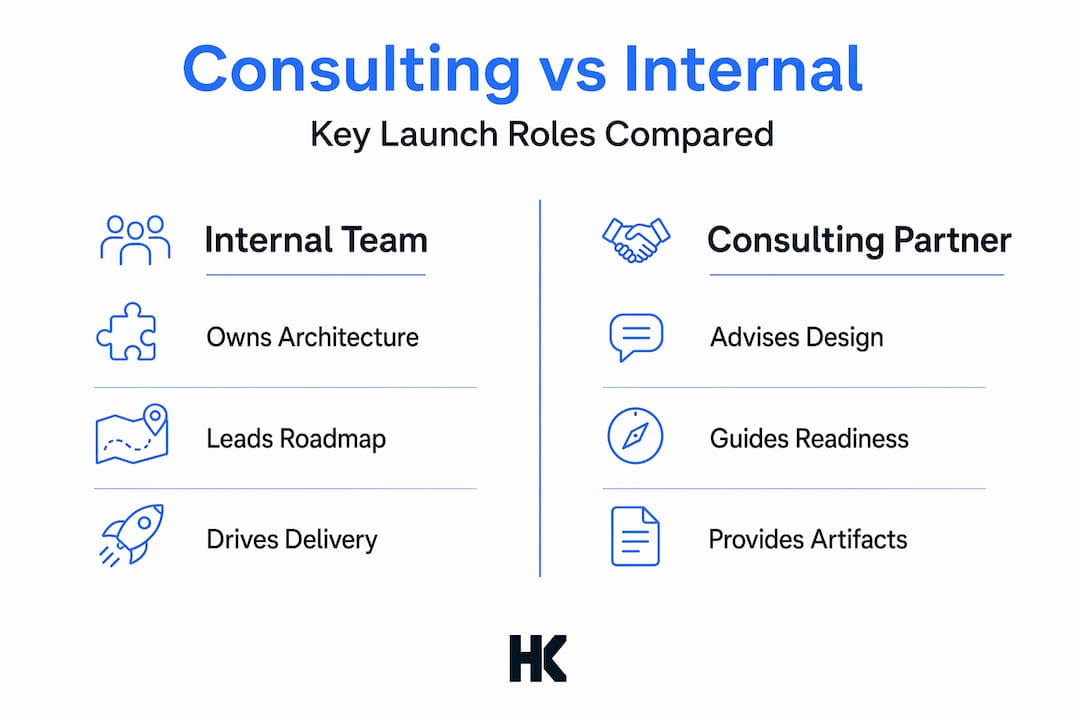
This is meaningfully different from what internal execution teams do. Internal teams own the architecture, the roadmap, and long-term product decisions. Consultants focus on bottlenecks, novel workstreams, and surge capacity during the compressed window before a critical launch deadline. Splitting ownership this way is not a workaround. It is intentional design that keeps strategic control inside the company while bringing in outside accountability where the launch pressure is highest.
Pro Tip: When scoping a consulting engagement, ask specifically what artifacts will be handed off at completion. If the answer is vague, the engagement scope is vague. Deliverables should be named documents with owners.
| Function | Internal team | Consulting partner |
|---|---|---|
| Product architecture | Owns | Advises |
| Launch readiness checklist | Executes | Designs and governs |
| Sales enablement | Receives | Builds and delivers |
| Post-launch measurement | Monitors | Defines success criteria |
How consulting frameworks improve launch readiness
Structured launch methodology is where consulting delivers its most underestimated value. Most internal teams launch by calendar. Consulting-led launches run by phase gates.
A practical 4-phase SaaS launch framework structures the process into pre-launch (4 to 8 weeks), launch preparation (1 to 2 weeks), launch day operations, and a post-launch iteration window of 4 to 8 weeks. Each phase has specific exits: beta program completion, release QA sign-off, training confirmation, and feedback channel activation. Nothing moves forward without those exits being confirmed in writing.
- Strategy and validation (weeks 12 to 8): Consultants run revenue goal alignment sessions, define segment targeting, and test buyer messaging. Revenue goals and segment focus set the direction for everything downstream.
- Build and enablement (weeks 7 to 4): Sales training, demo script preparation, and partner channel activation happen here. The launch team is not waiting for the product to ship. They are getting ready to sell it.
- Launch preparation (weeks 3 to 1): QA completion, compliance baseline documentation, and final artifact review. Enterprise engagements include a Discovery phase that establishes regulatory baselines like HIPAA or FedRAMP where applicable.
- Go/no-go gate (T-72 hours): A go/no-go meeting 72 hours before launch with functional leads signing off their respective checklist sections. Any unchecked box is an automatic red flag that blocks the launch date.
Pro Tip: Run your go/no-go gate at T-72 hours, not T-24. The extra 48 hours gives you time to actually fix what is flagged, not just document that it was broken.
The critical mechanism here is named accountability. Cross-team readiness assumptions cause more launch failures than individual task misses. When engineering assumes marketing is ready and marketing assumes legal signed off, the result is a launch week where nothing actually worked as planned but nobody knew until it mattered.
| Phase | Timing | Consulting role |
|---|---|---|
| Strategy and validation | Weeks 12 to 8 | Revenue alignment, buyer messaging |
| Sales and partner enablement | Weeks 7 to 4 | Training, battle cards, demos |
| Launch preparation | Weeks 3 to 1 | QA, compliance, artifact review |
| Go/no-go gate | T-72 hours | Cross-team sign-off facilitation |
Consulting's reach into sales, marketing, and post-launch
The value of software launch consulting services does not stop at product readiness. The revenue impact depends on what happens when the product meets buyers, and most internal teams underinvest there.

Consulting-led go-to-market planning starts from the buyer backward. That means testing messaging with actual prospects before the product ships, not with the internal team that built it. Consultants run structured buyer interviews, validate positioning against alternatives, and refine the language that sales will use in the first 90 days. Starting from revenue goals rather than feature completeness consistently outperforms ad hoc launches in execution quality.
Sales enablement built by consultants typically includes:
- Battle cards that address the real objections buyers raise, not hypothetical ones.
- Demo scripts structured around outcomes, not features.
- Competitive positioning documents updated to reflect current market conditions at launch time, not six months earlier.
- Training sessions that simulate buyer conversations rather than walk through product screenshots.
Post-launch is where most B2B SaaS launches lose money quietly. The product ships, the team celebrates, and then nobody systematically collects the feedback that would make the next quarter's numbers work. Post-launch phases are often neglected, and consulting structures the investment in adoption monitoring, user feedback channels, and iterative improvement sprints that keep the launch compounding rather than fading.
"The companies that treat launch day as the finish line are the ones who call us six months later trying to figure out why activation rates dropped off. Launch day is the starting line for post-launch optimization, not the end of the project."
Consultants who close the revenue loop connect launch metrics back to the business outcomes defined in week 12. They track activation rates, not just signup counts. They monitor support ticket volume by feature area to identify friction before it becomes churn. This is the consulting benefit for software launches that rarely appears in a vendor brochure but consistently appears in the results.
Common consulting mistakes and how to avoid them
Knowing how to use consulting in software launches means knowing what goes wrong when it is done poorly. The patterns are consistent.
Engaging too late is the most common and most costly error. Consulting works best when engaged early, at concept or prototype stage. Late-stage involvement compresses the consultant's ability to shape anything meaningful and turns the engagement into expensive cleanup work rather than strategic contribution.
Other pitfalls worth knowing before you sign a contract:
- Treating launch as purely technical: Approximately 50% of SaaS implementations fail to meet original success criteria, largely because rollout is treated as a technical project without cross-functional coordination and training. The product working is table stakes. The adoption plan is the actual product.
- No single owner: SaaS implementations require one accountable owner with cross-functional authority to make decisions and resolve conflicts. Distributing ownership across a committee produces diffusion of accountability and missed deadlines.
- Underbudgeting post-launch: The research is specific here. Allocate 20 to 30% of your implementation budget to the post-launch window. That is where adoption happens. That is where ROI accumulates or disappears.
- Misaligned scope: When consultants do not have a defined scope with explicit boundaries, they drift. When internal teams do not know where consultant authority ends, they resist. Write the scope document before week one.
Pro Tip: Before engaging any consulting partner, run a one-page RACI on the five highest-stakes launch decisions. If you cannot agree on who makes each call before the contract is signed, you will fight about it during launch week.
For founders building their first SaaS product, the startup mistakes that sink launches most often come down to skipping validation and skipping coordination. Both are things a well-scoped consulting engagement fixes directly.
Selecting the right consulting partner
The criteria founders use to evaluate consulting firms often focus on the wrong things. Portfolio logos matter less than process transparency and deliverable specificity.
When evaluating partners, look for these signals:
- Named deliverables in the proposal: A consulting partner who cannot list the specific artifacts they will produce before signing is not ready to govern your launch process.
- Domain-relevant experience: A firm that has shipped B2B SaaS products understands different constraints than one that primarily does enterprise IT migration. Ask for examples specific to your product category and deal size.
- Direct access to senior practitioners: Junior teams supervised by senior consultants who appear only in steering committee meetings create significant risk. You want the people in the proposal to be the people in the work.
- Clear separation of roles: A good partner defines explicitly what they own, what internal teams own, and what requires joint decision-making.
| Evaluation criterion | Green flag | Red flag |
|---|---|---|
| Deliverables | Named artifacts with owners | "We will provide guidance and support" |
| Staffing model | Senior practitioner does the work | Partner sells, juniors execute |
| Role clarity | RACI provided before kickoff | Scope defined after kickoff |
| Domain fit | Shipped SaaS products in your segment | Broad consulting portfolio, no SaaS depth |
The best integrations happen when consultants operate within the internal team's tools and cadence rather than running a parallel process. Weekly syncs, shared project tracking, and co-ownership of the launch checklist keep the engagement embedded rather than advisory-only. For a practical view of how this works in a launch context, the SaaS product launch guide covers the phase structure in detail.
My perspective on consulting and software launches
I have seen both sides of this. I have shipped SaaS products end-to-end as the person writing the code, and I have come into organizations six weeks before launch to help make sense of the coordination gap between engineering, sales, and product. The pattern is consistent enough that I have stopped being surprised by it.
The founders who get the most from consulting engagements treat the consultant as a co-owner of the outcome, not a skilled vendor. They share context early, they bring consultants into conversations about positioning and timing before the product is built, and they push back when the consultant is wrong about their specific market. That relationship dynamic is what separates a launch that generates pipeline from a launch that generates a post-mortem.
The founders who get the least treat consulting as a fix for execution gaps they should not have created. They bring consultants in at week two of a six-week runway, they withhold the messy internal context because it feels embarrassing, and then they are frustrated when the consultant cannot course-correct a launch that was structurally broken before the engagement started.
My honest advice: if you are not ready to give a consultant the real numbers, the real timeline, and the real internal conflicts, you are not ready to get value from the engagement. The strategic value of consulting in software launches depends entirely on the quality of information the consultant has to work with. Treat it like hiring a surgeon. You would not hide symptoms to seem healthy.
— Hanad
Ready to plan your launch with expert support?
At Hanadkubat, launch consulting is built into both service tracks, whether you are scoping a new MVP or scaling a product with a fragile codebase. Every engagement includes direct access to Hanad, fixed pricing, and a defined set of artifacts at completion. No account managers between you and the work.
For founders building their first product, the MVP development service covers launch readiness from strategy sprint through go-live. For technical founders who need a strategic co-pilot on an upcoming product release, the strategy sprint at €1,500 gets you a scoped launch plan in one week. You can also explore the founder MVP checklist to audit your current launch readiness before we talk.
FAQ
What does a software launch consultant actually deliver?
A software launch consultant delivers concrete artifacts: product charter, requirements checkpoints, launch readiness checklist, sales enablement materials, and a post-launch measurement plan. The role spans advisory, enablement, and governance functions across all launch-critical teams.
When should you bring in a consultant for a SaaS launch?
Engage consultants at concept or prototype stage for maximum impact. Late-stage involvement compresses their ability to shape strategy and increases the risk of redesign. By the time you are six weeks from launch, consulting becomes triage rather than planning.
What is a go/no-go gate and why does it matter?
A go/no-go gate is a structured review meeting held approximately 72 hours before launch where each functional lead signs off their readiness checklist items. Any unchecked box triggers a delay decision. It eliminates the cross-team assumption failures that cause most preventable launch breakdowns.
How much budget should go to post-launch after a SaaS launch?
Allocate 20 to 30% of your total implementation budget to the post-launch window, covering adoption monitoring, feedback collection, and iterative improvement. This is where SaaS implementations generate measurable ROI, and it is consistently the most underfunded phase.
How do you evaluate whether a consulting partner is the right fit?
Look for named deliverables in the proposal, direct access to senior practitioners doing the actual work, a defined RACI before kickoff, and demonstrated experience shipping SaaS products in your category. Vague scope and junior staffing are the two most reliable predictors of a consulting engagement that underdelivers.