
TL;DR:
- Non-technical founders often fail to conduct structured discovery, leading to misguided MVP features and costly detours. Strategic product consulting aligns product decisions with business goals through evidence-based roadmaps, KPIs, and risk assessments, ensuring effective execution. Genuine strategy emphasizes validation over superficial planning, enabling startups to build focused products that deliver measurable value efficiently.
Non-technical founders who skip structured discovery routinely lock their MVPs into the wrong features from day one, and the damage compounds fast. You spend months building, launch to silence, and wonder what went wrong. The answer is almost always the same: the direction was set before the evidence was in. Skipping early discovery and measurement can lock in the wrong MVP journey and metrics, turning a promising idea into an expensive detour. This guide breaks down what strategic product consulting is, why it matters specifically for non-technical startup leaders, and exactly how to use it to ship products that actually land.
Table of Contents
- Defining strategic product consulting: Beyond generic advice
- How strategic consulting bridges strategy to execution
- Discovery, measurement, and evidence: The foundation of MVP success
- Strategic versus tactical: Why startups need both, but can't afford to skip strategy
- Our take: Why the real risk for founders is "strategy theater"
- Accelerate your MVP with expert strategic product consulting
- Frequently asked questions
Key Takeaways
| Point | Details |
|---|---|
| Align vision and execution | Strategic product consulting links big-picture goals to clear, evidence-based plans for startup growth. |
| Measure before building | Early discovery and analytics are essential to avoid costly MVP mistakes and wasted resources. |
| Bridge strategy to hands-on delivery | Consultants provide frameworks, roadmaps, and prioritization tools to move ideas into action. |
| Demand results, not presentations | Real value comes from executing validated strategies, not just producing pretty decks. |
| Non-technical founders can excel | With expert advice, you can drive strategic product decisions even without a technical background. |
Defining strategic product consulting: Beyond generic advice
Most founders who've sat through a generic product workshop or hired a freelance product manager for a few weeks know the feeling: lots of frameworks, beautiful slide decks, and then... not much changes. That's because what they experienced wasn't strategic product consulting. It was surface-level advice dressed up in consulting language.
Strategic product consulting is something fundamentally different. According to TCGen's product strategy overview, strategic product consulting aligns product vision and development choices with business goals using structured frameworks, roadmaps, and KPIs. It's hands-on and advisory at the same time. The consultant doesn't just hand you a template. They work with you to understand your specific business context, your users, your constraints, and your growth targets, then build a plan that ties all of those together.
The contrast with generic advice is sharp. Generic product advice says "prioritize user needs." Strategic consulting asks which user needs map directly to revenue, how you'll measure progress, what the top three risks are to your business model, and what you'll cut from scope if resources run tight. That specificity is the whole point.
ProductPlan's research makes the distinction even clearer: unlike tactical product management, strategic consulting focuses on big-picture direction and measurable alignment. A tactical product manager ensures your sprint is running smoothly. A strategic consultant ensures your sprint is pointed at the right destination in the first place.
Here's a practical comparison of what separates the two approaches:
| Dimension | Generic product advice | Strategic product consulting |
|---|---|---|
| Focus | General best practices | Business-specific outcomes |
| Output | Frameworks and templates | Prioritized roadmaps and KPIs |
| Involvement | One-time workshop or report | Ongoing advisory and iteration |
| Risk coverage | Rarely addressed | Central to the engagement |
| Success measure | Deliverables completed | Business metrics moved |
The tools of strategic product consulting include product roadmaps that are tied to business milestones, not just feature lists. They include business case rationale, meaning the "why this and not that" argument for each major investment. They include KPIs defined before development starts, not bolted on afterward. And they include formal risk identification so you know what assumptions could kill the plan.
Key hallmarks of real strategic product consulting:
- Business alignment: Every product decision traces back to a specific business objective
- Prioritization frameworks: Features are ranked by impact and cost, not by who asked loudest
- Measurable milestones: Success is defined in numbers, not vibes
- Risk mapping: Known unknowns are surfaced and addressed proactively
- Bespoke planning: The roadmap reflects your startup, not a generic template
Pro Tip: Before hiring any consultant, ask them to show you a past roadmap they built. If it's a feature list with dates and no business rationale attached, keep looking.
For a deeper look at how this applies to early-stage SaaS companies specifically, the startup product strategy guide on this site is worth your time.
How strategic consulting bridges strategy to execution
Strategy without execution is just an opinion. And execution without strategy is just noise. The real value of strategic product consulting sits in the bridge between those two worlds.

McKinsey's documented approach to product strategy confirms what experienced practitioners already know: consulting bridges vision to execution with frameworks, business case rationales, risk assessment, and clear roadmaps, not just ideas. The process is repeatable and structured because improvisation at the strategy level is expensive.
So what does that bridge actually look like in practice? Here's the typical sequence:
- Define the strategic intent: What does the business need this product to accomplish in the next 6 to 12 months? Revenue targets, user acquisition goals, retention benchmarks.
- Map the current state: What exists today? What are the gaps between where you are and where you need to be?
- Identify the key bets: Which features or capabilities have the highest potential impact given your resources and timeline?
- Build the roadmap: Sequence those bets into a milestone-driven plan with clear owners, timelines, and success metrics.
- Assess risks: What assumptions does this plan depend on? What happens if they're wrong?
- Define the measurement system: How will you know if things are working before it's too late to course-correct?
Each of these steps produces an artifact. Not a deck to impress investors. An actual working document that the team uses every week to make decisions.
The roadmap is the most visible artifact, and it's also the most misunderstood. Most early-stage founders think a roadmap is a timeline of features. It's not. A real MVP product roadmap is a prioritized sequence of bets, where each bet is tied to a hypothesis, a metric, and a delivery milestone.
"A roadmap that doesn't trace every item back to a business outcome is just a project plan with a fancier name."
Here's the contrast between high-level ambition and concrete execution that strategic consulting makes possible:
| High-level ambition | Concrete execution (post-consulting) |
|---|---|
| "We want to grow our user base" | 500 new signups by Q3 via onboarding flow improvements |
| "We need better retention" | Reduce 30-day churn from 22% to 14% by adding in-app activation prompts |
| "Users want more features" | Ship 2 high-impact features validated by interview data before Q2 |
| "We should improve the product" | Fix top 3 friction points identified in session recordings by sprint 4 |
The shift from vague to specific is not cosmetic. It changes how the team works, how you allocate budget, and how fast you catch problems.
If you're building your first SaaS product, the lean MVP creation guide breaks down how to keep scope tight while still hitting meaningful milestones.
Discovery, measurement, and evidence: The foundation of MVP success
Here's the uncomfortable truth: most MVPs fail not because of bad engineering, but because of bad assumptions. The founder assumed users wanted feature X. Nobody asked. The product launched. Users didn't care about feature X. Months wasted.
Discovery is the discipline of replacing assumptions with evidence before you build. It sounds obvious. In practice, founders skip it constantly because it feels slow or because they're already convinced they know what users want.
Real-world product consulting engagements show what happens when you do it right. One fintech startup ran 20 structured user interviews and built a metrics dashboard before writing a single line of product code. The result? 23% conversion growth after implementing changes grounded in what those interviews revealed. That's not luck. That's evidence working.
The discovery process in a proper consulting engagement covers several critical areas:
- User interviews: Structured conversations designed to surface real pain points, not confirm existing beliefs. The goal is to hear things that surprise you.
- Analytics instrumentation: Setting up tracking before you launch so you can measure what actually matters from day one, not retrofit it six months later.
- Assumption mapping: Writing down the core beliefs your business plan depends on and ranking them by risk. Which assumptions, if wrong, would kill the product?
- Effort vs. Impact analysis: Before committing to any feature, score it on two dimensions. How hard is it to build? How much business value does it unlock? Build the high-impact, lower-effort items first.
- Competitive landscape review: Where are users going today? What do those solutions do well? What do they fail at?
The Effort vs. Impact model deserves special attention because it's one of the most practical tools a non-technical founder can use. Draw a two-by-two grid. High impact and low effort goes in the top left: build these first. High effort and low impact goes in the bottom right: cut these ruthlessly. The top right (high impact, high effort) gets scheduled carefully. The bottom left (low impact, low effort) gets ignored.
This is exactly the kind of prioritization framework that separates strategic consulting from feature-list thinking. It forces real tradeoff conversations before resources are committed.
Pro Tip: Validate your three biggest product assumptions with real users before writing a spec. If you can't find ten people willing to talk to you about the problem, that's already important information.
For a step-by-step look at how validation works in practice, the startup validation steps guide covers exactly what to do before your first build sprint. And if you're preparing for launch specifically, the product launch guide for non-technical founders is directly relevant. You can also see how technical consulting accelerates the entire launch timeline.
Strategic versus tactical: Why startups need both, but can't afford to skip strategy
Tactical work is seductive. You can see it. Sprint completed. Features shipped. Tickets closed. It feels like progress because it produces visible output every day.
Strategic work is harder to measure in the short run. You're making choices about direction, framing tradeoffs, and building alignment. The output looks like documents and decisions, not code. For non-technical founders especially, it's tempting to skip strategy and jump to building because building feels tangible.
This is exactly the trap that kills early-stage startups.
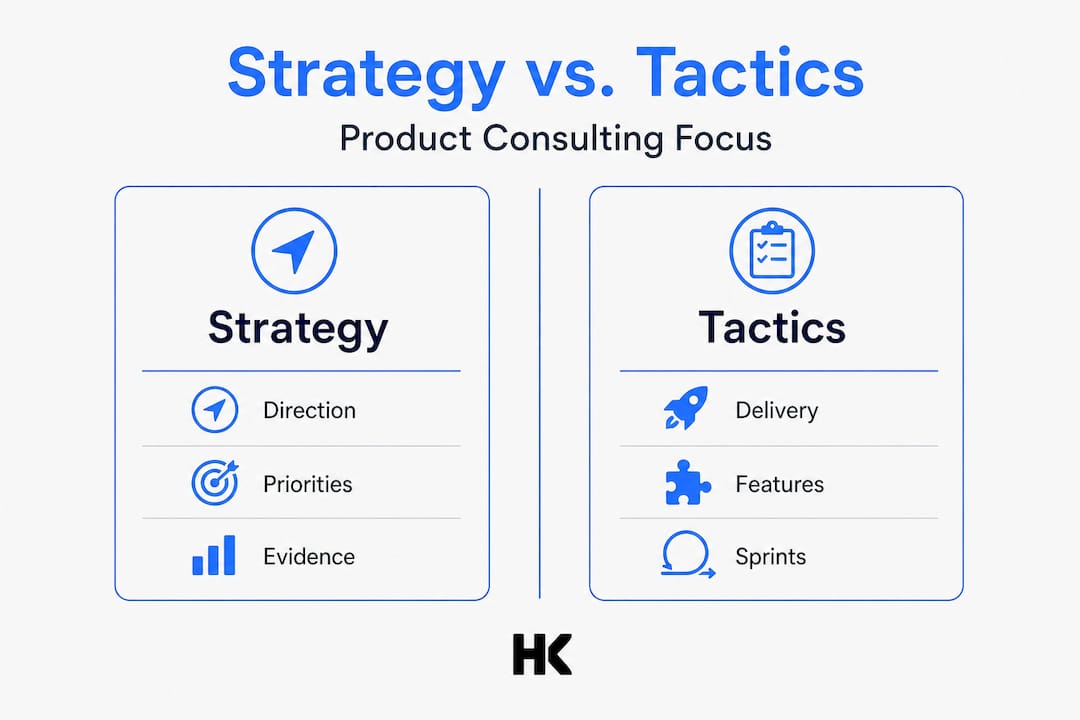
ProductPlan's breakdown of strategic versus tactical product focus is direct: strategic engagements cover big-picture direction, prioritization, and anchoring business outcomes. Tactical work ensures execution but alone it isn't sufficient for long-term alignment. You need both, in the right order.
Think of it this way. Tactical execution without strategic alignment is like optimizing the fuel efficiency of a car that's driving in the wrong direction. You're getting very good at going somewhere you don't want to be.
Valantic's analysis of strategy consulting adds another layer: strategy consulting anchors long-term goals, blends economic, technological, and cultural analysis, and helps implement action plans within organizations. That blend matters for startups because product decisions don't live in isolation. They connect to your go-to-market motion, your pricing model, your hiring plan, and your fundraising timeline.
Here's what strategic work covers versus what tactical work covers in a startup context:
Strategic product work:
- Choosing which market segment to prioritize first
- Deciding whether to go web-first or mobile-first (a decision explored in depth in the web vs. mobile guide)
- Defining the business model and pricing architecture
- Identifying which metrics will signal product-market fit
- Making explicit tradeoffs between scope, speed, and quality
Tactical product work:
- Writing user stories and acceptance criteria
- Running sprint planning and retrospectives
- Managing the product backlog
- Coordinating between design and engineering
- Tracking delivery timelines and removing blockers
| Work type | Time horizon | Primary output | Risk if skipped |
|---|---|---|---|
| Strategic | 6 to 18 months | Direction, priorities, roadmap | Building the wrong thing |
| Tactical | Days to weeks | Shipped features, completed tasks | Slow or chaotic delivery |
"The founders who come to me after burning through €50K in development without user traction almost always have the same story: great execution, wrong direction. They were tactically brilliant and strategically blind."
Startups that over-index on tactical work create a specific kind of debt. It's not technical debt. It's strategic debt. You accumulate a product full of features nobody asked for, optimized to metrics that don't predict revenue, built on assumptions nobody tested. Unwinding that is harder and more expensive than doing the strategy work upfront.
The ROI of strategic alignment is real and underappreciated. When your team knows exactly what they're optimizing for and why, decisions happen faster, debates get shorter, and scope creep gets rejected automatically because the criteria for inclusion are clear.
Our take: Why the real risk for founders is "strategy theater"
Here's what I've seen working with early-stage founders across Europe: the biggest risk isn't that they ignore strategy entirely. It's that they do strategy theater instead.
Strategy theater looks like this. You hire a consultant or facilitate a workshop. You spend two days filling out a business model canvas. Someone builds a beautiful 40-slide deck with a three-year roadmap and color-coded priority tiers. Everyone feels aligned. Then you start building, and within six weeks the roadmap is irrelevant because nobody validated the core assumptions it was built on.
The deck was beautiful. The strategy was theater.
Real strategic product consulting is uncomfortable. It requires running experiments that could disprove your favorite idea. It means talking to users who might tell you the problem you're solving isn't actually painful enough to pay for. It means having explicit conversations about what you'll cut when resources run short, not just what you'll build when everything goes perfectly.
The consultants worth paying are the ones who push back. They ask which of your assumptions you've actually tested. They challenge the priority order of your roadmap based on evidence, not opinion. They point out when your metrics don't connect to the business outcomes you claim to care about. That friction is the service.
The lean MVP creation lessons I've applied across my own SaaS products and with founders I've worked with all point to the same principle: the most valuable thing early discovery does is tell you what to remove. Every assumption you kill in week two is a feature you don't build in month four.
Founders should demand that any strategic engagement includes real customer signals, explicit risk identification, and honest assessment of what the evidence does and does not support. If the deliverable is a polished deck with no user quotes, no metric benchmarks, and no "here's what we don't know yet," you've paid for theater.
Pro Tip: Challenge any strategy that doesn't include customer signals and documented risks as core deliverables. Slide-making is not strategy. Evidence is strategy.
The question to ask any strategic consultant before you sign: "What will you do if our first assumptions turn out to be wrong?" The answer tells you everything about whether they're selling strategy or practicing it.
Accelerate your MVP with expert strategic product consulting
Building an MVP without strategic grounding is one of the most expensive mistakes a non-technical founder can make. If this guide has made one thing clear, it's that the difference between startups that ship and scale versus those that spin in circles often comes down to whether the strategy work was done honestly, early, and with real evidence.
At hanadkubat.com, the work is built on exactly this foundation. You get hands-on technical execution combined with the kind of direct strategic input that keeps your MVP scoped to what actually matters. No agency overhead, no project manager relay race, no fluff. If you're a non-technical founder who needs a senior technical partner to turn a validated idea into a production-ready product in weeks rather than months, this is where to start. The process begins with honest scope discussion, not a sales deck.
Frequently asked questions
What does a strategic product consultant actually do?
A strategic product consultant helps startups decide what to build and why, then creates a practical, prioritized plan including roadmaps, metrics, and risk assessments to deliver business value. Product strategy consulting defines this as aligning product vision with business goals through structured frameworks and measurable KPIs.
How is strategic product consulting different from regular product management?
While product management often focuses on daily delivery and execution, strategic consulting sets overall direction, prioritizes investments, and ensures alignment to business outcomes. Strategic vs. tactical focus research confirms that strategic consulting is concerned with big-picture direction, not just sprint delivery.
Why is early discovery and measurement important for MVPs?
Without early discovery interviews and measurement setup, MVP decisions are based on assumptions instead of evidence, risking wasted time and money. A real 23% conversion growth result came directly from combining user interviews with an analytics dashboard before building.
What deliverables are included in a strategic product consulting engagement?
Deliverables often include product roadmaps, business case justifications, KPI dashboards, and clear plans for risk assessment and delivery sequence. The McKinsey product strategy approach confirms that consulting bridges vision to execution through exactly these structured artifacts.
Do I need technical skills to benefit from strategic product consulting?
No. Strategic product consultants work specifically with non-technical founders, helping you make data-driven decisions, validate assumptions, and execute with confidence without needing to write a single line of code yourself.