
Pre-selling means asking customers to pay now for a product you haven't finished yet. Money is the strongest validation signal you have. Before you write a line of code or manufacture a single unit, pick 5–10 target buyers, make a narrow founding offer, collect real payments, and measure the result against a threshold you set in advance. If you hit it, build. If you don't, you've saved months of wasted work.
The success rule is simple: real payment beats stated interest every time.
Key Takeaways
Pre-selling validates demand by exchanging real money for a promised outcome before you build, giving founders a concrete build/no-build signal within 14 days.
| Point | Details |
|---|---|
| Money beats stated interest | Paid orders are the only reliable demand signal; clicks and signups are proxies. |
| Set thresholds before you start | Define green/amber/red criteria upfront; 5 paid orders at $99–$299 is a meaningful B2B/SMB SaaS signal. |
| Match format to uncertainty | Use a refundable deposit when delivery date is unclear; a paid pilot when you can deliver manually first. |
| FTC compliance is non-negotiable | State a delivery date, notify buyers of delays, and process refunds within 7 business days. |
| Hanadkubat for delivery | Fixed-price 2-week sprints (€4,500) and 4–12 week MVP builds (from €18,000) convert pre-sell commitments into shipped products. |
Table of Contents
- What does "pre-sell" mean, and should you run one?
- Why pre-sell? Benefits, risks, and how to manage both
- How to run a pre-sell sprint in 7–14 days
- Which pre-sell format fits your product?
- Which platforms and tools should you use?
- Pricing, payment capture, and fulfillment planning
- What metrics tell you the pre-sell worked?
- Common mistakes that kill pre-sell campaigns
- Turning a successful pre-sell into a shipped product
- The pre-sell most founders skip
- Fixed-price technical delivery for founders who've validated demand
- Sources
- FAQ
What does "pre-sell" mean, and should you run one?
Merriam-Webster defines "presell" as selling in advance or creating advance demand for something before it is published or manufactured. Oxford gives a concrete example: putting a trial version on a website to pre-sell a product. You'll see the term written three ways: pre-sell (hyphenated verb), presell (closed form), and presale (the noun for the event itself). All three are standard; the hyphenated form is most common in editorial contexts.
Common synonyms include preorder, presale, refundable deposit, and founding-customer agreement. They describe the same core act: exchanging money for a promise of future delivery.
When a pre-sell makes sense:
- You have a clear, describable outcome the buyer will receive
- Delivery is feasible within a timeline you can state honestly
- You can reach at least a few dozen potential buyers directly
- You're willing to issue refunds if you can't deliver
When it doesn't:
- The product requires regulatory approval before sale (medical devices, certain financial instruments, licensed pharmaceuticals)
- You can't describe what the buyer gets or when
- You have no direct access to the audience
Two quick examples. A digital course on SaaS pricing: pre-sell works because you can deliver a PDF or video series within 30 days and the only regulatory constraint is your own honesty. A new glucose monitor: pre-selling before FDA clearance creates legal exposure and erodes trust the moment buyers ask about certification.
Why pre-sell? Benefits, risks, and how to manage both
Pre-selling does four things at once that no survey or waitlist can replicate.
Primary benefits:
- Real demand signal. Someone handing over $199 is a stronger data point than 500 people clicking "notify me." Payment reveals actual willingness to pay, not just curiosity.
- Price validation. You learn whether your price point holds before you've sunk development cost into the wrong tier.
- Early cashflow. Pre-sale revenue can fund the first sprint of development, reducing personal financial risk.
- Sharper product requirements. Early buyers tell you what they actually need, which tightens scope and cuts feature bloat.
Main risks and one-line mitigations:
- Overpromising: Write a specific delivery date and scope on the sales page. If it slips, communicate early.
- Logistics delays: Build a 30% buffer into any timeline you publish. Physical products especially.
- Refund obligation: State your refund policy explicitly before payment. Honor it without friction.
- Reputational risk: One failed pre-sell handled badly damages future launches. One handled transparently often strengthens trust.
Legal callout for U.S. sellers. The FTC's Mail, Internet, or Telephone Order Rule requires sellers to ship within the stated timeframe (or within 30 days if no date is given), notify buyers of delays, and offer a full refund if the revised date is unacceptable. Practically: always state a delivery date, send delay notices proactively, and process refund requests within 7 business days.
Pro Tip: Set your refund policy and delivery date before you open the payment link. Changing either after buyers have paid creates legal and reputational exposure that is far harder to fix than a slower launch.
How to run a pre-sell sprint in 7–14 days
This is a repeatable framework. Run it once, learn from it, and the second time takes half the effort.
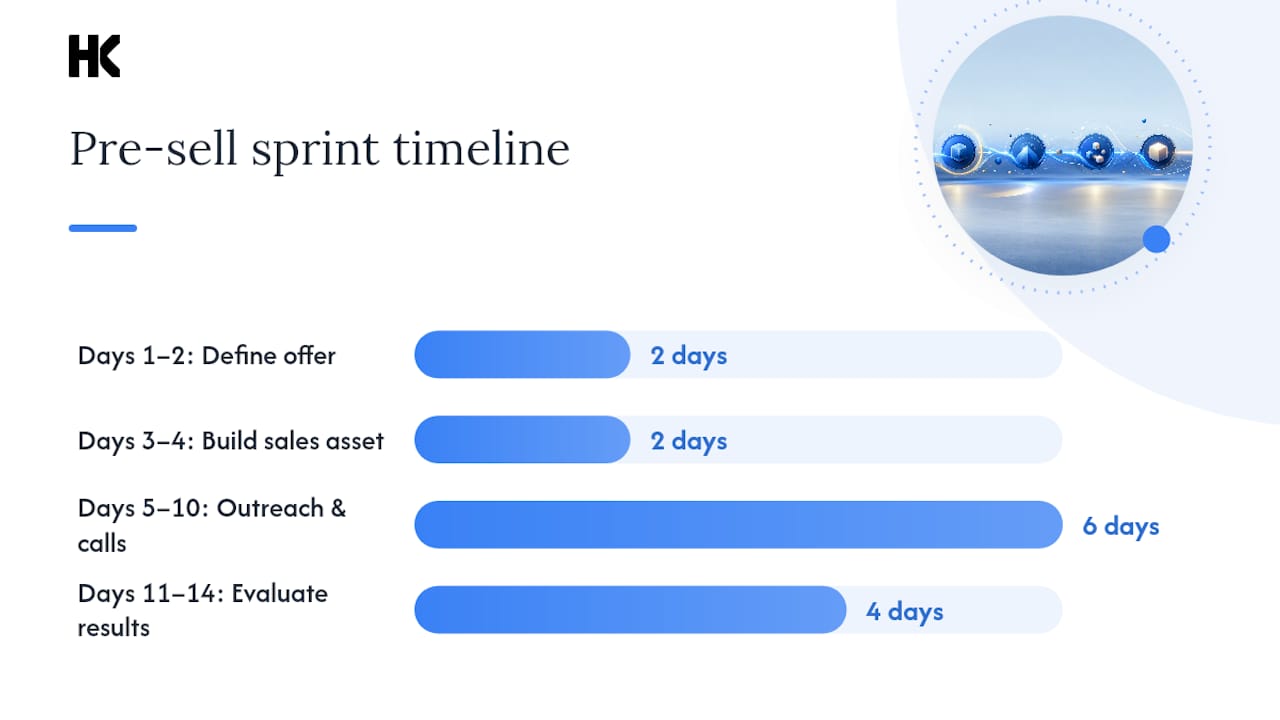
Days 1–2: Define the offer
- Write one sentence describing what the buyer gets and when.
- Set a founding price reduced below your planned retail price.
- Write your success threshold: minimum paid orders or minimum revenue before you commit to building.
Days 3–4: Build the minimal sales asset
- Create a single-page sales document or landing page. You need: a headline with the promised outcome, a short description, price, delivery date, and refund terms.
- Set up a Stripe payment link or Gumroad checkout. No full website required.
- Draft three outreach messages (email, LinkedIn DM, and a short social post).
Days 5–10: Outreach and conversations
- Contact your list of at least 20 target buyers directly. Personal messages convert better than broadcast.
- Offer a 15-minute call to anyone who asks questions. Calls close pre-sales; email threads rarely do.
- Track every response: interested, paid, declined, no reply.
Days 11–14: Evaluate
- Compare paid orders against your pre-set threshold.
- Green: threshold met or exceeded. Build.
- Amber: 50–80% of threshold. Investigate why. Wrong price? Wrong audience? Wrong promise?
- Red: fewer than 50% of threshold. Do not build yet. Interview the declines.
Sample presell page outline:
- Headline: "[Specific outcome] for [specific audience] in [timeframe]"
- Promised outcome: Two sentences on what they get and what problem it solves
- Limited quantity or founding price: "Limited founding spots at a reduced price with a higher future price stated"
- Delivery date: "Shipped by [specific date]"
- Refund terms: "Full refund if not delivered by [date]"
Three micro-template CTAs:
- "Reserve your spot at the founding price — $199 until [date]."
- "Pay now, cancel anytime before [delivery date] for a full refund."
- "Join 12 founders already in — [Stripe link]."
Pro Tip: Set your green/amber/red thresholds before you start outreach. Once you're mid-campaign and emotionally invested, you'll rationalize weak results. The threshold is your pre-commitment device. Bright Curios recommends 5 paying customers at $99–$299 as a meaningful early signal for B2B/SMB SaaS offers.
Which pre-sell format fits your product?
The format you choose signals something to buyers about how certain you are of delivery. Match it to your actual delivery uncertainty, not to what sounds most confident.

Matching format to delivery uncertainty is the key decision: use a refundable deposit when the delivery date is unclear; use a paid pilot when you can manually deliver value before automating it.
A paid pilot is often the strongest format for B2B SaaS founders: you deliver the outcome manually (a spreadsheet, a Zapier workflow, a consulting call) while you build the automated version. Buyers get real value immediately; you learn exactly what to automate.
Which platforms and tools should you use?
Short answer: use the simplest tool that captures a real payment and gives you the buyer's contact details with this marketing automation checklist that complements presell outreach and post-purchase nurture. Here's how the main options break down for U.S. sellers.
-
Kickstarter. Best for physical products and creative projects that benefit from public discovery. All-or-nothing funding model means you only charge if you hit your goal. Platform takes 5% plus payment processing fees. You don't own the backer email list until the campaign ends.
-
Indiegogo. Similar to Kickstarter but offers flexible funding (keep what you raise even if you miss the goal). Useful when you need partial funding to start. Same caveat on data ownership during the campaign.
-
Shopify with a preorder app. Best for founders who already have a Shopify store or plan to sell ongoing. Apps like Pre-Order Now or Timesact add preorder functionality to existing product pages. You own all customer data from day one.
-
Gumroad. Fast setup for digital products, courses, and software. No monthly fee; takes a percentage per transaction. Checkout is hosted by Gumroad, so messaging customization is limited, but the tradeoff is zero technical setup.
-
Stripe. The most flexible option for founder-led outreach. Create a payment link in minutes, send it directly to prospects, and own all transaction data. No storefront needed. Combine with a simple Notion page or Google Doc as your "sales page."
-
PayPal. Widely trusted by buyers, especially outside tech circles. Invoice or payment link setup is fast. Less developer-friendly than Stripe but sufficient for a 14-day sprint.
-
ConvertKit. Purpose-built for creators running email-first pre-sells. Build a landing page, capture emails, segment by interest, and send a payment link to the warmest segment. Strong automation for post-purchase sequences.
-
Mailchimp. Broader audience than ConvertKit, better for founders with an existing mixed list. Landing page builder is included. Less granular automation than ConvertKit but easier to start if you're already using it.
Best choice when: Kickstarter or Indiegogo for broad crowdfunding discovery and hardware. Shopify plus a preorder app for existing e-commerce stores. Stripe payment link plus ConvertKit for a founder-led outreach sprint where speed and data ownership matter most. The pre-sell before you build framework specifically advocates this email-first, tracked-link approach as the fastest way to get a clean paid-commitment signal.
For SaaS validation, pairing Stripe with a SaaS idea validation checklist tightens the signal further by ensuring you're testing the right assumptions before you open the payment link.
Pricing, payment capture, and fulfillment planning
Getting the price wrong is the most common reason a pre-sell fails to give you useful data. Too low and you attract bargain hunters who won't pay full price later. Too high and you filter out your best early adopters.
Pricing checklist:
- Set a founding discount of 30–50% below planned retail price, and say so explicitly on the page
- Decide between full payment now vs. a refundable deposit (deposit lowers friction; full payment gives stronger signal)
- For higher-priced products ($500+), consider a milestone payment: 50% now, 50% on delivery
Payment capture options:
- Stripe payment link: fastest setup, full data ownership, direct to your bank
- PayPal invoice: familiar to buyers, slightly higher friction for you
- Shopify checkout: best if you have an existing store
- Crowdfunding platforms: lowest data ownership, highest discovery potential
Sample refund policy language (include this on your presell page and in your confirmation email):
Fulfillment rules of thumb:
- Add 30% to your internal timeline estimate before publishing a delivery date
- For physical goods, add a separate shipping buffer of 2–4 weeks beyond production completion
- If your timeline slips, notify buyers before the original date, not after. State the new date and reconfirm their refund option.
- For digital products, a "soft launch" to pre-sell buyers 48 hours before public release is a low-cost way to reward early trust
What metrics tell you the pre-sell worked?
Gut feel is not a success metric. Set these KPIs before you launch and read them objectively at the end of the sprint.
Primary KPIs:
- Committed revenue: total dollars collected from paid orders. Formula: number of orders × price per order.
- Number of paid orders: the raw count. For B2B/SMB SaaS, 5 paying customers at $99–$299 is a meaningful early signal.
- Conversion rate from outreach: paid orders ÷ total people contacted. A rate above 5% on cold outreach is strong; 10%+ on warm outreach suggests real product-market fit.
- Customer acquisition cost (CAC): if you ran paid traffic, total ad spend ÷ number of paid orders.
- Refund rate: refund requests ÷ total paid orders. Above 15% early in the campaign is a warning sign.
Threshold rules by price point:
- Under $100: aim for 20+ paid orders in 14 days before committing to build
- $100–$500: 5–10 paid orders is a meaningful signal
- $500+: 3–5 paid orders from qualified buyers is sufficient to validate
Data-collection checklist:
- Track every outreach touchpoint (email, DM, call) in a simple spreadsheet
- Record the source of each paid order (which channel, which message)
- Capture a one-sentence "why did you buy" from at least 3 buyers via a follow-up email
- Note every "no" and the stated reason
Common mistakes that kill pre-sell campaigns
Most failed pre-sells fail for the same five reasons.
- Vague offer. "A tool that helps you grow" is not a pre-sellable product. Fix: write the outcome in one sentence with a specific result and timeframe.
- Wrong price. Pricing too low signals low value; pricing too high without social proof kills conversion. Fix: anchor to a named founding discount and state the future price.
- Weak traffic. Sending a payment link to 10 people and getting zero buyers proves nothing. Fix: reach at least 20–50 qualified prospects before drawing conclusions.
- No refund terms. Buyers who can't find a refund policy don't buy. Fix: put refund terms above the payment button, not in the footer.
- Overpromising timeline. Promising delivery in 4 weeks when you need 12 creates a refund crisis. Fix: add your 30% buffer and publish the honest date.
Red flags during a campaign:
- Multiple buyers asking about legal protection or certification before purchase (possible regulatory issue)
- High refund request rate within 48 hours of payment (offer clarity problem)
- Good traffic, zero conversions (price or trust problem, not a demand problem)
When to cancel and how to do it gracefully:
- Cancel if you receive credible legal questions suggesting the product requires certification you don't have
- Cancel if you hit fewer than 30% of your threshold with no clear fixable reason
- Refund every buyer within 7 business days. Send a personal email explaining what you learned and what you're doing next. Buyers who get a clean refund and an honest explanation often become customers on the next launch.
Turning a successful pre-sell into a shipped product
A pre-sell result is a commitment to buyers. The delivery plan needs to be as specific as the offer was.
Production-readiness checklist:
- Scope the MVP to exactly what you promised, nothing more
- Identify which parts can be manual workarounds in the first version (a spreadsheet instead of a dashboard, a Zapier flow instead of native integration)
- Write acceptance tests: what does "done" look like for each promised feature?
- Set up simple monitoring and a rollback plan before you ship to pre-sell buyers
Example sprint plan for a 4–12 week MVP:
- Weeks 1–2: architecture decision, data model, core user flow only
- Weeks 3–6: build the single workflow that delivers the promised outcome
- Weeks 7–8: internal testing, acceptance tests, staging environment
- Weeks 9–10: soft launch to pre-sell buyers, collect feedback
- Weeks 11–12: fix critical issues, public launch
For non-technical founders, a SaaS product launch guide covers the communication and delivery handoff in detail.
Delivery communication cadence:
- Week 1 after payment: confirmation email with delivery date and what to expect
- Every 2 weeks: a short progress update (3–5 sentences, no marketing language)
- 1 week before delivery: final confirmation with access instructions
- Day of delivery: personal email to each pre-sell buyer before the public announcement
Pro Tip: For a B2B SaaS pre-sell at $99–$299, a 2-week sprint with a fixed scope and a Stripe payment link is a repeatable, low-cost validation pattern. Hanadkubat's fixed-price 2-week AI integration sprint (€4,500) follows exactly this model: scoped deliverables, a stated delivery date, and no open-ended billing. If your pre-sell validates demand and you need production-grade delivery, that's the engagement structure to look for.
The pre-sell most founders skip
Most founders treat a pre-sell as a fundraising tactic. It isn't. It's a research method with a financial output.
The real value isn't the money you collect. It's the conversation you have with the five people who paid. Those conversations tell you which part of your promise actually moved them, which objection almost stopped them, and what they expect on delivery day. That information is worth more than the revenue from a 14-day sprint.
The founders who get the most from pre-selling treat early buyers as co-designers, not customers. They share rough specs, ask for reactions, and adjust scope before writing a line of code. That's not a nice-to-have process. It's how you avoid building the wrong thing at full speed.
One note for founders operating in the EU or DACH region: GDPR applies to the email addresses and payment data you collect during a pre-sell, even if your buyers are in the U.S. Use a GDPR-compliant email tool (ConvertKit and Mailchimp both offer EU data processing agreements), store payment data only through Stripe or a PCI-compliant processor, and include a one-line data use statement on your presell page. The EU AI Act adds an additional layer if your product includes AI features: categorize your use case across the Act's risk dimensions before you promise buyers a delivery date.
Fixed-price technical delivery for founders who've validated demand
You've run the pre-sell, collected payments, and now you need to ship. That's where most non-technical founders hit a wall: scoping the build, finding a developer who won't run over budget, and keeping pre-sell buyers informed while the product gets built.
Hanadkubat offers fixed-price engagements built for exactly this moment. A 2-week AI integration sprint starts at €4,500 and ships a production-ready feature with a stated delivery date. An AI audit with a prioritized roadmap runs €1,500. Full SaaS MVP builds start at €18,000 for a 4–12 week engagement, scoped upfront, no open-ended billing. Every engagement includes scoped deliverables, a delivery timeline you can share with your pre-sell buyers, and direct access to the engineer writing the code, not a project manager.
Hanad has shipped his own SaaS products end-to-end and brings engineering pedigree from BMW, Deutsche Bahn, and Bundesrechenzentrum Austria. If your pre-sell validated demand and you need a production-grade delivery partner, Hanadkubat and reach out for a scoped fixed-price sprint.
Sources
- presell | Definition of presell by Merriam-Webster
- How to Run a Pre-Sale Before Building Anything | Felix Lenhard
- The “Pre-Sell Before You Build” Framework – Online Marketing Classroom Blog
- How to Pre-Sell a Startup Idea Before Building (2026)
FAQ
What does "pre-sell" mean?
Merriam-Webster defines "presell" as selling in advance or creating advance demand before a product is manufactured or published. In practice, it means collecting real payment from buyers before the product is finished.
What is a presale?
A presale is the event or campaign during which pre-selling happens. The terms are often used interchangeably, though "presale" is the noun form and "pre-sell" is the verb.
Is it "presold" or "pre-sold"?
Both spellings are accepted. Dictionary.com and Merriam-Webster use the closed form "presold" as the past tense; "pre-sold" (hyphenated) appears frequently in editorial and business writing. Either is correct; pick one and stay consistent within a document.
How do you spell "presell"?
All three forms are standard: presell (closed), pre-sell (hyphenated), and presale (noun). Merriam-Webster uses the closed form; Oxford uses the hyphenated form. In U.S. business writing, the hyphenated pre-sell is most common as a verb.
How many paid orders do you need to validate a pre-sell?
For B2B/SMB SaaS products priced at $99–$299, 5 paying customers is a widely cited early signal. For lower-priced consumer products, aim for 20+ paid orders in a 14-day sprint before committing to build.