
TL;DR:
- A structured startup validation workflow tests key business hypotheses through six defined phases, ensuring decisions are evidence-based. Founders who pre-define specific go/no-go thresholds and focus on minimal experiments avoid wasted resources and accelerate validation within two to four weeks. Effective MVPs target one riskiest assumption, using tools like landing pages or concierge services, to generate clear behavioral signals for market demand and product fit.
A startup idea validation workflow is a structured, phase-based process that tests whether a business idea is worth building before you spend real money on development. Most founders skip it and pay for that mistake in months of wasted engineering time. The lean startup methodology, popularized by Eric Ries, formalized the core logic: run the smallest possible experiment, measure real behavior, and decide fast. This guide walks you through the six phases, the tools that generate reliable signals, and the decision rules that keep you from falling in love with a bad idea.
What are the core phases in a startup idea validation workflow?
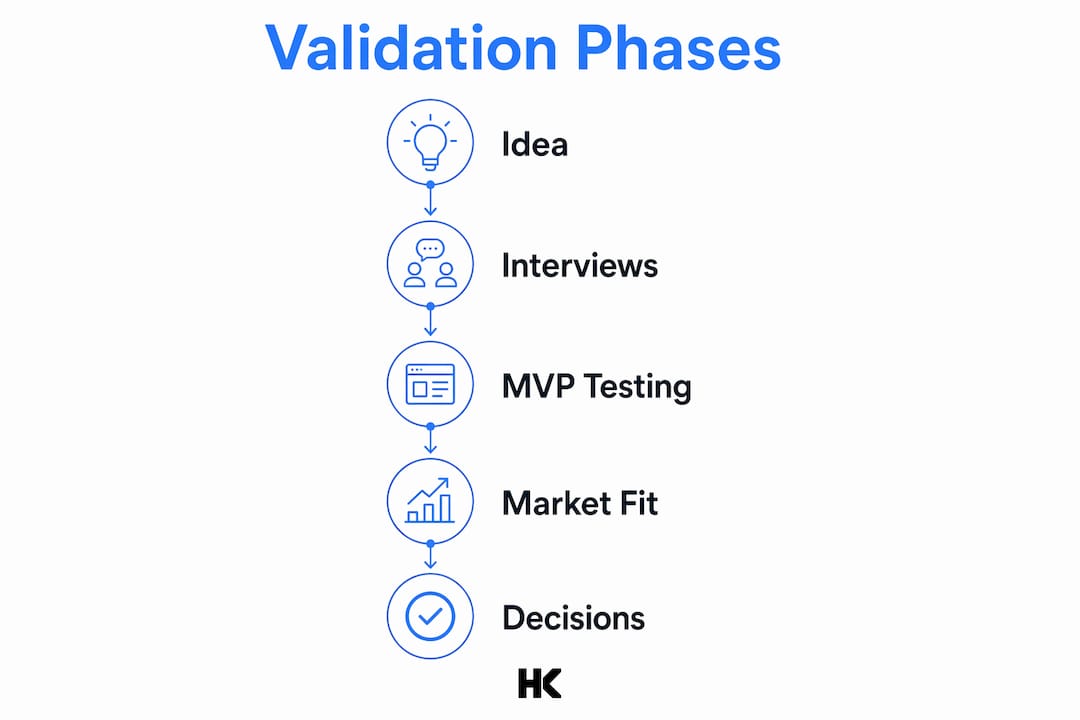
A well-designed startup validation workflow runs through six distinct phases, each with its own hypothesis, test, and explicit go/no-go threshold. Skipping phases or treating them as optional is how founders end up building products nobody wants.
The table below maps each phase to its primary question and the minimum signal required to advance.
| Phase | Core question | Go threshold |
|---|---|---|
| 1. Idea | Is there any initial interest? | >10% initial interest rate |
| 2. Problem | Is the problem urgent enough? | 60%+ of interviews rate it high urgency |
| 3. Solution | Will people pay for your solution? | 40%+ willing to pay |
| 4. PMF | Do users depend on the product? | 40%+ "very disappointed" if it disappeared |
| 5. Scale | Is the unit economics viable? | LTV/CAC ratio above 3 |
| 6. Expansion | Is retention strong enough to grow? | Net Revenue Retention above 100% |
Each threshold is a decision point, not a suggestion. If Phase 2 interviews show only 30% urgency, you do not advance to solution testing. You either reframe the problem or kill the idea. This discipline is what separates founders who validate in weeks from those who spend six months building something the market rejects.
The first three phases are the most critical for early-stage teams. They cost almost nothing to run. Phase 1 can be completed in roughly one hour using forum research, search trend analysis, and a simple landing page. Phases 2 through 5 typically take two to five days each when run with focus. A full SaaS validation cycle can be completed in two to four weeks if you commit to explicit kill criteria at every stage.
Pro Tip: Write your go/no-go thresholds before you start each phase. Founders who define success criteria after seeing results almost always interpret ambiguous data as confirmation. Pre-commitment removes that bias.
How to design and use MVPs effectively within the validation workflow
The MVP is the most misunderstood tool in the startup concept evaluation toolkit. Founders treat it as a stripped-down version of their full product. That framing is wrong and expensive. An MVP is the smallest experiment to test one specific hypothesis, with clear criteria for what counts as success or failure.

Eric Ries's Build-Measure-Learn loop makes this concrete. You build the minimum needed to generate a real behavioral signal, measure what users actually do (not what they say they would do), and learn whether your core assumption holds. The loop repeats until you have enough validated learning to justify the next investment.
Two MVP types work particularly well in early-stage B2B SaaS validation:
- Concierge MVP. You manually deliver the service that your software would eventually automate. Dropbox's early team did this. It proves willingness to pay and reveals workflow details no survey captures.
- Wizard of Oz MVP. The user sees a product interface, but a human operates the backend. This tests whether the experience solves the problem before you build the automation.
- Smoke test landing page. A single page describing the product with a signup or pre-order button. Behavioral signals like clicks on specific pricing tiers or feature descriptions are stronger proof than form submissions.
- Prototype walkthrough. A Figma or similar clickable prototype shown in user interviews. Tests solution comprehension and emotional response without writing a line of code.
The most common MVP mistake is building too much. Teams add features "just in case" and end up with a product that tests five assumptions at once. When it fails, they cannot identify which assumption was wrong. An MVP with unclear goals wastes resources and generates noise instead of signal.
Pro Tip: Before building anything, write one sentence: "We will know this MVP succeeded if [specific metric] reaches [specific number] within [specific timeframe]." If you cannot write that sentence, you are not ready to build.
Which tools and metrics validate market demand and product-market fit?
Demand validation requires multiple independent signals. A single data point, even a strong one, is not enough to justify building. The three-signal minimum is a practical standard: forum questions on Reddit or LinkedIn, search volume trends in Google Keyword Planner or Ahrefs, and direct competitor activity all count as independent signals.
Here is how the four primary validation tools compare:
| Tool | What it tests | Signal type | Reliability |
|---|---|---|---|
| Customer interviews | Problem urgency, willingness to pay | Qualitative | High when paired with decisions |
| Paid landing page test | Conversion intent | Behavioral | High |
| Search trend analysis | Passive demand | Behavioral | Medium |
| PMF survey (Sean Ellis) | Product dependency | Attitudinal | High when segmented |
Customer interviews are the starting point for problem validation. The goal is not to pitch your idea. The goal is to understand how urgent the problem is and whether the person has tried to solve it before. Founders who link interviews to decisions with explicit deadlines get actionable data. Founders who run open-ended discovery sessions get interesting stories that never force a decision.
Paid landing page tests are the most underused tool in early validation. You spend €50 to €200 on targeted ads driving traffic to a page that describes your product. The behavioral signals matter more than the conversion rate itself. Clicks on a specific use case, time spent on a pricing section, or queries about a particular feature tell you which problem framing resonates. Designing pages that are easy to reject produces cleaner signals than pages optimized to convert.
The Sean Ellis 40% test is the standard PMF measurement for products with active users. You ask: "How would you feel if you could no longer use this product?" The PMF score equals the percentage of respondents who answer "very disappointed." A score above 40% indicates strong product-market fit. Below 40% means you are still iterating. The critical nuance is segmentation. Aggregate scores can hide a high-fit subgroup. Analyzing results by segment often reveals that a specific user type is already at 60% while the broader base sits at 25%. That finding tells you exactly where to focus your positioning.
How to apply kill, pivot, and build decision rules
Kill criteria are not pessimism. They are the mechanism that prevents sunk-cost bias from turning a bad idea into a two-year project. Teams that define explicit kill criteria validate in weeks rather than months because they stop collecting data the moment the threshold is breached.
The decision framework is straightforward:
- Kill if Phase 1 through 3 thresholds fail. No initial interest, no urgency, and no willingness to pay means the market does not exist or you have the wrong framing. Stop now.
- Pivot if later-phase signals are mixed. Phase 4 or 5 failures often mean the right problem but the wrong solution, the wrong customer segment, or the wrong pricing model. Pivot the approach, not the entire idea.
- Build only when Phase 3 thresholds are met and Phase 4 testing begins. Building before this point is speculation dressed as execution.
Writing decision rules before testing is the practice that separates disciplined founders from optimistic ones. The rule format is simple: "If [metric] is below [threshold] after [sample size or timeframe], we kill or pivot." For example: "If fewer than 10% of landing page visitors click the pricing section after 200 visits, we kill this positioning." That rule is specific, measurable, and immune to post-hoc rationalization.
Mixed signals are the hardest case. You get 35% urgency in interviews but three people offer to pay immediately. The right move is to treat the quantitative threshold as the decision rule and investigate the three outliers as a potential niche segment. Do not average them into a false positive. Run a focused test on that segment before advancing.
What are common challenges in startup idea validation?
Confirmation bias is the most expensive problem in the business idea testing process. Founders who believe in their idea unconsciously ask leading questions, interpret weak signals as strong ones, and advance past failed thresholds because "the data felt promising." The fix is pre-commitment: write your hypotheses and success criteria before you collect a single data point.
Vanity metrics are the second major trap. Signups, page views, and social media likes feel like progress. They are not validation. Validated learning comes from real user behavior: someone paying, someone returning, someone completing a core workflow. If your metric does not connect to a specific assumption about your business model, it is not a validation metric.
MVP overbuilding is a direct consequence of unclear hypotheses. When founders cannot articulate the single riskiest assumption they are testing, they build features to cover every possible objection. The result is a product that takes three months to ship and tests nothing clearly.
Pro Tip: Run your PMF survey results through a segmentation filter before drawing conclusions. A 32% aggregate score that hides a 58% score among a specific job title or company size is a product-market fit signal, not a failure.
"Validation is about falsifying your riskiest assumptions, not generating consensus. Pre-commit your hypotheses and decision rules before you start, or you will find the evidence you are looking for regardless of what the data actually says."
Ineffective customer feedback usually comes from asking the wrong questions. "Would you use this?" is not a validation question. "Tell me about the last time you tried to solve this problem" is. Behavioral and historical questions reveal real pain. Hypothetical questions reveal what people think you want to hear.
Key takeaways
A startup idea validation workflow works because it forces explicit decisions at each phase, replacing hope-driven development with evidence-based go/no-go criteria.
| Point | Details |
|---|---|
| Six-phase structure | Each phase has a specific threshold; failing one means kill or pivot, not advance. |
| MVP as experiment | Build only what tests one riskiest assumption with clear falsification criteria defined upfront. |
| Sean Ellis 40% test | Score above 40% "very disappointed" signals PMF; always segment results by user type. |
| Kill criteria prevent waste | Pre-defined thresholds stop sunk-cost bias and compress validation from months to weeks. |
| Multiple demand signals | Use at least three independent signals before concluding demand exists. |
Why most founders validate too late (and what I do differently)
I have worked with founders across DACH and the EU, and the pattern is consistent. By the time they reach out about an MVP build, they have already spent two to four months on product decisions based on five customer interviews and a lot of enthusiasm. The validation work that should have happened in weeks one through three gets compressed into a retrospective justification for choices already made.
The founders who move fastest are the ones who treat Phase 1 and Phase 2 as non-negotiable gates. They write their kill criteria on day one. They run a paid landing page test before they open a code editor. They use the €1,500 strategy sprint format I offer at Hanadkubat to scope and validate before committing to a full build. That sprint pays for itself the first time it kills an idea that would have cost €18,000 and three months to build.
The other thing I have noticed: founders underestimate how much the Sean Ellis test improves when you segment it. An aggregate score of 34% looks like a near-miss. The same data segmented by company size often shows that mid-market SaaS teams score 55% while SMBs score 18%. That is not a near-miss. That is a positioning decision waiting to be made.
Speed and rigor are not opposites in validation. A well-structured workflow with explicit thresholds is faster than an open-ended discovery process precisely because it forces decisions. The goal is not to collect more data. The goal is to reach a defensible decision with the minimum data required.
— Hanad
Validate before you build with Hanadkubat
If you are at the stage where you have an idea but are not sure whether to build, the right move is a structured validation sprint before committing to development.
Hanadkubat offers a fixed-price strategy sprint at €1,500 that scopes and validates your SaaS idea before a single line of code is written. The sprint covers problem validation, solution framing, go/no-go thresholds, and a clear recommendation on whether to build, pivot, or stop. For founders ready to move into development, the SaaS MVP build track runs from €18,000 with a 4 to 12 week delivery window. You work directly with Hanad, not a project manager or junior team. Full validation resources and documentation are available at hanadkubat.com.
FAQ
What is a startup idea validation workflow?
A startup idea validation workflow is a structured, phase-based process that tests specific business assumptions before committing to full product development. It uses explicit go/no-go thresholds at each phase to force kill, pivot, or build decisions based on evidence.
How long does startup idea validation take?
A focused SaaS validation process takes two to four weeks when run with explicit kill criteria and a clear phase structure. Phase 1 can be completed in roughly one hour; Phases 2 through 5 typically take two to five days each.
What is the Sean Ellis 40% test?
The Sean Ellis test measures product-market fit by asking active users how they would feel if the product disappeared. A score of 40% or more "very disappointed" responses indicates strong PMF. Segment results by user type to avoid misleading aggregate scores.
When should you kill a startup idea?
Kill an idea when Phase 1 through 3 thresholds fail: no initial interest above 10%, urgency below 60% in interviews, or willingness to pay below 40%. Pre-defined kill criteria prevent sunk-cost bias from extending a failed validation cycle.
What is the difference between an MVP and a prototype?
An MVP is the smallest experiment that tests one specific business assumption with real users under real conditions. A prototype tests comprehension and usability, typically in a controlled interview setting, without requiring actual user commitment or payment.