
The phrase "you can be anything you want to be" is one of the most repeated lines in children's media, motivational speeches, and pop songs — a shorthand for human potential and agency. The honest caveat: it glosses over structural barriers, unequal access to resources, and the years of deliberate skill-building that most meaningful goals actually require.
Key Takeaways
The phrase "you can be anything you want to be" is a genuine motivational tool when paired with concrete skill-building steps, but it misleads when treated as a standalone promise.
| Point | Details |
|---|---|
| The phrase is half-right | It correctly signals that starting points aren't permanent ceilings, but omits the effort and structural realities involved. |
| Passions are built, not found | Research from sources like Scientific American and 80,000 Hours shows that interests develop through practice, not discovery. Hours both show that interests develop through practice, not discovery. |
| Better phrasing exists | "What do you keep coming back to, even when it's hard?" is more durable than an open-ended promise. |
| Primary sources matter | Verify song credits on Spotify and book details on publisher pages before citing. |
| Pair aspiration with steps | A short checklist (curiosity, small skill, experiment, honest review) converts the phrase into something usable. |
Table of Contents
- Where does "you can be anything you want to be" come from?
- How people commonly interpret this phrase
- Why critics call the phrase misleading
- Cultural examples: children's books, classrooms, and music
- What to say instead: research-backed alternatives
- Where to listen, read, and learn more
- How does hearing this phrase affect motivation and self-esteem?
- An engineer's perspective on aspiration and craft
- Sources
- FAQ
Where does "you can be anything you want to be" come from?
The phrase shows up across decades of songs, picture books, and classroom materials. No single author coined it, but several creators have built notable works around it.
| Item | Artist / Author | Year / Context | Where to Find |
|---|---|---|---|
| You Can Be Anything You Want to Be! (song) | Karen Sokolof Javitch | Available on streaming | Spotify |
| You Can Be Anything You Want to Be (score/instrumental) | Heitor Pereira | Alternate recording | Spotify |
| Anything You Want to Be (pop song) | Simon Curtis | Pop lyrics usage | Genius |
| I Can Be Anything! (picture book) | Jerry Spinelli | Children's picture book | Hachette Book Group |
| I Can Be Anything! Don't Tell Me I Can't | Scholastic Canada | Children's book | Scholastic Canada |
| I Can Be Anything (classroom song) | Scholastic PreK | Early-education song | Scholastic PreK |
Pro Tip: Before citing a song's lyrics or crediting an artist, check the streaming metadata directly on Spotify or the publisher's own page. Lyric aggregator sites sometimes misattribute tracks, especially for children's music where multiple recordings share nearly identical titles.
How people commonly interpret this phrase
The phrase lands differently depending on who's saying it and to whom.
- Childhood encouragement: Parents and teachers use it to counter early self-doubt, especially when a child says "I can't do math" or "I'm not a good writer."
- Motivational speeches: Commencement addresses and TED-style talks deploy it as a rallying call for agency and ambition.
- Song refrains: Artists use it as a lyric hook because it's emotionally resonant and universally relatable.
- Career-advice slogans: Coaches and mentors repeat it to push people past fear of career change.
The phrase connects naturally to Carol Dweck's growth-mindset framework, which distinguishes between a fixed mindset (talent is innate and unchangeable) and a growth mindset (abilities develop through effort and learning). Read charitably, "you can be anything" is a growth-mindset statement: it says your current position isn't your permanent ceiling.
The distinction matters in practice. When the phrase functions as encouragement, it opens doors. When it functions as a promise, it sets up disappointment. When it comes with practical steps, it actually helps.
Scientific American's research summary makes this concrete: passions are developed through repeated engagement and a growth mindset, not discovered pre-formed. That reframes the phrase from a statement about destiny into a statement about process.
Why critics call the phrase misleading
The critique isn't that aspiration is bad. It's that the phrase, as usually delivered, skips several hard truths.
Unrealistic expectations. Telling a child they can be anything sets no floor on what counts as realistic effort or preparation. A kid who hears "you can be an astronaut" and then doesn't get into a competitive STEM program at 17 can feel like a personal failure rather than a statistical reality.
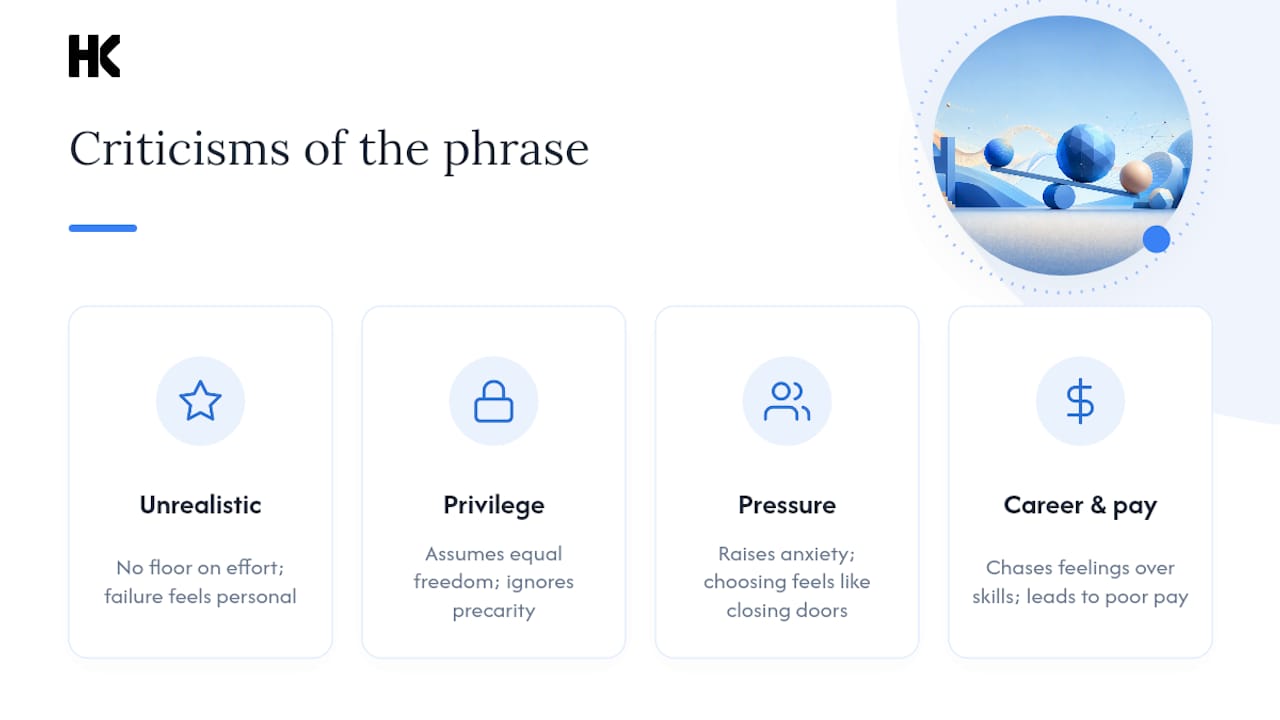
Privilege blind spots. Leadership coach Amina AlTai, writing via CNBC, argues that centering passion assumes everyone has the same freedom to choose. For people managing financial precarity, caregiving responsibilities, or discrimination, "follow your passion" can be advice that only the privileged can afford to take.
Pressure on children. Constant messaging that you can be anything can paradoxically increase anxiety. When every door is theoretically open, choosing one feels like closing all the others.
Bad financial and career choices. Harvard Business Review and 80,000 Hours both document how "follow your passion" advice leads people to chase elusive feelings rather than build durable skills. The result is often career paralysis or accepting poor pay because the work feels meaningful.
Pro Tip: A simple reframe for parents and mentors: replace "you can be anything" with "let's figure out what you're curious about and build from there." It keeps the door open without overpromising.
Cultural examples: children's books, classrooms, and music
Jerry Spinelli's picture book I Can Be Anything! uses playful rhymes and illustrations to throw open a child's sense of possibility. Spinelli, a Newbery Medal winner, brings enough literary credibility that the book reads as genuine exuberance rather than empty cheerleading.
The Scholastic title I Can Be Anything! Don't Tell Me I Can't takes a more grounded approach. Publisher notes emphasize that confidence messaging works best when paired with concrete learning steps, including the acknowledgment that "first I have to learn to read." That's a meaningful distinction from pure aspiration.
Scholastic's PreK classroom song I Can Be Anything gives teachers a singable, age-appropriate vehicle for the idea, with role examples children can picture. The classroom context matters: a song sung with a teacher present can prompt conversation in a way a poster on a wall cannot.
On the music side, Karen Sokolof Javitch's recorded track is the most directly titled version available on streaming. Simon Curtis's pop song Anything You Want to Be, with full lyrics on Genius, shows how the phrase migrates into adult pop contexts with a different emotional register.
What to say instead: research-backed alternatives
The goal isn't to kill aspiration. It's to pair it with something actionable.
Alternative phrasings grounded in research:
- "You can get really good at many things if you keep practicing." (Reflects Scientific American's finding that passion is cultivated, not found.)
- "Let's try a two-step plan: first learn X, then see if you still love it." (Matches SNExplores' mini-goal research on breaking big ambitions into measurable steps.)
- "What do you keep coming back to, even when it's hard?" (Echoes HBR's advice to follow durable interests rather than a single elusive passion.)
- "Skills and connections open doors. Let's build both." (Grounded in INSEAD's finding that career satisfaction comes from accumulating competence and networks over time.)
Checklist for mentors and parents:
- Ask what the child or mentee is already curious about, not what they want to be.
- Identify one small, concrete skill they can practice in the next two weeks.
- Run a short experiment: try the activity, then evaluate honestly.
- Acknowledge structural realities without crushing ambition ("this field is competitive; here's what people who succeed in it actually do").
- Revisit and adjust the goal as skills and interests develop, rather than treating the original aspiration as fixed.
For readers thinking about skill accumulation in technical careers, the same logic applies: competence compounds, and curiosity directed at a specific craft tends to outlast any initial burst of passion.
Where to listen, read, and learn more
- Spotify: Search the track title directly or use the Karen Sokolof Javitch link to verify artist metadata before citing.
- Publisher pages: Hachette and Scholastic Canada both list edition details, ISBNs, and author credits. Use these over third-party retail pages when accuracy matters.
- Lyric sites: Genius is useful for pop-music lyrics but always cross-check against the streaming metadata for artist attribution.
- Research articles: Research articles from Scientific American, Harvard Business Review, and 80,000 Hours all publish freely accessible pieces on the "follow your passion" debate. Hours all publish freely accessible pieces on the "follow your passion" debate.
- Library catalogs: WorldCat or your local library system can confirm edition details for children's books and surface related titles.
For further reading on career construction and technical skill-building, Hanadkubat covers practical approaches to building expertise in engineering and product development.
How does hearing this phrase affect motivation and self-esteem?
The psychological picture is mixed, and the outcome depends heavily on how the message is delivered and who receives it.
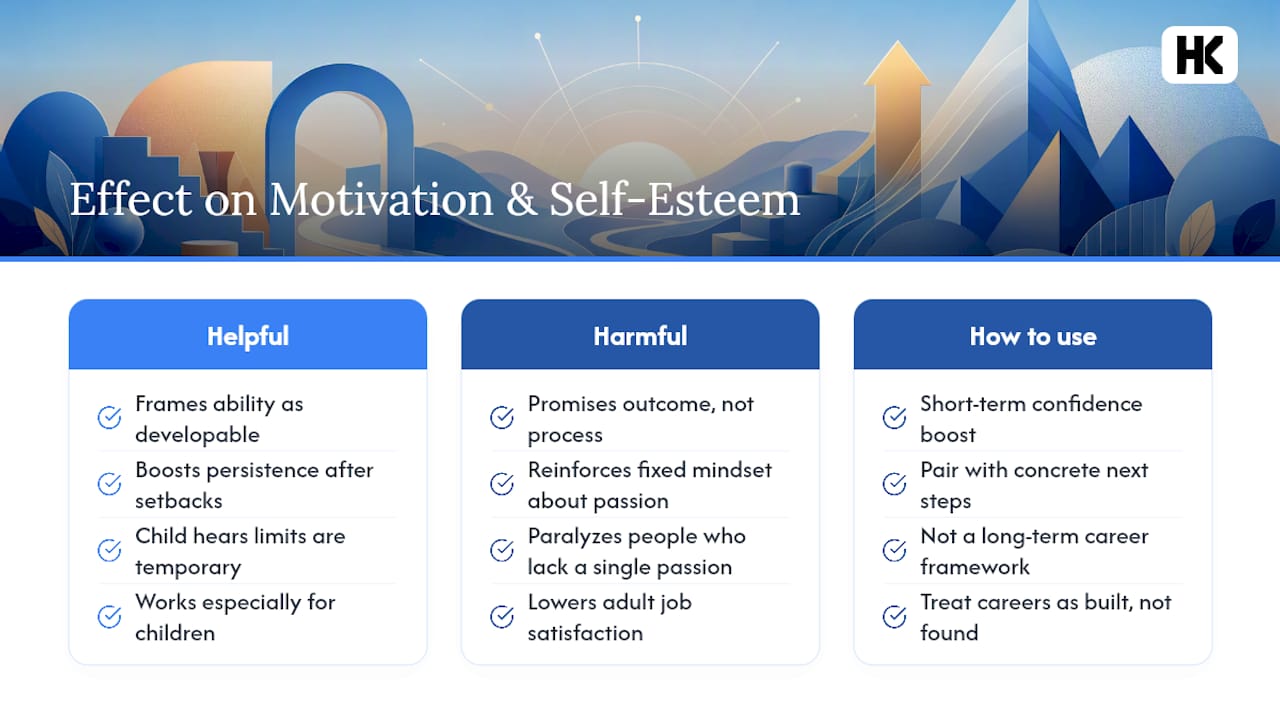
Research on growth mindset, most associated with Carol Dweck's work at Stanford, shows that framing ability as developable rather than fixed tends to increase persistence after setbacks. In that sense, "you can be anything" carries a real motivational benefit when a child hears it as "your current limitations aren't permanent."
The problem emerges when the phrase functions as a promise rather than a process. 80,000 Hours' career research documents a pattern where people who believe they have a single pre-existing passion feel paralyzed when they can't identify it, or feel like failures when a chosen path turns out to be hard. The phrase can inadvertently reinforce a fixed-mindset belief about passion itself: that you either have the right one or you don't.
For adults, INSEAD's research points to a related effect: people who expect to find a dream job often experience lower satisfaction in real jobs because the gap between expectation and reality feels like personal failure rather than normal career development. Career satisfaction, the research suggests, is more often built than found.
The practical implication: the phrase works best as a short-term confidence boost, not a long-term career framework. Pair it with concrete next steps and it can genuinely help. Leave it standing alone as a life philosophy and it tends to disappoint.
An engineer's perspective on aspiration and craft
The phrase has always struck me as half-right. The half that's right: your starting point doesn't determine your ceiling. The half that's wrong: wanting something is not a plan.
When I was early in my engineering career, the most useful thing anyone told me wasn't "you can be anything." It was: "Pick one thing you want to get genuinely good at, do it until it's uncomfortable, then do it again." That's a less poetic sentence. It's also the one that actually worked.
A model sentence worth copying: "You have real potential here. Let's pick one specific skill to build this month and see what opens up from there." It keeps the encouragement intact while giving the person something to act on before the next conversation.
The discipline to build skills incrementally, rather than wait for passion to arrive fully formed, is what separates people who achieve their goals from people who spend years searching for the right one. That's not pessimism. It's just how craft works.
Sources
- Stop Trying to 'Find' Your Passion—There's a Better Way to Love What You Do | Scientific American
- Don’t follow your passion — 80,000 Hours
- Your dream job may not exist, and that’s okay | INSEAD Knowledge
- Big goals can feel overwhelming. Here’s how to stay on track
- What you should follow instead of your passion | Harvard Business Review
- ‘Follow your passion’ is bad advice, says leadership coach—here’s why — CNBC
- I Can Be Anything! — Jerry Spinelli | Hachette Book Group
- I Can Be Anything! Don't Tell Me I Can't — Scholastic Canada
- You Can Be Anything You Want to Be! - song and lyrics by ... — Spotify
FAQ
Who sang "You Can Be Anything You Want to Be"?
The track titled You Can Be Anything You Want to Be! on Spotify is credited to Karen Sokolof Javitch. Verify the exact artist credit directly on the Spotify track page, since multiple recordings share similar titles.
What does "you can be anything you want to be" actually mean?
It's an empowerment phrase signaling that your current position isn't your permanent ceiling. Research from Scientific American supports reading it as a growth-mindset statement, meaning ability develops through effort, not as a literal promise that any goal is equally achievable.
Why do critics say the phrase is harmful?
Critics, including leadership coach Amina AlTai via CNBC, argue it ignores structural barriers, assumes equal access to opportunity, and can pressure children into feeling like failures when reality doesn't match the promise.
What should I say instead to encourage someone?
Try "What do you keep coming back to, even when it's hard?" or "Let's pick one skill to build this month." Both phrasings are grounded in HBR and SNExplores research on durable interests and mini-goal setting.
Where can I find the full lyrics or read the children's books?
For song lyrics, check Spotify for artist metadata and Genius for full text. For Jerry Spinelli's I Can Be Anything!, the Hachette Book Group page lists edition details; for the Scholastic title, the Scholastic Canada page has publisher information and ordering details.