
TL;DR:
- SaaS is a cloud-based subscription model where providers manage infrastructure and updates, not the users. The business thrives on continuous development, customer retention, and strategic decisions like application versus platform focus. Early technical and architecture choices determine scalability and growth potential, making ongoing lifecycle management essential.
Software as a service (SaaS) is a cloud-based delivery model where users access applications over the internet via subscription instead of purchasing and installing software on their own devices. The provider manages all infrastructure, maintenance, and updates. Users get the software without owning it. The global SaaS market was valued at approximately $273.5 billion in 2023 and is projected to reach over $1 trillion by 2032. That growth reflects how deeply this model has displaced traditional software across industries. Products like Salesforce, Microsoft 365, and Slack are SaaS at its most recognizable: no installation, no version management, just a login and a subscription.
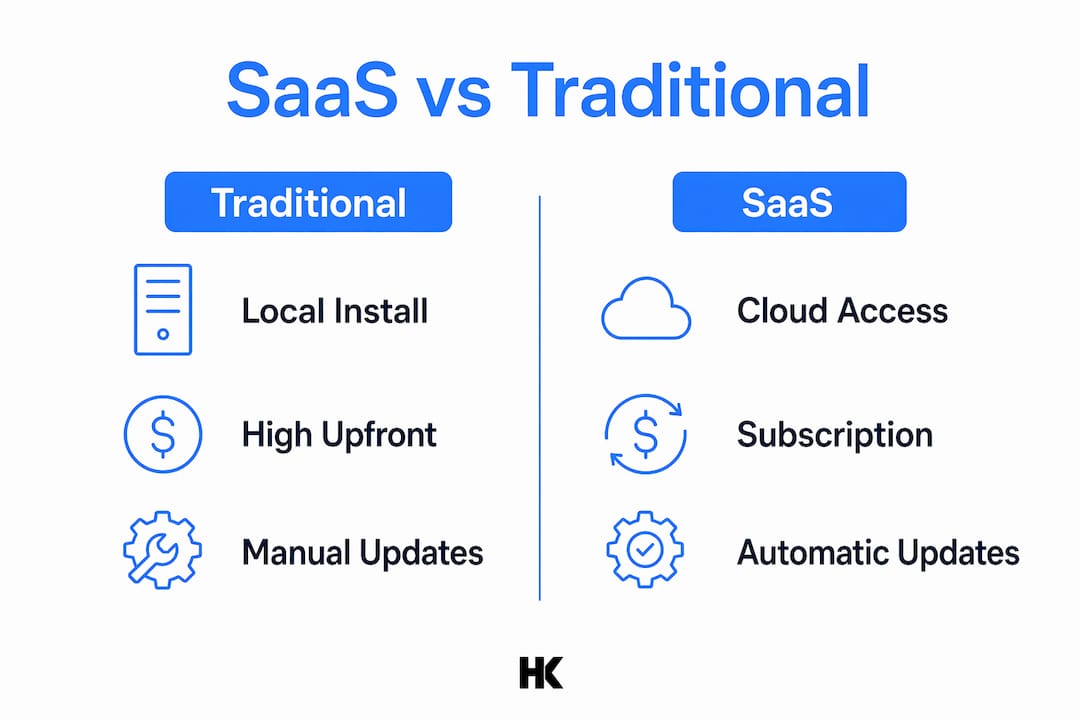
What is SaaS and how does it differ from traditional software?
SaaS separates software ownership from usage, shifting infrastructure complexity away from the customer and onto the provider. This is the defining structural difference from on-premise software, where the buyer purchases a perpetual license, installs the product locally, and manages updates, backups, and hardware themselves.

The practical impact is significant. A company running SAP on-premise needs dedicated servers, a database administrator, and a patching schedule. A company using a SaaS equivalent logs in through a browser and gets the latest version automatically. The IT overhead disappears from the customer's side.
Multi-tenant architecture is what makes this economically viable for providers. One shared infrastructure instance serves many customers simultaneously, with logical separation between their data. This lets providers spread infrastructure costs across their entire customer base rather than provisioning dedicated environments per client.
| Dimension | Traditional software | SaaS |
|---|---|---|
| Delivery | Local installation | Browser or API access |
| Licensing | Perpetual purchase | Monthly or annual subscription |
| Updates | Manual, scheduled | Automatic, continuous |
| Infrastructure | Customer-managed | Provider-managed |
| Scaling | Hardware procurement | On-demand resource adjustment |
The cost structure shifts too. Traditional software has high upfront costs and lower ongoing fees. SaaS flips this: lower entry cost, predictable recurring fees, and no capital expenditure on hardware. For early-stage companies and DACH Mittelstand teams evaluating software, this distinction directly affects budget planning and vendor lock-in risk.
How does the SaaS product lifecycle work?
The SaaS product lifecycle is a continuous loop, not a linear path with a defined endpoint. Successful SaaS requires ongoing development cycles rather than one-time releases, supporting feature updates without downtime and adapting to user behavior over time. This is the sharpest contrast with traditional software, where a version ships and the cycle resets.
The lifecycle moves through these stages:
- Ideation and validation. The product idea is scoped, tested against real user problems, and validated before a line of code is written. Skipping this stage is the most common reason SaaS products fail before reaching market.
- Development. Engineering builds the core product, typically in sprints. Architecture decisions made here, such as database design and multi-tenancy approach, carry forward for years.
- Launch. The product reaches its first paying customers. Feedback volume spikes. The team prioritizes what to fix versus what to build next.
- Growth. Acquisition accelerates. The product must handle increased load, and the team must handle increased support and feature requests simultaneously.
- Maturity. Growth stabilizes. Retention becomes the primary metric. The product competes on depth and reliability rather than novelty.
- Renewal and expansion. Providers introduce new tiers, add-ons, or adjacent features to grow revenue from existing customers.
- Offboarding. Effective SaaS lifecycle management includes procurement, onboarding, monitoring, renewal, and offboarding to protect data security and control costs. Gaps in offboarding create data leaks and unmanaged resource spend.
SaaS success depends on customer retention through continuous value delivery, not just acquisition. A product that stops improving loses subscribers to competitors within a single billing cycle.
Pro Tip: Map your offboarding process before you launch. Most SaaS teams build it last, but poor offboarding is where GDPR violations and data security incidents actually happen.
What are the main SaaS business models and revenue strategies?
SaaS pricing is not one-size-fits-all. SaaS pricing models include subscription, freemium, and usage-based fees, and each approach shapes customer acquisition and retention differently.
- Subscription (monthly or annual). The most common model. Customers pay a flat fee per seat or per tier. Annual plans improve cash flow and reduce churn. Monthly plans lower the barrier to entry but increase cancellation risk.
- Freemium. A free tier with limited features converts users into paying customers over time. Slack and Notion built their user bases this way. The risk is that free users consume support resources without generating revenue.
- Usage-based pricing. Customers pay for what they consume, such as API calls, storage, or active users. This model aligns cost with value but makes revenue harder to forecast.
One distinction that matters strategically: SaaS applications typically perform single functions, whereas SaaS platforms provide an ecosystem that developers can extend. Platforms create higher switching costs and open additional revenue streams through marketplace fees or developer partnerships. An application competes on its core feature set. A platform competes on its ecosystem.
Customer engagement requires continuous value delivery and proactive support to prevent churn. Disengaged users switch providers easily because the subscription model makes exit low-cost and low-friction.
Pro Tip: If you are building a SaaS product, decide early whether you are building an application or a platform. The architecture, pricing, and go-to-market strategy are fundamentally different. Trying to be both at launch usually means doing neither well.
For a closer look at why B2B teams choose SaaS over custom-built alternatives, the considerations go beyond pricing to include compliance, integration depth, and vendor stability.
How does SaaS application development work?
SaaS application development sits on top of cloud infrastructure. SaaS typically uses Infrastructure as a Service (IaaS) or Platform as a Service (PaaS) to host applications and scale resources on demand. Providers like AWS, Google Cloud, and Microsoft Azure supply the compute, storage, and networking. The SaaS team builds the product layer on top.
The technical decisions made during early development determine how well the product handles growth. Early technical decisions matter for SaaS growth in ways that are expensive to reverse later. A poorly designed database schema or a monolithic architecture that was fast to build can become a bottleneck at 10,000 users that costs months to refactor.
Key technical areas that shape SaaS product outcomes:
- Multi-tenant data architecture. How customer data is isolated and stored affects both security and query performance at scale.
- Continuous deployment pipelines. SaaS products ship updates frequently. A CI/CD pipeline that runs automated tests and deploys without downtime is not optional at any serious scale.
- Responsive UI/UX design. UI/UX in SaaS must support both desktop and mobile platforms with cloud-optimized interfaces. A product that breaks on mobile loses a significant portion of its potential users.
- Observability and monitoring. Logging, error tracking, and performance monitoring need to be in place before launch, not added after the first incident.
| Technical decision | Low-quality approach | High-quality approach |
|---|---|---|
| Data isolation | Shared tables with tenant ID column | Schema-per-tenant or database-per-tenant |
| Deployment | Manual FTP or SSH | Automated CI/CD with rollback |
| Scaling | Fixed server capacity | Auto-scaling cloud resources |
| Monitoring | None until users complain | Proactive alerting and dashboards |
The role of a SaaS architect is to make these decisions coherently at the start, not patch them under pressure later. For non-technical founders, this is exactly where a fixed-scope engagement with an experienced engineer pays for itself many times over.
Key Takeaways
SaaS is a subscription-based software model where the provider manages all infrastructure, and customer retention through continuous product improvement is the primary driver of long-term revenue.
| Point | Details |
|---|---|
| SaaS meaning | Software delivered over the internet via subscription, with the provider managing all infrastructure and updates. |
| Lifecycle is continuous | SaaS products never reach a final version. Iteration, monitoring, and offboarding are permanent responsibilities. |
| Pricing model shapes strategy | Subscription, freemium, and usage-based models each carry different acquisition and churn dynamics. |
| Application vs. platform | Applications compete on features. Platforms compete on ecosystems. The distinction drives architecture and revenue potential. |
| Early architecture decisions | Multi-tenancy, deployment pipelines, and monitoring choices made at launch determine how much refactoring growth will require. |
What I have learned building SaaS products end-to-end
Most articles about SaaS stop at the definition. The part that actually matters is what happens after you ship.
The biggest mindset shift for teams coming from traditional software is accepting that the product is never done. At BMW and Deutsche Bahn, I worked on systems where a release was a milestone. In SaaS, a release is a Tuesday. The cadence is relentless, and teams that treat each deployment as a major event burn out or slow down to the point where competitors overtake them.
The lifecycle management piece is genuinely underestimated. I have seen DACH companies with dozens of SaaS subscriptions where nobody owns the offboarding process. Former employees still have active accounts. Data sits in tools that the company stopped using two years ago. This is not just a cost problem. Under GDPR, it is a compliance liability.
The other thing I would push back on is the idea that freemium is a safe starting point. It works for products with viral mechanics and low support costs per user. For B2B SaaS targeting Mittelstand companies or enterprise teams, free tiers often attract the wrong users and create support overhead that slows down the team without generating revenue. Charge from day one, even if the price is low.
If you are a non-technical founder trying to understand what you are actually building, the application versus platform distinction is the most important strategic question you can answer before writing a single line of code. The answer changes your architecture, your pricing, your hiring, and your go-to-market approach entirely.
— Hanad
SaaS development and strategy with Hanadkubat
Building a SaaS product from scratch or adding production-ready AI features to an existing one requires more than a good idea. It requires architecture decisions that hold up at scale, a lifecycle process that does not collapse under growth, and pricing that matches the actual value you deliver.
Hanadkubat works with non-technical founders, B2B SaaS teams, and DACH Mittelstand companies on exactly these problems. Fixed prices, clear timelines, and direct engineering work from the person writing the code. SaaS MVP builds start from €18,000 and ship in 4–12 weeks. AI integration sprints ship production features in 14 days at €4,500. Full details and pricing are at hanadkubat.com.
FAQ
What does SaaS mean?
SaaS stands for Software as a Service. It is a delivery model where software is hosted by a provider and accessed by users over the internet via a subscription, with no local installation required.
How is SaaS different from traditional software?
Traditional software requires a one-time purchase, local installation, and manual updates managed by the customer. SaaS is subscription-based, automatically updated, and fully managed by the provider.
What is the SaaS lifecycle?
The SaaS lifecycle covers ideation, development, launch, growth, maturity, renewal, and offboarding. Unlike traditional software, it is a continuous loop with no fixed endpoint, requiring ongoing iteration and active lifecycle management.
What is SaaS application development?
SaaS application development is the process of building cloud-hosted software products using IaaS or PaaS infrastructure, multi-tenant architecture, and continuous deployment pipelines to serve multiple customers from a single codebase.
Is SaaS right for my business?
SaaS fits businesses that want predictable costs, automatic updates, and no infrastructure overhead. It is the standard delivery model for B2B software in 2026, though the right pricing model and application versus platform decision depend on your specific use case.