
TL;DR:
- Product-market fit indicates a good match between a product and its specific market, measured by multiple signals. Founders must continuously track key metrics like NRR, user sentiment, and retention to prevent erosion and sustain success over time.
Product-market fit is defined as being in a good market with a product that satisfies that market, a definition first articulated by Marc Andreessen. For B2B SaaS founders, this means your customers keep paying, expand their usage, and would be genuinely disappointed if your product disappeared. The Sean Ellis test sets the standard diagnostic threshold at 40% of active users saying they would be "very disappointed" without your product. Reaching that threshold is not a finish line. It is the beginning of a more demanding phase: keeping it.
What is product-market fit and how do you measure it?
Product-market fit is not a single number. It is a cluster of indicators that together confirm your product solves a real problem for a specific, paying segment. Relying on one metric alone gives you a false sense of security.

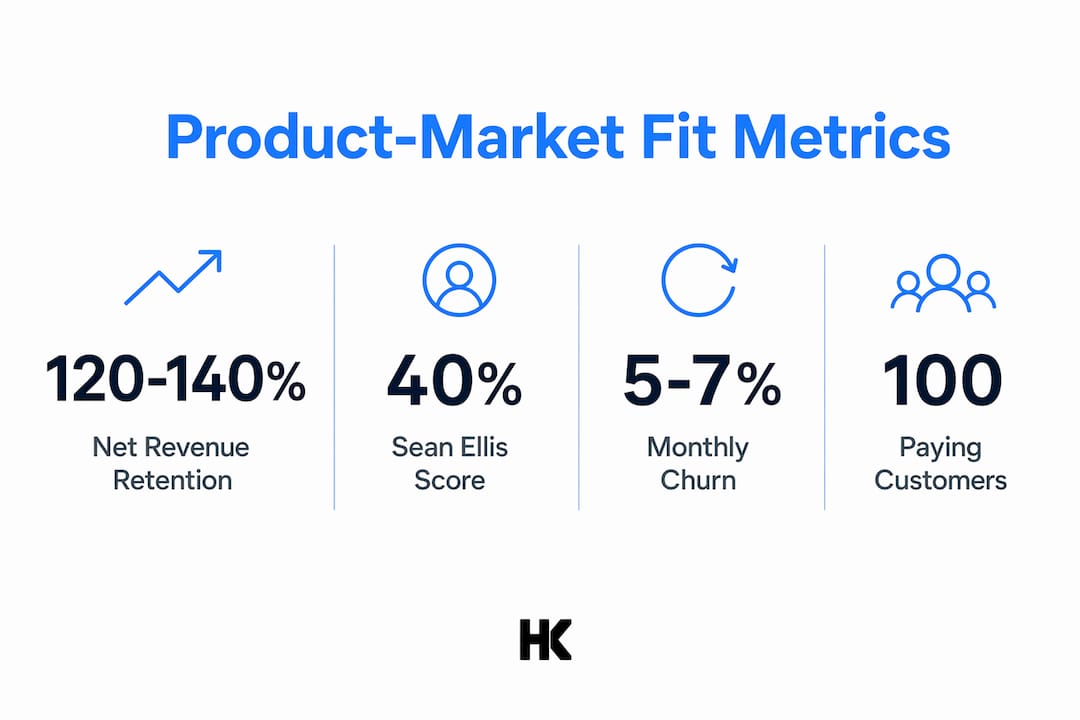
The most reliable measurement framework for B2B SaaS combines four signals:
Net Revenue Retention (NRR) measures whether existing customers spend more over time. NRR between 120% and 140% is best-in-class. NRR below 90% signals weak fit regardless of what users say in surveys.
The Sean Ellis survey asks active users one question: how would you feel if you could no longer use this product? Only survey users who have engaged recently. Averaging results from inactive users inflates the score and produces misleading data.
Retention curve shape tells you whether users stay. A curve that flattens instead of declining toward zero is a signal of sustained engagement and genuine fit. A curve that keeps falling means users try and leave.
Customer count and churn rate give you a revenue reality check. The benchmark is 100 paying customers at fair-market value with a churn rate of 5%–7%.
| Metric | Threshold | Interpretation |
|---|---|---|
| Sean Ellis survey | 40% "very disappointed" | Core fit signal from active users only |
| Net Revenue Retention | 120%–140% best-in-class | Expansion revenue confirms deep fit |
| NRR warning zone | Below 90% | Weak fit despite positive sentiment |
| Monthly churn rate | 5%–7% | Healthy retention for early-stage B2B SaaS |
| Paying customer count | 100 at fair-market value | Validates willingness to pay at scale |
Pro Tip: Run your Sean Ellis survey only on users who logged in within the past two weeks. Polling dormant accounts pulls your score down and tells you nothing about actual fit.
Common misconceptions about product-market fit
The most dangerous misconception is treating product-market fit as a binary milestone. Founders hit the 40% threshold, declare victory, and stop measuring. That is how companies lose fit without noticing.
Product-market fit is a dynamic, transient state that shifts as competition intensifies, customer expectations rise, and markets mature. A fit you earned in 2023 may be eroding right now.
Several specific misunderstandings trip up B2B SaaS founders:
- Confusing engagement fit with revenue fit. High daily active usage does not mean customers will pay, expand, or renew. Engagement fit and revenue fit are distinct dimensions that may not coexist.
- Mistaking early traction for fit. Early viral enthusiasm differs from product-market fit. Retention and sustainable usage are what confirm fit, not launch-week signups.
- Surveying the wrong users. Averaging results from a broad user base, including people who signed up once and never returned, produces a score that means nothing.
- Targeting too broadly. Founders who try to fit everyone fit no one. A narrow, well-defined segment produces the depth of alignment that shows up in NRR and retention curves.
Pro Tip: If your Sean Ellis score is below 40%, do not immediately assume the product is wrong. First check whether you are surveying the right users and targeting the right segment.
How to achieve product-market fit in B2B SaaS
Achieving fit is a process of narrowing, testing, and adjusting. The founders who reach it fastest are the ones who resist the urge to build broadly before they have confirmed a specific pain point.
- Define a narrow customer profile. Targeting a narrow niche produces deep alignment and avoids diluting your product positioning. Pick one job title, one industry, one company size. Expand later.
- Identify a pain point customers actively want to fix. Not a problem they acknowledge in theory. A problem they are already spending time or money to solve imperfectly. That gap is where fit lives.
- Validate with paying customers, not free users. Free signups tell you about curiosity. Paying customers at fair-market value tell you about real demand. Aim for the 100-customer benchmark before drawing conclusions.
- Run retention tracking from day one. Set up cohort analysis before you have enough users to make it statistically meaningful. The habit of tracking matters as much as the data.
- Pivot messaging before pivoting product. Founders should adjust their sales pitch and messaging before assuming the product itself is the problem. Many fit failures are positioning failures.
- Build tight customer feedback loops. Monthly calls with your top ten customers reveal more than any dashboard. Ask what they would cut first if they had to reduce their SaaS spend. Your product should not be the answer.
- Track NRR monthly. If expansion revenue is not growing, fit is not deepening. NRR is the single most honest financial signal you have.
The MVP validation checklist approach works well here: validate assumptions in the smallest testable increment before committing engineering resources to a full build.
How do you maintain product-market fit over time?
Fit erodes. Competition and shifting customer needs can erode product-market fit within 1–3 years. The B2B SaaS companies that sustain fit treat measurement as an ongoing operational function, not a one-time exercise.
The signals that fit is weakening include:
- Rising involuntary churn, where customers fail to renew due to budget cuts rather than dissatisfaction, which often masks a deeper value problem
- NRR dropping below 100%, meaning existing customers are contracting or churning faster than they expand
- Declining Sean Ellis scores across successive survey cohorts
- Customers citing your product as "nice to have" rather than "critical" in renewal conversations
Sustaining fit requires three ongoing commitments. First, continuous innovation and pricing adaptation keep your product aligned with what customers need now, not what they needed at signing. Second, customer intimacy at the account level, meaning regular direct contact with decision-makers, surfaces problems before they become churn. Third, competitive monitoring tells you when a new entrant is solving your customers' problems better or cheaper.
Mature B2B SaaS firms that sustain best-in-class NRR above 120% share one practice: they treat their top 20% of customers as a product advisory board. Those customers define the roadmap. The product follows the market, not the other way around.
For founders building toward this stage, the features of successful startups framework covers the organizational habits that make continuous fit management possible.
Key Takeaways
Product-market fit requires a combination of strong NRR, a 40% Sean Ellis score from active users, low churn, and a retention curve that flattens rather than falls.
| Point | Details |
|---|---|
| Use multiple metrics | No single number confirms fit; combine NRR, Sean Ellis, churn, and retention curves. |
| NRR is the revenue truth | NRR below 90% signals weak fit even when user sentiment looks positive. |
| Fit is not permanent | Market shifts can erode product-market fit within 1–3 years without ongoing measurement. |
| Narrow your segment first | Targeting a specific niche produces deeper alignment and faster validation. |
| Pivot messaging before product | Many fit failures are positioning problems, not product problems. |
What I have learned building B2B SaaS products end to end
Product-market fit is a relationship, not a certificate. The founders I see struggle most are the ones who treat it as a box to check before fundraising. They hit 40% on the Sean Ellis survey, raise a round, and stop asking hard questions. Six months later, NRR is sliding and they cannot explain why.
The uncomfortable truth is that engagement without revenue fit is a slow-motion failure. I have seen B2B SaaS products with strong daily active usage and terrible NRR. Users loved the product. They just did not need it enough to pay full price, expand seats, or fight for it in a budget review. That is not fit. That is a hobby project with a pricing page.
The founders who get this right do one thing differently: they stay close to their customers after the sale. Not through NPS surveys sent by a customer success tool. Through actual conversations. The signal you need is almost never in your dashboard. It is in what your best customer says when you ask them what would make them cancel.
My advice to any B2B SaaS founder in the DACH market or beyond: run your Sean Ellis survey quarterly, track NRR monthly, and call your top ten customers personally every month. If any of those three numbers is moving in the wrong direction, treat it as a fire, not a trend to monitor.
— Hanad
Building toward fit: how Hanadkubat can help
Validating product-market fit before you build the full product is the single highest-leverage decision an early-stage B2B SaaS founder can make.
Hanadkubat offers fixed-price strategy sprints at €1,500 to scope and validate SaaS ideas before committing to a full build. For founders who are past the idea stage, the SaaS MVP development track covers 4–12 week builds from €18,000, with retention and validation architecture built in from day one. Every engagement is direct: you work with the engineer writing the code, not a project manager. Details and pricing are at hanadkubat.com.
FAQ
What is the Sean Ellis test for product-market fit?
The Sean Ellis test surveys active users and asks how they would feel if they could no longer use the product. A score of 40% or more "very disappointed" responses is the accepted threshold for product-market fit.
What NRR indicates strong product-market fit in B2B SaaS?
Net Revenue Retention between 120% and 140% is best-in-class for B2B SaaS. NRR below 90% signals weak or absent fit regardless of user sentiment.
How many customers do you need to validate product-market fit?
The benchmark is 100 paying customers at fair-market value with a monthly churn rate of 5%–7%. Free users do not count toward this validation.
Can product-market fit disappear after you achieve it?
Yes. Fit can erode within 1–3 years due to competition, shifting customer needs, or market changes. Continuous measurement of NRR, churn, and user sentiment is required to detect and respond to erosion early.
What is the difference between engagement fit and revenue fit?
Engagement fit means users actively use the product. Revenue fit means they pay, expand, and renew. The two do not always coexist, and B2B SaaS businesses need both to sustain growth.