

TL;DR:
- Cross-platform development allows one codebase to run on multiple operating systems, reducing build and maintenance costs. Modern frameworks like Flutter, React Native, and .NET MAUI enable near-native performance, with trade-offs depending on project needs. Testing on actual devices remains essential for maintaining quality across Android and iOS platforms.
Cross-platform development is the practice of writing a single codebase that runs on multiple operating systems, such as iOS, Android, and Windows, without rewriting the app for each platform. Teams using this approach typically reuse 70–90% of their code across targets. That number matters because it directly compresses both build time and maintenance cost. Frameworks like Flutter, React Native, and .NET MAUI have made cross-platform software development the default starting point for many SaaS teams in 2026, particularly those targeting both mobile and desktop users from a single product team.
What is cross-platform development, and how does it work?
Cross-platform development works by abstracting platform differences behind a shared runtime, compiler, or bridge layer. The developer writes code once. The framework then either compiles it to near-native binaries or bridges calls to native OS components at runtime.

Cross-platform apps compile to near-native code rather than running inside a web wrapper like WebView. That distinction separates cross-platform from hybrid development, which wraps a web app in a native shell. The performance gap between the two approaches is significant. Hybrid apps inherit the overhead of a browser engine; cross-platform apps do not.
The three most common execution models are: a shared rendering engine (Flutter draws its own UI pixels), a JavaScript bridge to native components (React Native), and a shared business logic layer with optional native UI (Kotlin Multiplatform). Each model involves different trade-offs between UI consistency and platform fidelity, which is why framework selection depends on project needs and developer expertise.
What are the main benefits of cross-platform development?
The primary business driver for cross-platform adoption is faster time-to-market through a single deployment pipeline. Instead of shipping iOS and Android releases on separate schedules, teams ship both simultaneously. That alone changes how quickly a product can respond to user feedback.
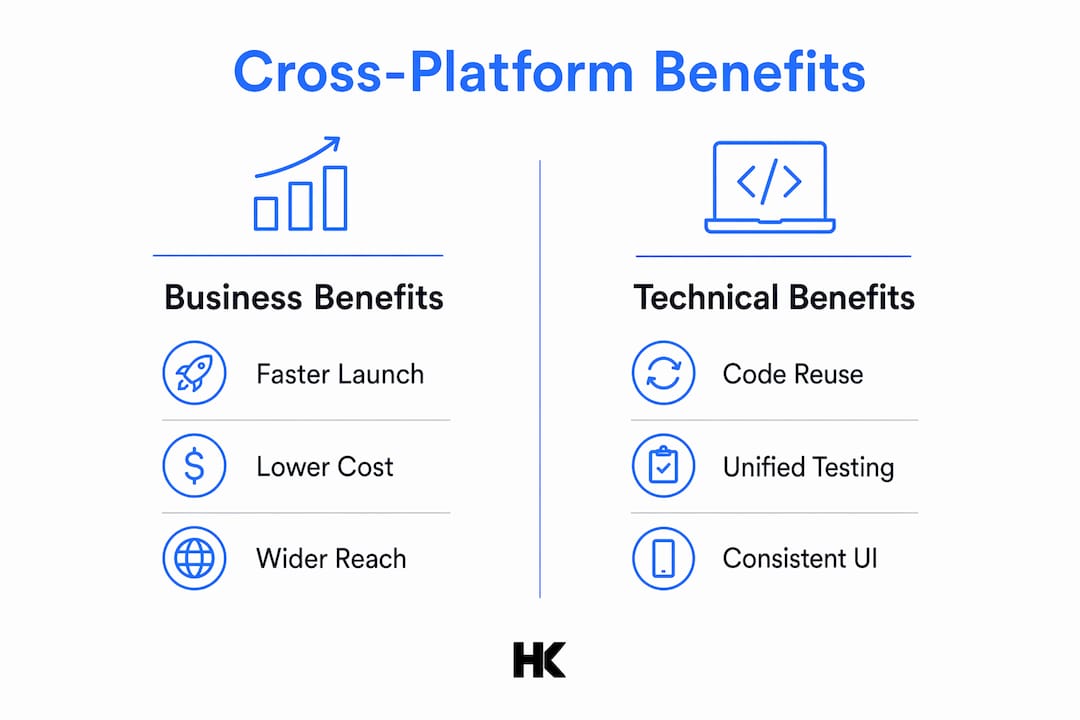
Cost reduction is the second major benefit. Cross-platform development cuts costs by 30–50% compared to maintaining separate native codebases. Savings come from code reuse, reduced QA duplication, and faster release cycles. For a SaaS team running lean, that difference can fund an entire additional feature sprint.
Key benefits that drive adoption among development teams:
- Single codebase. One team ships to iOS, Android, and often web or desktop simultaneously.
- Reduced maintenance overhead. Bug fixes and feature updates deploy across all platforms at once.
- Broader audience reach. A product available on every major OS captures more users without proportional cost increases.
- Faster feedback loops. Simultaneous releases mean user data from all platforms arrives at the same time, not weeks apart.
- Lower hiring costs. One team with shared skills replaces two or three platform-specific teams.
Pro Tip: Before committing to a framework, map which platforms your users actually run. Many B2B SaaS products in the DACH market see 60%+ desktop usage. Choosing a mobile-first framework for a desktop-heavy product adds friction you will spend months working around.
Which are the leading cross-platform frameworks in 2026?
Major cross-platform frameworks include Flutter, React Native, .NET MAUI, and Kotlin Multiplatform. Each targets a different combination of platforms and developer backgrounds.
Flutter
Flutter uses Dart and its own Skia/Impeller rendering engine. It draws every pixel itself rather than delegating to native OS components. This gives Flutter pixel-perfect UI consistency across iOS, Android, web, and desktop. The trade-off is that Flutter UIs can feel slightly off-platform to users who expect strict OS-native controls. Flutter suits teams that prioritize visual consistency over platform convention.
React Native
React Native uses JavaScript or TypeScript and bridges calls to native UI components. The UI looks and behaves like a native app because it uses actual native widgets. The JavaScript bridge adds some overhead, though the newer JSI (JavaScript Interface) architecture reduces this significantly. React Native suits teams with existing JavaScript expertise and products where native look-and-feel matters.
.NET MAUI
.NET MAUI (Multi-platform App UI) uses C# and targets iOS, Android, Windows, and macOS from a single project. It is the natural choice for teams already working in the Microsoft ecosystem or building enterprise apps that need tight Windows integration. .NET MAUI maps to native controls on each platform, similar to React Native's approach.
Kotlin Multiplatform
Kotlin Multiplatform shares business logic while keeping UI layers native per platform. Compose Multiplatform extends this to share declarative UI code as well. This model gives teams the most flexibility: shared data, networking, and domain logic with full native UI control when needed. It suits teams building on Android who want to extend to iOS without rewriting core logic.
| Framework | Language | UI approach | Platform targets |
|---|---|---|---|
| Flutter | Dart | Own rendering engine | iOS, Android, web, desktop |
| React Native | JS / TypeScript | Native OS components | iOS, Android, web |
| .NET MAUI | C# | Native OS controls | iOS, Android, Windows, macOS |
| Kotlin Multiplatform | Kotlin | Native or shared (Compose) | iOS, Android, desktop, web |
Pro Tip: Kotlin Multiplatform is worth serious consideration for teams that already ship Android apps. Sharing the business logic layer alone, without touching the UI, reduces risk and lets you move at your own pace toward fuller code sharing.
How does cross-platform development compare to native app development?
Native development means writing separate codebases in platform-specific languages: Swift or Objective-C for iOS, Kotlin or Java for Android. Each codebase is optimized for its OS and has direct, unmediated access to every platform API. The result is maximum performance and the tightest possible integration with OS features like widgets, background processing, and hardware sensors.
Cross-platform development trades some of that directness for efficiency. Modern frameworks deliver nearly native performance in most SaaS and mobile app use cases. Users cannot distinguish the difference in the vast majority of everyday interactions. The gap only becomes visible in graphics-intensive applications, complex animations, or features that depend on very new OS APIs before the framework has added support.
"Cross-platform is evolving to meet complex business requirements while maintaining native-like user experiences, making it a compelling choice for many projects." — Kotlin Multiplatform Documentation
The honest comparison comes down to three questions. How performance-sensitive is the app? How quickly does it need to reach multiple platforms? And how large is the team? A two-person team building a SaaS MVP almost never has a strong reason to maintain two native codebases. A team building a real-time 3D game or a camera-heavy app might.
One misconception worth correcting: cross-platform does not mean test once. Platform-specific testing remains necessary because OS updates on Android and iOS introduce unique regressions. A shared codebase reduces the volume of testing, but it does not eliminate the need to run the app on actual devices for each target platform.
What are the key best practices for cross-platform projects?
Getting cross-platform development right requires more than picking a framework. The implementation decisions made in the first two weeks of a project determine whether the codebase stays clean or becomes a fragmented mess of platform-specific workarounds.
-
Define your platform split early. Decide upfront what percentage of code will be shared versus platform-specific. Trying to share everything often leads to awkward abstractions. Targeting 70–80% shared code with deliberate native escape hatches produces cleaner results.
-
Test on real devices, not just simulators. Simulators miss hardware-specific behavior, memory constraints, and OS-level permission flows. Budget time for physical device testing on both Android and iOS before every release.
-
Isolate platform-specific code. Use platform channels (Flutter), native modules (React Native), or dependency injection to keep platform-specific implementations behind clean interfaces. This makes future framework upgrades far less painful.
-
Monitor framework release cycles. Flutter, React Native, and .NET MAUI all ship breaking changes. Assign someone on the team to track release notes and test upgrades in a branch before merging to main.
-
Plan for GDPR compliance from day one. For teams shipping in the EU, data handling in cross-platform apps must comply with GDPR regardless of which framework is used. This affects analytics SDKs, crash reporting tools, and any third-party library that touches user data. Build the consent layer before you need it, not after.
Pro Tip: For EU-facing SaaS products, audit every third-party SDK in your cross-platform app for GDPR compliance before launch. Many popular analytics and crash-reporting libraries send data to US-based servers by default. Replacing them after launch costs significantly more than choosing compliant alternatives upfront.
Checking the web app vs. mobile app decision before committing to a cross-platform mobile build is also worth the time. Some SaaS products genuinely serve users better through a responsive web app, which sidesteps framework complexity entirely.
Key takeaways
Cross-platform development delivers 30–50% cost savings over separate native codebases, but only when teams choose the right framework, test on real devices, and plan platform-specific customization deliberately from the start.
| Point | Details |
|---|---|
| Code reuse rate | Cross-platform apps share 70–90% of code, cutting build time and maintenance cost. |
| Cost reduction | Maintaining one codebase instead of two reduces development costs by 30–50%. |
| Framework choice matters | Flutter, React Native, .NET MAUI, and Kotlin Multiplatform each suit different team skills and product requirements. |
| Testing is still required | Shared code does not eliminate platform-specific regressions; test on real Android and iOS devices before every release. |
| EU compliance applies | GDPR obligations apply to every third-party SDK in a cross-platform app, regardless of framework. |
My take on where cross-platform development is heading
I have built and shipped SaaS products end-to-end, and the question I hear most often from technical founders is: "Should we go cross-platform or native?" My honest answer is that the question is usually framed wrong.
The real question is: "What is the smallest team that can ship and maintain this product at the quality level our users expect?" For most B2B SaaS products I see in the DACH market, that answer points directly at cross-platform. The performance gap between Flutter or React Native and native is now small enough that it rarely justifies doubling your engineering effort.
What I do see teams get wrong is treating cross-platform as a shortcut rather than a deliberate architecture choice. They pick Flutter because it is popular, skip the platform-specific testing, and then spend months debugging regressions that a proper device testing protocol would have caught in hours. The framework does not save you from bad process.
The other thing worth saying plainly: Kotlin Multiplatform is underrated for teams that already have Android engineers. Sharing just the business logic layer, without touching the UI, is a low-risk way to extend to iOS without a full rewrite. I have seen teams ship iOS versions of existing Android apps in weeks using this approach.
Framework capabilities are improving fast. The gap between cross-platform and native will continue to narrow. But the teams that get the most out of these tools are the ones that understand the trade-offs clearly, not the ones chasing the newest release.
— Hanad
Building cross-platform apps with Hanadkubat
Teams that want to ship a cross-platform SaaS product without spending months on framework decisions and architecture debates work directly with Hanadkubat. Fixed-price MVP builds start at €18,000 and ship in 4–12 weeks. Strategy sprints at €1,500 scope and validate the product before a single line of code is written.

Hanadkubat brings engineering pedigree from BMW, Deutsche Bahn, and Bundesrechenzentrum Austria, plus direct experience shipping SaaS products end-to-end. Every engagement is a direct partnership: you work with the engineer writing the code, not a project manager relaying messages. For teams building in the EU, GDPR-aware architecture is built in from day one. See full service details and pricing at hanadkubat.com.
FAQ
What is cross-platform development in simple terms?
Cross-platform development is writing one codebase that runs on multiple operating systems, such as iOS, Android, and Windows. Frameworks like Flutter and React Native handle the platform differences so developers do not have to rewrite the app for each OS.
How does cross-platform development differ from native development?
Native development uses separate codebases written in platform-specific languages like Swift for iOS and Kotlin for Android. Cross-platform development uses a single shared codebase, which reduces costs by 30–50% but requires deliberate testing on each target platform.
Which cross-platform framework should I choose in 2026?
Framework selection depends on project needs, developer expertise, and whether UI consistency or platform fidelity matters more. Flutter suits teams prioritizing visual consistency; React Native suits teams with JavaScript skills; Kotlin Multiplatform suits teams extending existing Android apps to iOS.
Does cross-platform development work for enterprise SaaS products?
Yes. Modern cross-platform frameworks deliver near-native performance for the vast majority of SaaS use cases. .NET MAUI and Kotlin Multiplatform are particularly well-suited to enterprise environments that need Windows integration or tight control over business logic.
Do cross-platform apps still need platform-specific testing?
Yes. OS updates on Android and iOS introduce unique regressions that shared code cannot prevent. Testing on real devices for each target platform before every release remains necessary to maintain app quality and consistency.