
A web stack is the collection of software layers used to build and run a web application: at minimum, an operating system, a runtime or programming language, a web server, and a database. Every layer you add above that baseline is a trade-off between capability and complexity.
For most projects, the right starting point is one of these:
- MVP or early SaaS: TypeScript + Next.js + Postgres on a managed platform (Vercel or Railway)
- Content or marketing site: JAMstack with Next.js or Astro, a headless CMS, and a CDN
- Data-heavy app or analytics: Python backend (Django or FastAPI) + a columnar store (BigQuery, Redshift, or ClickHouse) + an event bus
- Enterprise monolith or regulated product: Rails or Django on containerized managed infrastructure, with explicit compliance and observability requirements from day one
The rest of this guide explains why, with a comparison table, a decision checklist, and three concrete architecture patterns you can take straight into a scoping call.
Key Takeaways
Postgres, TypeScript, and a meta-framework like Next.js cover the majority of B2B SaaS use cases in 2026 without adding operational complexity that a small team cannot sustain.
| Point | Details |
|---|---|
| Start with four layers | Browser, framework, server, and data. Add tools only when a specific problem demands it. |
| Postgres as the default DB | Handles relational, JSON, and vector workloads; one database to operate for most MVPs. |
| Unify on TypeScript | One language across frontend and backend reduces hiring complexity and context switching. |
| Compliance is architecture | GDPR and EU AI Act requirements determine database region and inference endpoint before you write code. |
| Hanadkubat fixed-price builds | Strategy sprints from €1,500 and MVP builds from €18,000 deliver deployable code in 4–12 weeks. |
Table of Contents
- What does a web stack actually consist of?
- Which web stacks are worth considering in 2026?
- How do you choose the right stack for your project?
- What stack trends actually matter in 2026?
- Three architecture patterns you can use today
- The stack decision most teams get wrong
- Fixed-price stack selection and MVP builds with Hanadkubat
- Sources
- FAQ
What does a web stack actually consist of?
A solution stack is a set of layers built on top of one another, where each layer depends on the one below it. Understanding what each layer does is what lets you make deliberate trade-offs instead of just copying someone else's setup.
- Frontend / UI layer (React, Vue, Angular, Svelte): renders what the user sees. Your choice here drives bundle size, interactivity model, and how much JavaScript ships to the browser.
- Meta-framework / SSR layer (Next.js, Nuxt, SvelteKit, Remix): sits between the frontend and the server. Controls server-side rendering, routing, and data fetching. This layer has the biggest impact on SEO and time-to-first-byte.
- Runtime / application server (Node.js, Deno, Python/Gunicorn, Ruby/Puma): executes your business logic. Affects concurrency model, library ecosystem, and hiring pool.
- Database (Postgres, MySQL, MongoDB, Redis): where your data lives. Postgres handles relational, JSON, and time-series workloads well enough that it covers the majority of B2B SaaS use cases without a second database.
- CDN and edge layer (Cloudflare, Fastly, AWS CloudFront): caches static assets and, increasingly, runs lightweight compute at the edge. Directly affects global latency.
- Caching layer (Redis, Memcached): reduces database load for hot reads. Add it when you have a documented bottleneck, not before.
- Auth (NextAuth, Auth0, Clerk): session management and identity. Underestimated in complexity; a managed auth service saves weeks on an MVP.
- Observability (OpenTelemetry, Datadog, Sentry): logs, traces, and error tracking. Non-negotiable in production; often skipped on MVPs and regretted immediately.
The layer that most often surprises teams is the meta-framework. Choosing Next.js App Router versus a plain React SPA is not a frontend decision; it is a decision about rendering strategy, caching behavior, and whether your content will rank in search.
Which web stacks are worth considering in 2026?
JavaScript-based stacks remain dominant because a single language across client and server simplifies tooling, reduces context switching, and makes hiring easier. That said, the right stack depends on your project's constraints, not on what's trending.
| Stack category | Best for | Primary language/runtime | Ecosystem | Learning curve | Scalability and ops | Hosting profile | SSR / SEO |
|---|---|---|---|---|---|---|---|
| JavaScript unified (MERN, MEAN, MEVN) | MVPs, SaaS, real-time apps | TypeScript / Node.js | Large; npm | Moderate | Scales well; ops complexity grows with microservices | Vercel, Railway, Render, AWS | Good with Next.js; manual with plain React |
| Next.js / edge / serverless | Content sites, SaaS frontends, API routes | TypeScript / Node.js + edge | Very large | Low to moderate | Serverless scales automatically; cold starts on edge | Vercel, Netlify, AWS Lambda | Excellent; built-in SSR and ISR |
| Traditional LAMP | Legacy apps, WordPress, shared hosting | PHP / Apache / MySQL | Mature; vast | Low | Vertical scaling; ops-heavy at scale | Shared hosting, VPS, managed PHP | Moderate; depends on framework |
| Opinionated full-stack (Rails, Django) | Regulated apps, internal tools, data-heavy backends | Ruby or Python | Strong; opinionated | Low (conventions reduce decisions) | Good; Kubernetes or managed VMs at scale | Heroku, Render, AWS ECS | Good with server-rendered views |
| JAMstack (Next.js + headless CMS + CDN) | Marketing sites, content platforms, e-commerce | TypeScript / JS | Large; growing | Low to moderate | Excellent for static; dynamic parts need care | Vercel, Netlify, Cloudflare Pages | Excellent; pre-rendered by default |
JavaScript unified stacks: MERN, MEAN, and MEVN
MERN (MongoDB, Express, React, Node.js), MEAN (MongoDB, Express, Angular, Node.js), and MEVN (MongoDB, Express, Vue, Node.js) all share the same core: Node.js on the server, a document database, and a JavaScript framework on the client. Coursera's tech stack overview ties these stacks directly to project needs and developer availability, and that framing holds up. MongoDB's flexible schema is genuinely useful early in a product when the data model is still shifting. The trade-off is that document databases make relational queries painful, and most B2B SaaS products eventually need joins. Best for: MVPs where the data model is uncertain and the team is JavaScript-first.

Next.js and serverless patterns
Next.js has become the default meta-framework for TypeScript teams. App Router (introduced in Next.js 13 and now stable) gives you server components, streaming, and edge-compatible rendering in one package. Pair it with Postgres and a managed deployment platform and you get a stack that handles SEO, API routes, and background jobs without adding a separate backend service. The cold-start problem on serverless functions is real but manageable: keep functions small, use edge runtime for latency-sensitive routes, and warm critical paths with a scheduled ping. Best for: SaaS frontends, content-heavy products, and any team that wants one deployment target.
Traditional LAMP
LAMP (Linux, Apache, MySQL, PHP) is the stack that built most of the early web, and it still powers a large share of production sites. PHP's ecosystem is mature, shared hosting is cheap, and WordPress runs on it. The honest trade-off: PHP's concurrency model and Apache's configuration overhead make LAMP a poor fit for real-time features or high-throughput APIs. If you are starting fresh in 2026, LAMP is rarely the right choice unless you are extending an existing PHP codebase. Best for: WordPress sites, legacy PHP applications, and teams with existing PHP expertise.
Rails and Django
Both Ruby on Rails and Django are opinionated, convention-heavy frameworks that let small teams ship production features fast. Rails' "convention over configuration" philosophy means you make fewer decisions per feature. Django's Python ecosystem is a direct advantage for data-heavy products: you can call a machine learning model from the same codebase that serves your API. The ops story for both is straightforward on managed platforms like Render or AWS ECS. Best for: regulated B2B apps, internal tools, and products that need a Python data pipeline alongside the web layer.
JAMstack
JAMstack (JavaScript, APIs, Markup) pre-renders pages at build time and serves them from a CDN, with dynamic behavior handled by API calls. Next.js with a headless CMS (Contentful, Sanity, or Payload) is the most common implementation. Page load times are fast, SEO is strong, and hosting costs are low. The catch: content that changes frequently requires either incremental static regeneration (ISR) or a shift to server-rendered routes, which blurs the line between JAMstack and a standard Next.js app. Best for: marketing sites, documentation platforms, and e-commerce storefronts.
How do you choose the right stack for your project?
Choosing a stack means matching it to your product's needs: scalability, time-to-market, developer availability, and cost. Here is a prioritized checklist for B2B SaaS teams.
- What does your team already know? The fastest stack is the one your engineers can ship in without a learning curve. A team fluent in Python ships a Django MVP faster than the same team learning Next.js from scratch, regardless of what the benchmark says.
- What is your data model? If your core entities have clear relationships (users, organizations, subscriptions, invoices), use a relational database. Postgres covers this and adds JSON support for semi-structured data. Document databases make sense when schema flexibility genuinely matters, not as a default.
- Do you need SSR or SEO from day one? A B2B SaaS app behind a login wall does not need server-side rendering for SEO. A content site or a public-facing product page does. Choosing Next.js for a fully authenticated app adds complexity without a clear payoff.
- What is your latency requirement? Global users and sub-100ms response times push you toward edge deployment. A single-region B2B app with a known user base does not need edge compute on day one.
- What is your integration surface? Count the third-party APIs you will call (payment, email, CRM, identity). A large integration surface favors a backend language with strong SDK support. Node.js and Python both have broad coverage; Ruby's ecosystem is narrower but adequate for most SaaS integrations.
- What are your compliance and data residency requirements? EU-based products handling personal data under GDPR need to know where data is stored and processed. Managed cloud services simplify ops but require explicit region configuration. If you are building for DACH or EU clients, confirm that your managed database and object storage are in an EU region before you write a line of code.
- What is your observability plan? Decide on error tracking (Sentry), structured logging, and at least one APM tool before you go to production. Retrofitting observability into a running system is significantly more expensive than adding it at the start.
Red flags to watch for:
- A team choosing a stack because it is new, not because it solves a documented problem
- A framework with fewer than two years of production use at scale in your target domain
- A managed service with no documented data export path (vendor lock-in without an exit plan)
- Mixing three or more programming languages across a small team (three context switches per day kills velocity)
For a first deploy, budget 2–6 weeks for an MVP on a managed stack. Production-grade, with auth, billing, observability, and CI/CD, typically runs 8–16 weeks depending on scope. Managed cloud services reduce ops burden and compress that timeline, at the cost of higher per-unit hosting costs as you scale.
What stack trends actually matter in 2026?
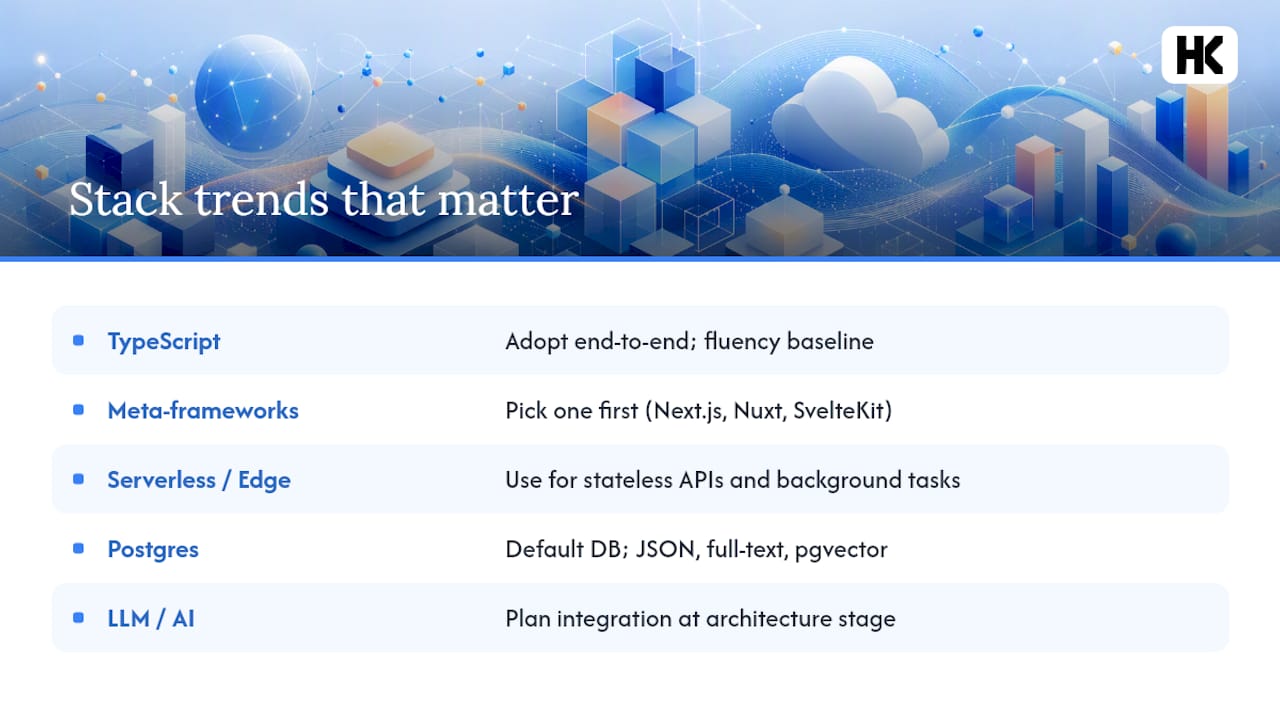
JavaScript/TypeScript unification is now the default, not a trend. Teams that use TypeScript end-to-end (Next.js frontend, Node.js or Bun backend, Prisma or Drizzle ORM) report fewer type-related bugs and faster onboarding. If you are hiring a generalist engineer in 2026, TypeScript fluency is a baseline expectation. Adopt this now; there is no reason to wait.
Meta-frameworks have won the frontend. Next.js, Nuxt, and SvelteKit have displaced the "plain SPA + separate API" pattern for most new projects. The practical implication: if you are starting a new web application, your first question is which meta-framework, not whether to use one.
Serverless and edge compute are production-ready but not universal. AWS Lambda, Cloudflare Workers, and Vercel Edge Functions handle stateless workloads well. They are a poor fit for long-running jobs, stateful connections (WebSockets), or workloads that need consistent low latency without cold starts. Use serverless for API routes and background tasks; use a persistent runtime for anything that holds state.
Postgres has become the default database for new projects. Its support for JSON, full-text search, and extensions like pgvector (for vector similarity search) means most teams no longer need a separate document store or search engine at MVP stage. The resurgence is practical: one database to operate, one backup strategy, one query language.
LLM and AI integration is now a stack-level decision. If your product will call an LLM API (OpenAI, Anthropic, or a self-hosted model), plan for it at the architecture stage. That means deciding where inference happens (client, server, or edge), how you handle latency and cost, and whether EU data residency rules require EU-resident inference endpoints. Bolting an LLM call onto an existing architecture as an afterthought creates cost and compliance problems that are expensive to fix later.
Three architecture patterns you can use today
Pattern A: MVP fast (2–6 week first deploy)
Stack: TypeScript + Next.js App Router + Postgres (managed, e.g., Neon or Supabase) + Vercel + Clerk for auth
This is the sensible default for most new web applications: one language, one deployment target, managed database with automatic backups, and auth handled by a third-party service. You write zero DevOps config to get a production URL.
- Frontend and API routes live in the same Next.js project
- Postgres handles all data; add Redis only when you have a measured cache miss problem
- Clerk or Auth0 handles auth; do not build session management from scratch on an MVP
- Sentry for error tracking from day one; add structured logging before your first real user
Expected timeline: a working, deployed, authenticated app within a few weeks. Add billing (Stripe) and expect additional development time.
Pro Tip: Deploy to production on day one, even with a placeholder page. Catching infrastructure issues early costs hours; catching them after you have real users costs days.
Pattern B: Scale-ready SaaS (8–16 weeks to production)
Stack: TypeScript + Next.js (frontend) + Node.js services (or Python for data-heavy domains) + Postgres + Redis + a job queue (BullMQ or Inngest) + containerized deployment (AWS ECS or Kubernetes)
Once you have product-market fit and predictable load, you introduce service boundaries. The frontend stays in Next.js. Background jobs move to a dedicated worker process. Heavy read paths get a Redis cache in front of Postgres. You add a job queue for anything that should not block an HTTP response (email, webhooks, report generation).
- Keep Postgres as the source of truth; Redis is a cache, not a database
- Use a managed Postgres service (AWS RDS, Supabase, or Neon) until your DBA workload justifies self-hosting
- Containerize services from the start; it makes horizontal scaling and environment parity straightforward
- Add distributed tracing (OpenTelemetry) before you split into more than two services
For scalable architecture decisions, the biggest mistake at this stage is splitting into microservices before you understand your service boundaries. Start with a modular monolith and extract services only when a specific scaling or team-ownership reason forces it.
Pattern C: Data-heavy analytics app
Stack: Python (FastAPI or Django) + Postgres for transactional data + ClickHouse or BigQuery for analytics + Kafka or a serverless event bus (AWS EventBridge) + a React or Next.js frontend
When your product's core value is derived from large-scale data processing, the database choice drives everything else. Postgres handles transactional writes well; it does not handle analytical queries across hundreds of millions of rows efficiently. Add a columnar store (ClickHouse for self-hosted, BigQuery for managed) and route analytical queries there.
- Use an event bus to decouple data producers from consumers; Kafka for high-throughput, EventBridge for lower-volume serverless patterns
- Keep the transactional and analytical databases separate from day one; merging them later is a multi-month migration
- Python's data ecosystem (pandas, SQLAlchemy, dbt) integrates naturally with both Postgres and columnar stores
- EU data residency: if you process personal data for EU users, confirm that your data warehouse region is EU-compliant before ingesting production data
For a deeper look at how these patterns map to app architecture trade-offs, the key question is always: where does your data flow, and who reads it?
The stack decision most teams get wrong
The conventional advice is to pick the most popular stack. That is the wrong frame. Popularity tells you about hiring pool size and community support, both of which matter, but they are second-order concerns. The first-order question is: what does this stack cost your team in cognitive load per week?
A team of three engineers maintaining two languages, three deployment targets, and four databases is not building product. They are managing infrastructure. The teams that ship fastest in the 2–10 engineer range almost always share one trait: they made a boring, unified stack choice early and only added complexity when a specific, documented problem forced it.
The four-layer mental model (browser, framework, server, data) is the right starting point. Add a tool only when you can name the exact problem it solves and the exact metric you will use to confirm it worked. That discipline keeps MVPs shippable and production systems maintainable.
One more thing: compliance is a stack decision, not a deployment afterthought. If you are building for GDPR-regulated markets or under the EU AI Act, your database region, your inference endpoint location, and your logging retention policy are architecture decisions. Make them before you write the first migration.
Fixed-price stack selection and MVP builds with Hanadkubat
Picking a stack is faster when someone has already made the mistakes. Hanadkubat offers fixed-price engagements specifically for technical decision-makers who need a production-ready architecture without a six-month agency timeline.
The MVP track (from €18,000, 4–12 weeks) delivers a deployable codebase with auth, database schema, basic observability, and CI/CD configured from day one. The strategy sprint (€1,500) scopes your architecture, validates your stack choice against your compliance requirements, and produces a prioritized build plan before a single line of production code is written. For teams with an existing codebase that has grown fragile, the rescue/scale track (from €4,500) audits the current stack and produces a concrete refactoring plan.
Every engagement is direct: you work with Hanad, not a project manager. Engineering pedigree includes BMW, Deutsche Bahn, and Bundesrechenzentrum Austria. Hanadkubat to discuss your stack and timeline.
Sources
- What is a web stack? – TechTarget Definition
- What Is A Technology Stack? Tech Stacks Explained | MongoDB
- Taim
- What Is A Tech Stack And How Do You Build One? | Contentsquare
- What is Full Stack Development? - Full Stack Development Explained - AWS
- What Is A Technology Stack? | Coursera
- Solution stack — Wikipedia
FAQ
What is the most popular web stack in 2026?
JavaScript-unified stacks built around Next.js, Node.js, and Postgres are the most common choice for new B2B SaaS products. MERN and MEAN remain widely used for teams that prefer MongoDB's flexible schema.
What is a good example of a web stack?
TypeScript + Next.js + Postgres + Vercel is a practical, production-ready example: one language, one deployment target, and a managed database that handles most B2B SaaS data requirements without a second database.
What is the best web stack for an MVP?
For most MVPs, TypeScript + Next.js + Postgres on a managed platform (Vercel, Railway, or Supabase) gets a working, deployed app in 2–6 weeks. Add Clerk or Auth0 for auth and Sentry for error tracking from day one.
Is full-stack development a strong career path?
Full-stack development remains in high demand, particularly for engineers fluent in TypeScript and familiar with meta-frameworks like Next.js. Teams building B2B SaaS products consistently hire for engineers who can own both frontend and backend layers without handoffs.