

Human in the loop means a person reviews, approves, or corrects an AI system's output before, during, or after it takes effect. Use it whenever a decision is high-stakes, ambiguous, regulated, or made by an autonomous agent that can take real-world action. The rest of this guide covers the patterns, tools, and a working checklist for adding it without turning your codebase into a review-queue swamp.
TL;DR:
- Human review should be limited to high-impact or uncertain decisions, avoiding unnecessary gates on routine, low-risk actions to prevent reviewer fatigue.
- Reviewers need clear, concise decision prompts with only essential evidence to prevent complacency and ensure accurate judgment.
- Implementing a single approval gate for the most costly or risky action, with proper state persistence and structured feedback, simplifies retrofitting HITL into existing systems.
- Cost-effective HITL scales by routing only borderline cases to humans and gradually increasing automation as model confidence improves.
- Reviewers' decisions must be stored as structured data with privacy controls to enable ongoing model retraining and long-term system improvement.
Table of Contents
- What Do HITL, Human-on-the-Loop, and Human-Out-of-the-Loop Actually Mean?
- Where Does Human Oversight Fit in the AI/ML Lifecycle?
- Which HITL Pattern Fits Your System?
- How Do You Implement HITL in a Real Pipeline?
- How Do You Design Around Alert Fatigue and Reviewer Trust?
- What Does HITL Cost You, and How Do You Scale It?
- Where Does Human-in-the-Loop Show Up in Real Systems?
- How Do You Add HITL to an Existing Pipeline?
- What I Actually Do When I Add HITL to a Client's Build
- Where the Conventional Advice on HITL Gets It Wrong
- How I Can Help You Ship a HITL-Ready MVP
- Selected Primary Sources and Implementation Docs
- Sources
- FAQ
What Do HITL, Human-on-the-Loop, and Human-Out-of-the-Loop Actually Mean?
Human in the loop (HITL) describes any AI workflow where a person inserts judgment at a decision point, either before an action fires or right after, to catch what the model gets wrong. IBM's framing is direct about the payoff: HITL improves accuracy, safety, and ethical alignment, and it leaves behind an audit trail that supports accountability when someone asks why the system did what it did.
Two related terms get confused constantly, and the distinction matters for how you design the system:
- Human-on-the-loop means a person monitors the system and can intervene, but the system runs autonomously by default. Think of a fraud model that auto-blocks transactions while an analyst watches a dashboard and can override.
- Human-out-of-the-loop means no person reviews individual decisions at all. This is appropriate for low-stakes, high-volume, well-validated tasks like spam filtering, not for anything with legal or safety consequences.
- HITL sits between the two: a human decision is required, not optional, at a defined checkpoint.
HITL also overlaps with two machine learning techniques you'll hear in the same breath. Active learning uses human labels to teach a model where it's uncertain, cutting the total labeling burden. Reinforcement learning from human feedback (RLHF) uses human preference judgments to shape model behavior during training, which is how most modern chat models got tuned to be less unhelpful and less unhinged.
Stanford HAI's framing is worth internalizing here: the point isn't that AI happens to include humans, it's that humans stay in charge and the AI operates inside a boundary they control. That's a design constraint, not a courtesy.
Where Does Human Oversight Fit in the AI/ML Lifecycle?
Human input doesn't belong in one place. It shows up at four distinct points, and conflating them is how teams end up with reviewers rubber-stamping things they were never meant to catch.
- Training and labeling. Supervised models need annotated data, and someone has to decide what counts as correct. Get this wrong and every downstream prediction inherits the mistake.
- Model improvement. Active learning routes the model's most uncertain predictions to human labelers, so review time goes toward cases that actually move accuracy. RLHF works similarly but on preference judgments rather than labels.
- Pre-action approval. Before an agent sends an email, issues a refund, or deletes a record, a person signs off. This is the checkpoint that matters most for agentic systems, since the cost of an autonomous mistake here is immediate and often irreversible.
- Post-action audit. After the fact, someone samples decisions to catch drift, bias, or compliance gaps. This doesn't stop a bad action, but it stops the next hundred.
Databricks makes the case that this should be risk-based from the start: reserve human review for decisions that are high-impact, uncertain, or regulated, not for every single output a model produces. A model that flags 10,000 transactions a day cannot have a human look at all 10,000. It needs a rule for which ones actually reach a person.
Which HITL Pattern Fits Your System?
Two architectural choices drive almost everything else: whether the human blocks the action (synchronous) or reviews it afterward (asynchronous), and what triggers the review in the first place.
Synchronous pause-and-approve stops the workflow until a person responds. Use it for actions that are expensive to undo: a payment, a legal document, a customer-facing message from an autonomous agent. Asynchronous audit and monitoring lets the action proceed and samples it for review later. Use it for high-volume, lower-severity decisions where the cost of a mistake is recoverable.
Routing logic usually comes down to confidence scores or risk tiers:
- Low-confidence predictions get routed to a human regardless of stakes, because the model is telling you it doesn't know.
- High-stakes actions get routed to a human regardless of confidence, because being wrong is expensive even if the model sounded sure.
- Everything else runs on autopilot, with periodic sampling for audit.
Active learning and RLHF function as long-run feedback mechanisms layered on top of this. Every human decision at a pause gate is also a labeled example you can feed back into the model, which is where the real return on HITL shows up over months, not days.
A few primitives show up in every serious implementation: a pause state that persists across restarts, a timeout that defines what happens if nobody responds, and an explicit on_reject behavior so a denial doesn't just vanish into a dead end.
Pro Tip: Define the timeout and the rejection path before you build the approval screen. Teams design the "yes" flow first and then discover, in production, that a "no" or a 48-hour silence has nowhere to go.
How Do You Implement HITL in a Real Pipeline?
Most engineers reach for the same handful of tools once they get past the whiteboard stage, and each one solves the pause-and-resume problem a little differently.
Apache Airflow's HITL operator persists a task in an awaiting_input state and resumes the run once a person responds through the API. In recent Airflow versions, that waiting state doesn't tie up a worker slot, which matters if you're running approval gates across hundreds of pipelines and don't want them clogging your scheduler.
Elastic's waitForApproval and waitForInput primitives are worth studying even if you never touch Elastic, because the UX defaults they ship are genuinely well thought out: lead with the decision, attach minimal evidence, default to a 24 or 72 hour timeout, and push the review into Slack instead of a separate dashboard nobody checks.
For agent-based systems, frameworks like Loopstack expose primitives named AskForApproval and AskClarification directly in the agent loop, pausing execution and resuming once input arrives.
A few things to get right regardless of tool:
- Persist pause state to a database, not memory, or a server restart silently kills every pending approval.
- Route notifications to wherever your reviewers already work, not a new tool they'll forget to check.
- Treat any data shown to a reviewer as data that left your model's trust boundary. If it includes customer PII, that's a data access event, not just a UI render.
How Do You Design Around Alert Fatigue and Reviewer Trust?
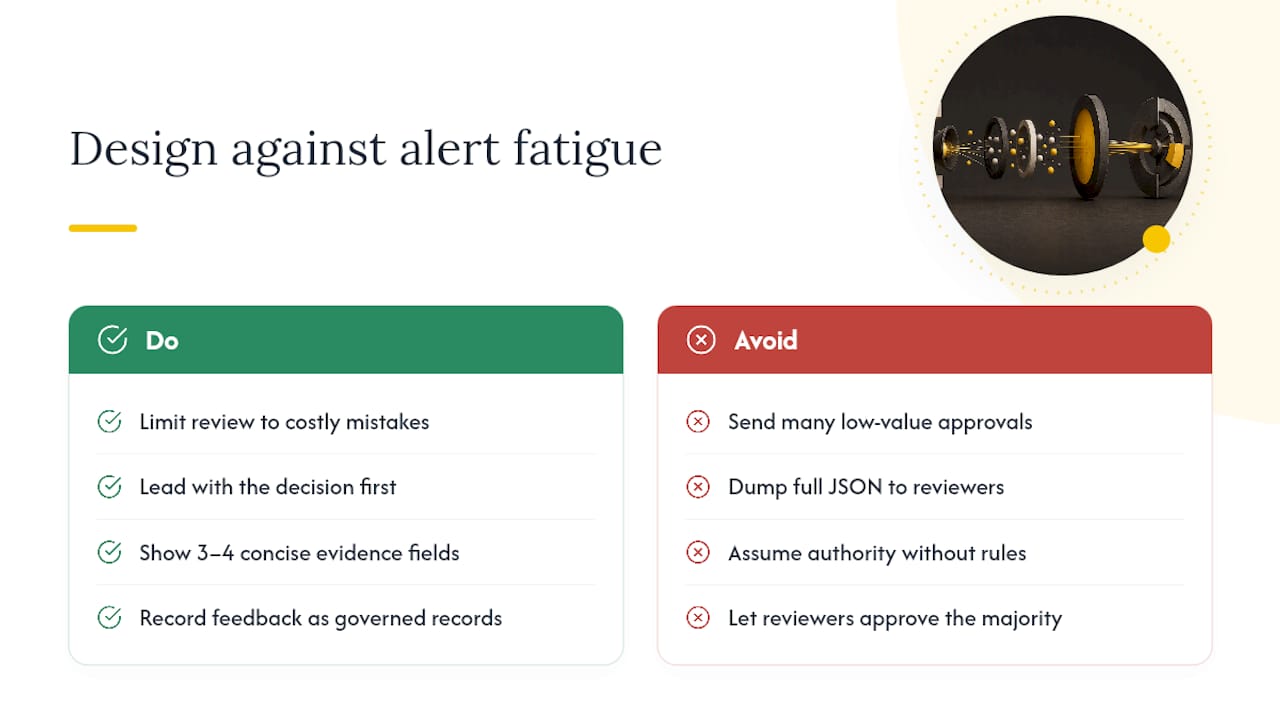
The single fastest way to kill a HITL system is to send reviewers too many low-value approvals. People stop reading and start clicking "approve" on reflex, which defeats the entire point of the checkpoint. Limit human review to decisions where being wrong actually costs something, and let everything else run without a gate.
The reviewer interface matters more than most teams assume. Lead with the decision itself, not a wall of context. A reviewer should see "approve this $4,200 refund" before they see the seven fields that justify it. Keep the evidence concise and the schema small: three or four fields a person can actually scan in ten seconds, not a JSON dump.
Reviewer competence and authority need to be explicit, not assumed. If a support agent is approving refunds, they need to know what they're authorized to approve and where to escalate when a case falls outside that. An escalation path that only exists in someone's head disappears the day that person goes on vacation.
Human feedback is operational data once it enters the system, not a one-off click. Databricks frames this correctly: capture it as structured records, govern it with the same privacy and retention rules you'd apply to any customer data, and keep an audit trail that shows who decided what and when.
Pro Tip: If your reviewers are approving the majority of what reaches them, your routing threshold is too aggressive. Tighten it so the gate only catches genuinely uncertain cases, not everything.
What Does HITL Cost You, and How Do You Scale It?
Human review isn't free, and pretending otherwise is how HITL projects quietly die. The direct costs are subject-matter experts' time, the hours spent labeling training data, and the ongoing overhead of staffing a review queue that never quite empties.
The failure modes are just as real. Reviewers disagree with each other, producing inconsistent labels that confuse the model instead of improving it. Under time pressure, reviewers start rubber-stamping, which quietly turns your safety net into theater. And any sensitive data routed to a human reviewer is a privacy exposure you now have to account for.
Scaling HITL without scaling headcount comes down to three moves:
- Route only borderline or uncertain cases to a person, and let confident predictions through automatically.
- Use progressive automation: as the model proves itself on a given decision type, widen the autonomy threshold gradually instead of all at once.
- Store every human decision as governed feedback data, feeding it back into retraining so today's review queue shrinks tomorrow's.
Where Does Human-in-the-Loop Show Up in Real Systems?
The pattern looks different depending on the industry, but the underlying logic doesn't change: gate the action that's expensive to undo, let the rest run.
In healthcare, a diagnostic model flags a scan as suspicious, and a clinician reviews the flagged image before anything touches a patient record or a treatment plan. In security operations, an automated remediation system detects an intrusion and prepares a fix, but pauses before executing anything destructive, like isolating a production server, until an analyst signs off.
In customer support, an AI agent drafts a response or a refund, but any message that changes a customer's account state, balance, or subscription requires a human click before it goes out. In content moderation, borderline flags route to a human reviewer while clear violations get actioned automatically.
The common thread: the gate sits on the action that's hard to walk back, not on every step that led up to it.
How Do You Add HITL to an Existing Pipeline?
Retrofitting HITL into a system that already ships decisions autonomously is a smaller job than most teams expect, if you sequence it right.
- Map your decisions by impact and volume. List every automated action, estimate how expensive a mistake is, and how often it happens. This tells you where a gate is worth the friction.
- Pick a pattern and prototype one pause gate. Start with synchronous pause-and-approve on your single highest-risk action. Don't build five gates at once.
- Persist state and define the edges. Add a timeout, a clear
on_rejectbehavior, and structured feedback capture so every review produces a reusable record. - Measure before you expand. Track reviewer throughput, time-to-decision, and whether accuracy actually improves. Only then add a second gate.
What I Actually Do When I Add HITL to a Client's Build
I've spent ten years building production systems, including work inside environments like Deutsche Bahn and BMW where a wrong automated decision has real consequences, not just an annoyed user. When a client's build needs human oversight, I don't reach for a review queue and five roles. I build one approval gate on the highest-risk path, wire it to persist state properly, and capture every decision as structured feedback the client can actually use later.
No vendor lock-in, no proprietary review platform they'll have to rip out in a year. Just a gate that works, code they own, and a handoff clean enough that another engineer can read it without calling me. That's the standard I hold every fixed-price build to: the prototype is the spec, and the review logic should be boring enough to survive whoever touches it next.
Where the Conventional Advice on HITL Gets It Wrong
Most guidance on human-in-the-loop treats it as a feature you bolt on: add a review step, call it done. That's backwards. The evidence points to routing, not coverage, as the thing that actually matters. A system that reviews everything trains its reviewers to stop paying attention, and a system that reviews nothing has no safety net when the model is confidently wrong. The value sits entirely in getting the threshold right.
The other place conventional advice falls short is treating human feedback as a one-time quality check instead of a data asset. If you're not feeding reviewer decisions back into retraining or fine-tuning, you're paying the labor cost of HITL without collecting its long-term return.
If you're building this into an early product, prioritize one thing first: pick the single action in your system that's most expensive to get wrong, and gate only that one. Everything else, including elaborate escalation trees and multi-tier review roles, can wait until you have real usage data telling you they're needed. Most MVPs never reach that point, and building for it early is wasted engineering.
— Hanad Kubat
How I Can Help You Ship a HITL-Ready MVP
I offer an alternative to traditional agencies for teams needing production-ready AI features without months of scoping calls. I provide fixed-price AI integration, production evaluation, and human-in-the-loop approval gates, built by a senior engineer. If your prototype needs a real approval workflow before it can survive a security review or a due-diligence check, that's exactly the gap I fill.
Every build is scoped upfront, priced fixed, and delivered in weeks, not months, with the client owning the code from the first commit. Invoices and pricing are transparent and straightforward. If you're not sure whether you need a full build or just a second opinion on your current architecture, the Prototype Audit is a fixed-price way to find out before committing to anything larger.
Selected Primary Sources and Implementation Docs
For deeper reading, start with Stanford HAI's framing of interactive AI systems, Databricks' practical HITL guidance, and the implementation docs from Apache Airflow and Elastic. For teams building toward compliance, the EU AI Act compliance checklist and the AI audit checklist cover the governance side this article only touches on.
Sources
- What Is Human In The Loop (HITL)? | IBM
- What is Human-in-the-Loop (HITL)? | Databricks Blog
- Apache Airflow HITL tutorial
- Human-in-the-loop workflows | Elastic
FAQ
What Is the Human-in-the-Loop Theory?
It's the design principle that AI systems should keep a human decision-maker in control of consequential outcomes rather than letting a model act fully autonomously. Stanford HAI frames it specifically as humans staying in charge while AI operates inside that boundary.
What Does It Mean to Keep the Human in the Loop?
It means a person must review, approve, or correct a specific decision before or after it takes effect, rather than letting the system act on its own. This typically applies to high-stakes, ambiguous, or regulated actions, not routine, low-risk ones.
What Is the Human-in-the-Loop Problem?
The core problem is balancing safety against scale: reviewing every decision creates bottlenecks and reviewer fatigue, while reviewing too few risks letting harmful or biased outputs through unchecked. The fix is risk-based routing, sending only high-impact or uncertain cases to a person.
What Is the Meaning of Human-Out-of-the-Loop?
Human-out-of-the-loop describes a system that operates fully autonomously, with no person reviewing individual decisions. It's appropriate for low-stakes, well-validated, high-volume tasks, not for actions with legal, financial, or safety consequences.
Can Hanad Kubat Add a HITL Approval Gate to My Existing Build?
Yes. Adding a single, well-scoped approval gate to a high-risk action is a common part of AI integration and MVP rebuild work, priced and delivered as a fixed-price engagement rather than open-ended hours.