
Ship a compliant e-learning SaaS MVP in a few weeks by building the core learning loop first, adding one auditably safe AI feature (RAG-powered search or a content recommender with human-review hooks), and documenting everything for GDPR and EU AI Act conformity from day one. Fixed-price, sprint-based delivery with direct engineer engagement is the fastest path to a production-ready platform without accumulating compliance debt.
Build now:
- Learner registration, course enrollment, content delivery, progress tracking, assessment submission
- Admin dashboard and payment integration (if monetizing at launch)
- One read-only AI feature with human oversight (RAG search or explainable recommendations)
- GDPR data-flow map (ROPA) and Article 28 DPA with your first vendor
Defer:
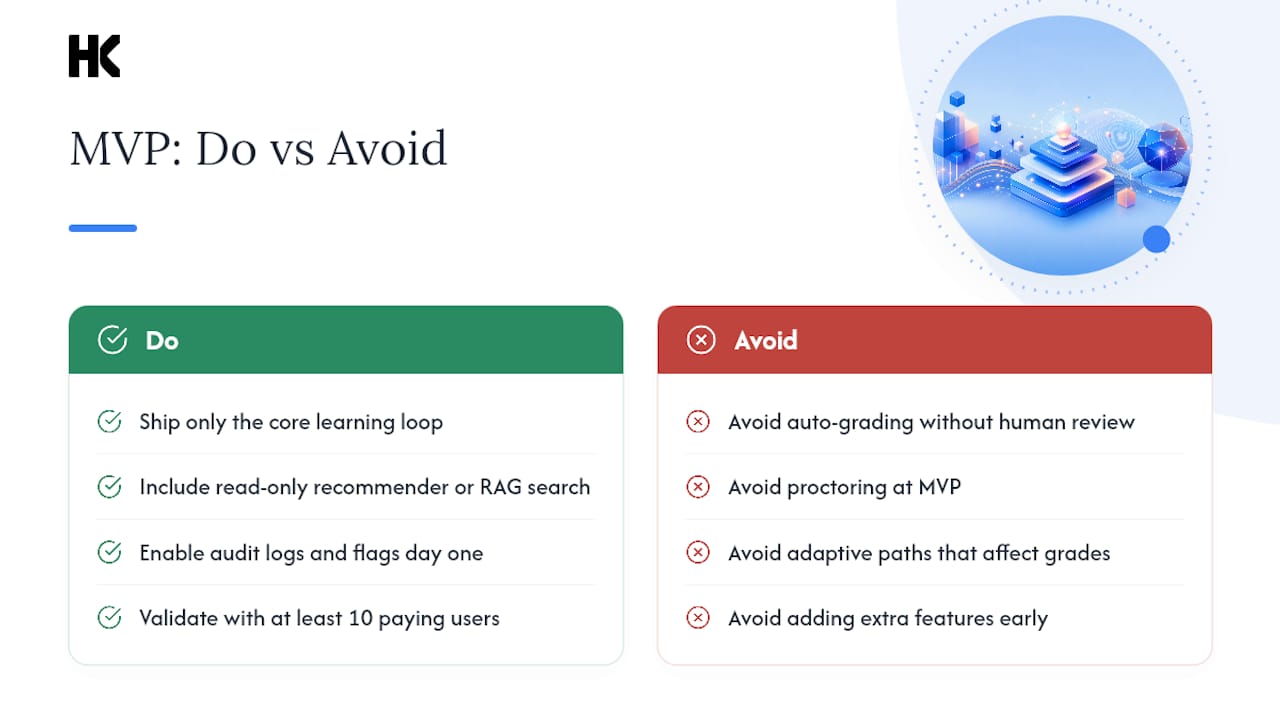
- Auto-grading without human review (high-risk under EU AI Act)
- Agentic tutors and proctoring features
- Multi-region data residency beyond your primary EU zone
Compliance obligations change architecture choices before you write a single line of code. GDPR treats every learner interaction as personal data. EU AI Act classifies grading and proctoring AI as high-risk, which triggers technical documentation, a quality management system, and log retention requirements. Design for those constraints upfront or rebuild later.
Key Takeaways
Developing an e-learning SaaS platform with production AI requires a scoped MVP, one auditable AI feature, and compliance documentation built into the architecture from the start.
| Point | Details |
|---|---|
| MVP scope first | Ship learner registration, enrollment, content delivery, progress tracking, and one AI feature before adding complexity. |
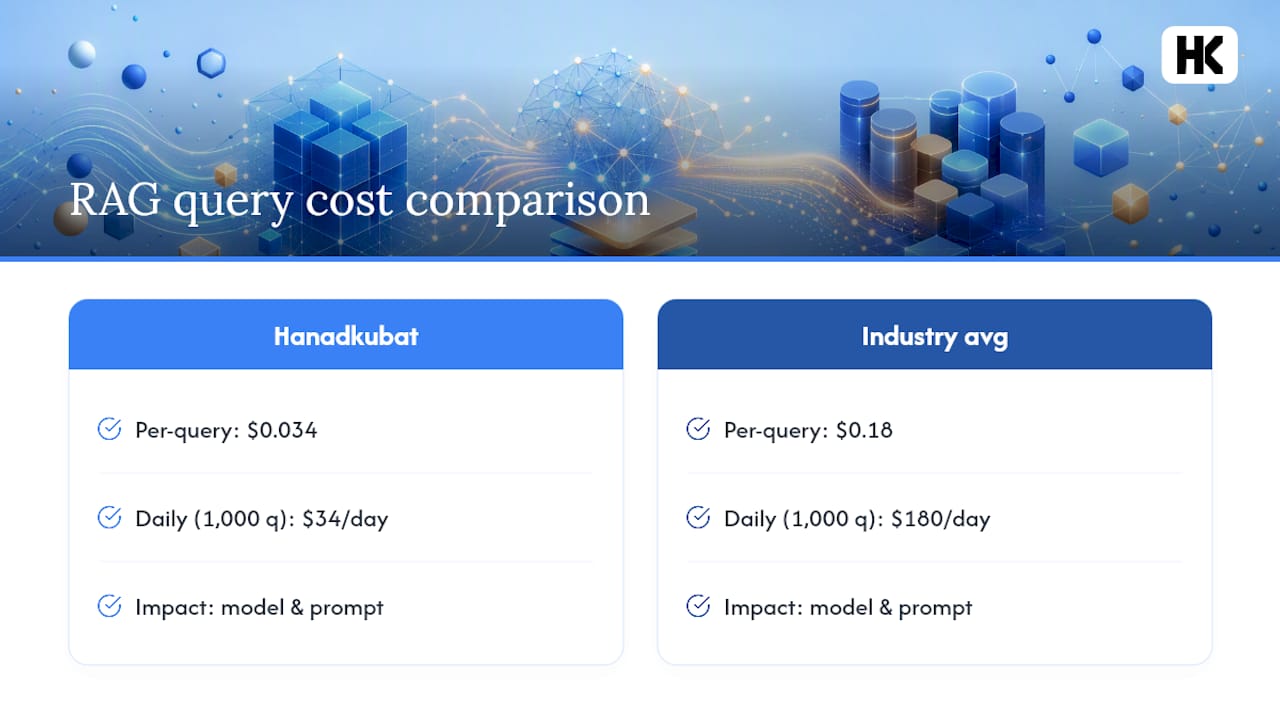
| RAG cost matters | At $0.034 per query vs. $0.18 industry average, model and prompt choices determine whether run costs are sustainable. |
| Compliance is architecture | GDPR, EU AI Act high-risk classification, and data residency choices must be made before vendor selection, not after. |
| Timeline and cost baseline | A core MVP ships in 4–8 weeks; a fuller build with AI runs 8–16 weeks and typically costs from $200k for custom builds. |
| Hanadkubat fixed-price option | 2-week AI sprints from €4,500 and full MVP builds from €18,000, with direct engineer engagement and compliance docs included. |
Table of Contents
- What should you include when developing an e-learning SaaS MVP?
- Which AI integration patterns work best for an LMS?
- What architecture and tech stack should a compliant LMS use?
- What does GDPR and EU AI Act compliance require for an LMS?
- What does a realistic timeline and cost look like?
- How do you test and monitor AI features in production?
- What should you ask vendors and engineers before hiring?
- How do you onboard and retain users on an AI-powered LMS?
- What actually matters when you ship an AI-powered LMS
- Fixed-price e-learning SaaS builds and AI sprints with Hanadkubat
- Sources
- FAQ
What should you include when developing an e-learning SaaS MVP?
A tight MVP includes learner registration, course enrollment, content delivery, basic progress tracking, assessment submission, a simple admin dashboard, and payment integration if you are monetizing at launch. Early architecture choices determine whether you can scale, so the core learning loop should be the only thing you ship in week one.
The one AI feature safe to include at MVP stage is a read-only content recommender or RAG-powered search with clear human-oversight hooks. Both are auditable, reversible, and do not make consequential decisions about learners. Auto-grading without human review, proctoring, and adaptive path selection that affects grades belong in a later sprint, after you have the compliance documentation to support them.
Scope discipline is the single biggest predictor of on-time delivery. Every feature you add to an MVP doubles the surface area for bugs, compliance gaps, and scope creep. Ship the learning loop, validate with real users, then add AI.
For productization, build feature flags and opt-in toggles from day one. That way you can disable an experimental AI feature for a single tenant in under five minutes if a procurement team raises a concern. Validate with at least 10 paying users before expanding scope.
Pro Tip: Enable audit logs and feature flags on day one. Switching off an experimental AI feature for a single tenant should take minutes, not a hotfix deployment.
Which AI integration patterns work best for an LMS?
Prioritize one production-ready AI feature that is auditable and human-supervised. The three patterns that fit LMS use cases well are:
- Embeddings + vector DB (Pinecone or Milvus): semantic search across course content; low latency, low cost, easy to audit
- RAG (Retrieval-Augmented Generation): knowledge-augmented Q&A grounded in your course library; answers are traceable to source documents
- Agentic assistants: guided workflows (study plan suggestions, quiz generation); higher complexity and higher compliance risk — defer to post-MVP
For inference, OpenAI's EU data residency option, Anthropic's API with EU routing, and AWS Bedrock on eu-west regions all reduce CLOUD Act exposure. Pseudonymize learner identifiers before they reach any LLM prompt.
Pro Tip: Separate training data from production inference data from the start. Keep model input/output logs for at least six months to satisfy post-market monitoring obligations under EU AI Act high-risk provisions.
What architecture and tech stack should a compliant LMS use?
Start cloud-native with row-level multi-tenancy scoped at the ORM layer. This keeps early costs low and gives you a migration path to dedicated schemas for enterprise tenants later, without a full rewrite. Row-level tenancy plus ORM scoping middleware gives the best tradeoff for early-stage multi-tenant LMS.
Canonical stack:
- UI: Next.js (React) with server-side rendering for SEO and fast initial load
- Database: PostgreSQL with row-level tenant scoping
- Containers: Kubernetes or managed containers (AWS EKS, Google GKE)
- Media delivery: CDN-backed video (CloudFront or Cloudflare)
- Vector DB: Pinecone (managed) or Milvus (self-hosted for data residency control)
- Learning records: xAPI/LRS or a custom event pipeline
- API layer: REST or GraphQL with JWT auth, SAML/SSO, and LTI support
For deeper guidance on scalable SaaS architecture patterns, the tradeoffs between tenancy models matter most at the architecture stage. Attach DPA controls and audit log hooks at every integration point, not as a post-launch retrofit.
What does GDPR and EU AI Act compliance require for an LMS?
Every learner interaction is personal data under GDPR. Map data flows before you choose vendors.
Compliance checklist:
- Article 28 DPA with all sub-processors (LRS vendor, LLM provider, CDN, vector DB)
- 14-day advance notice clause for sub-processor changes
- EU data residency or Standard Contractual Clauses / Data Privacy Framework in place
- Pseudonymize xAPI actor IDs before storage and before LLM input
- SAR (Subject Access Request) and erasure workflow documented and tested
- ROPA (Record of Processing Activities) updated before launch
- Retention schedules and automated deletion jobs
- Breach-notification SLA under 72 hours
xAPI statements are treated as immutable by the specification. Erasure requires pseudonymization, vendor API support for PII deletion, or mapping-table destruction. Plan this before launch, not after your first SAR arrives.
EU AI Act: features that grade, evaluate, or proctor learners are likely classified as high-risk. You must implement a quality management system, Annex IV technical documentation, human oversight measures, and log retention before placing such systems on the EU market. Enforcement deadlines apply from August 2, 2026.
Enterprise procurement increasingly demands EU AI Act conformity declarations and EU-resident inference to avoid cross-border compelled disclosure risks. Treat compliance as a product feature, not a legal afterthought.
Pro Tip: Require 14-day advance notice of sub-processor changes in your DPA. Insist on EU-hosted inference when procurement teams need to avoid CLOUD Act exposure.
What does a realistic timeline and cost look like?
A small MVP (core learning loop, no AI) ships in 4–8 weeks. A fuller MVP with live classes and one AI feature runs 8–16 weeks. A typical custom e-learning MVP costs $200–$420k for fuller feature sets and takes 5–7 months; adding an AI tutor adds roughly 10 person-weeks.
RAG run-cost example: at $0.034 per query (Hanadkubat's production benchmark vs. a $0.18 industry average), a platform serving 1,000 daily AI queries costs roughly $34/day. Model selection and prompt engineering drive this number more than infrastructure.
How do you test and monitor AI features in production?
Require automated tests, canary releases, and ML-specific monitoring before enabling AI features for real users. This is not optional if you are serving EU users under high-risk AI obligations.
Monitoring checklist: input/output logging, confidence scores, drift detection, bias tests by learner subgroup, human-review queues for high-risk decisions, anomaly alerts, and log retention aligned to your technical documentation.
SLO targets to define before launch:
- API availability: 99.5% or higher
- AI inference P95 latency: under 2 seconds
- Content retrieval error rate: under 0.5%
- Time-to-human-review for flagged outputs: under 4 hours
Store inference logs and model inputs in a protected bucket with retention periods aligned to your conformity assessment documentation. A log you cannot produce during an audit is the same as a log that does not exist.
Pro Tip: Run bias tests across learner subgroups (age, language, prior performance) before enabling any AI feature that influences course recommendations or assessment feedback.
What should you ask vendors and engineers before hiring?
Require direct-engineer engagement, fixed-price deliverables, and a sprint plan that includes compliance deliverables as explicit milestones, not a post-launch add-on.
Questions to ask every bidder:
- What tenancy model do you use, and can enterprise tenants migrate to dedicated schemas?
- Where does learner data and LLM inference run, and can you provide EU-only options?
- What does your CI/CD pipeline look like, and how do you handle rollbacks?
- What test coverage do you target, and what does your monitoring stack include?
- Can you produce exportable SAR/erasure tooling and handover documentation?
Red flags: vague DPA answers, no EU residency option, no audit logs in the architecture, missing test automation, and teams that treat technical documentation as optional.
Deliverables to demand: runnable codebase, infrastructure-as-code, deployment playbook, onboarding checklist, and a 30- to 90-day post-launch support window.
For adaptive learning and advanced EdTech integration patterns, external specialist partners can complement a core MVP build.
How do you onboard and retain users on an AI-powered LMS?
Onboarding on an AI-powered platform has one job: get the learner to their first meaningful outcome before they disengage. That means a short, guided setup flow (under five minutes), a pre-populated course recommendation on first login, and a clear explanation of what the AI does and does not decide.
For retention, the highest-leverage levers are progress visibility (a dashboard that shows exactly where a learner stands), timely nudges triggered by inactivity rather than a fixed schedule, and human touchpoints at key drop-off moments. AI can surface the right nudge at the right time, but a human-review queue for learners who have been inactive for seven or more days consistently outperforms fully automated re-engagement.
Charge early and track activation rate (first lesson completed) and 30-day retention separately. A learner who pays and completes lesson one is a fundamentally different signal than a free user who browses.
What actually matters when you ship an AI-powered LMS
Most teams building an e-learning platform spend the first month debating features and the last month scrambling on compliance. The order should be reversed. The architecture decisions that matter most — tenancy model, data residency, inference location, erasure workflow — are cheapest to get right before you write the first migration.
The RAG cost-per-query gap ($0.034 vs. $0.18) is not a footnote. At scale, it is the difference between a sustainable run cost and a margin problem. Model selection, prompt length, and caching strategy drive that number more than which cloud provider you pick.
Fixed-price, sprint-based delivery works for this category because the scope is definable. A 2-week AI sprint with a clear input (existing LMS codebase, target feature) and a clear output (shipped, logged, monitored AI feature) removes the ambiguity that makes hourly engagements expensive. The teams that ship fastest are the ones that scope the MVP ruthlessly, validate with real paying users early, and treat compliance documentation as a first-class deliverable rather than a checkbox.
Fixed-price e-learning SaaS builds and AI sprints with Hanadkubat
Hanadkubat delivers fixed-price e-learning SaaS MVPs and production AI integrations with direct engineer engagement — no project managers, no junior teams, no hourly billing surprises. A 2-week AI sprint (€4,500) ships one production-ready AI feature with audit logs, monitoring, and EU AI Act documentation included. A full MVP build (from €18,000, 4–12 weeks) covers architecture, compliance documentation, infra-as-code, and a 30- to 90-day post-launch support window. Every engagement is scoped upfront with a fixed price before work starts.
Hanad brings ex-Fortune 500 engineering pedigree from BMW, Deutsche Bahn, and Bundesrechenzentrum Austria, and has shipped his own SaaS products end-to-end. GDPR-aware architecture and EU-resident inference are defaults, not add-ons.
Book a discovery sprint to scope your MVP or AI feature in two weeks, with a fixed price and a clear deliverable list before any code is written.
Sources
- Learning Platform: Build & Scale SaaS Fast (2026) | Viprasol
- Sota
- How a Non-Technical Founder Builds a SaaS (2026) | VP0 Journal
FAQ
What is the fastest way to ship an e-learning SaaS MVP?
Focus on the core learning loop (registration, enrollment, content delivery, progress tracking, assessment) and one auditable AI feature. A scoped build delivers in 4–8 weeks with fixed-price sprint delivery.
Which AI features are safe to include in an LMS MVP?
RAG-powered search and read-only content recommendations with human-review hooks are safe at MVP stage. Auto-grading, proctoring, and adaptive path selection that affects grades are high-risk under the EU AI Act and should be deferred.
What does GDPR require for an LMS platform?
Every learner interaction is personal data. You need Article 28 DPAs with all sub-processors, a ROPA, pseudonymized xAPI actor IDs, and a tested SAR/erasure workflow before launch.
How much does a custom e-learning platform cost to build?
A typical custom e-learning MVP costs $200–$420k for fuller feature sets. Fixed-price sprint options (like Hanadkubat's 4–12 week MVP builds from €18,000) reduce cost and risk for founders who need a defined scope and timeline.
When does the EU AI Act apply to EdTech features?
AI features that grade, evaluate, or proctor learners are likely classified as high-risk. Enforcement applies from August 2, 2026, requiring technical documentation, a quality management system, human oversight, and log retention.