

Most SaaS companies play two roles under GDPR at once: controller for their own business data, processor for whatever their customers upload. The immediate priorities are unglamorous but non-negotiable: map where data lives, sign or offer a Data Processing Agreement, keep a Records of Processing Activities log current, turn on basic technical safeguards like MFA and encryption, and schedule Data Protection Impact Assessments for anything that touches profiling or sensitive data. None of this is a paperwork exercise you finish once. It is documentation, engineering work, and vendor oversight running in parallel, indefinitely.
TL;DR:
- Most SaaS companies must implement ongoing data mapping, basic safeguards, and vendor oversight to comply with GDPR, especially when processing EU resident data.
- Ensuring clear separation between controller and processor duties requires specific documentation, signed agreements, and compliance workflows, which are crucial for enterprise deals.
- Most processing activities rely on lawful bases like contract necessity, legitimate interests, or consent, with each requiring proper documentation and careful application.
- Conducting DPIAs is mandatory for features involving profiling, large-scale monitoring, or sensitive data, with straightforward templates to assess risks and mitigations.
- Prioritizing immediate tasks such as role mapping and MFA, followed by longer-term actions like DPIAs and penetration tests, allows compliance to be achieved in weeks rather than months.
Table of Contents
- How Does GDPR Apply to SaaS Companies?
- What Do Article 5 Principles Mean for Product Design?
- What's the Difference Between Controller and Processor Duties?
- Which Lawful Basis Applies to Each SaaS Data Flow?
- What Documentation Does a SaaS Company Actually Need?
- When Do You Need a DPIA for a SaaS Feature?
- What Security Measures Does GDPR Actually Require?
- How Do You Manage Sub-Processors and International Transfers?
- What Happens After a Data Breach at a SaaS Company?
- How Should SaaS Companies Handle Retention and Data Subject Requests?
- What Should You Fix First, and What Can Wait?
- How I Deliver GDPR-Ready Fixes in Weeks, Not Months
- Does GDPR Cover Minors' Data on Your SaaS Platform?
- Do You Need a Data Protection Officer for Your SaaS Company?
- How Does GDPR Change Your SaaS Marketing and CRM Setup?
- Why Most GDPR Advice for SaaS Misses the Point
- Get a Fixed-Price GDPR Fix Instead of a DIY Compliance Sprint
- Sources
- FAQ
How Does GDPR Apply to SaaS Companies?
GDPR applies the moment your platform processes personal data belonging to someone in the EU, regardless of where your company is incorporated. It doesn't matter if you're a five-person startup in Austin or a bootstrapped team in Bangalore. If EU residents sign up, get tracked by your analytics, or show up in a customer's uploaded spreadsheet, the regulation reaches you.
Multi-tenant architecture makes this messier than a single-tenant app. Shared databases, shared logging pipelines, and shared caching layers all create paths for cross-tenant leakage if row-level isolation isn't airtight. Telemetry tools that capture request payloads for debugging often capture personal data nobody meant to log. API endpoints built for internal tools can quietly expose more than intended once a third party gets access.
The commercial pressure is just as real as the legal one. Enterprise buyers now treat a signed DPA as a prerequisite, not a nice-to-have:
- Procurement teams ask for your sub-processor list before the first sales call ends.
- Security questionnaires increasingly include GDPR-specific line items, not just SOC 2 boxes.
- A missing or vague DPA has become one of the more common reasons enterprise deals stall in legal review.
Treat compliance as a sales asset. A clean answer here closes deals faster than most feature requests.
What Do Article 5 Principles Mean for Product Design?
Article 5 lists the core principles the entire regulation hangs on, and each one has a direct product consequence. Lawfulness, fairness, and transparency mean your privacy notice has to describe actual behavior, not aspirational language. Purpose limitation means you can't quietly repurpose support-ticket data for model training without a new lawful basis. Data minimization means your onboarding form shouldn't collect a phone number "just in case." Accuracy, storage limitation, and integrity/confidentiality round out the list, and each maps to a concrete engineering task: correction endpoints, retention jobs, encryption.
Article 25 turns these principles into a design obligation called Data Protection by Design and by Default. The EDPB's guidelines on DPbDD require you to build in safeguards at design time, not bolt them on after a customer asks. In practice, that looks like:
- Ship new features with the most privacy-protective settings on by default, not opt-out.
- Collect the minimum viable data set for each feature, and delete fields you added "for later."
- Build feature flags that let you disable non-essential processing (heatmaps, session replay) per customer or region.
To get this into your actual workflow, add a privacy checkbox to your ticket template, run lightweight threat modeling on any feature touching personal data, and require a privacy review gate before merge, the same way you'd require a security review.
Pro Tip: Bake the DPbDD checklist into your pull request template. If reviewers see it every time, nobody has to remember to ask.
What's the Difference Between Controller and Processor Duties?
Your company wears both hats, often on the same day. As a controller, you decide why and how you process data for your own operations: billing records, marketing lists, product analytics, hiring pipelines. As a processor, you handle data on a customer's behalf, most obviously the content they store inside your app: documents, tickets, messages, uploaded files.
The obligations diverge sharply:
- Controller activities need their own ROPA entries describing purpose, legal basis, and retention.
- Processor activities need a separate ROPA entry plus a signed Data Processing Agreement covering subject matter, duration, security measures, and deletion terms.
- When a customer's end user files a data request, you as processor must assist the controller (your customer) in responding, not handle it unilaterally.
- A breach affecting customer content triggers your duty to notify the controller, not the supervisory authority directly.
Keep these two data ownership maps separate internally. Conflating them is one of the more common gaps enterprise auditors flag first.
Which Lawful Basis Applies to Each SaaS Data Flow?
Every processing activity needs a lawful basis, and picking the wrong one is a paperwork problem that becomes a legal one during an audit. For SaaS, three bases cover most flows:
- Contractual necessity covers anything required to deliver the service the customer signed up for: authentication, core feature access, invoicing.
- Legitimate interest can justify product analytics or fraud prevention, but only after you run and document a balancing test weighing your interest against the individual's rights.
- Consent is required for marketing emails, non-essential cookies, and third-party ad pixels, and it has to be freely given, specific, and as easy to withdraw as it was to give.
A quiet trap: many teams default to legitimate interest for marketing analytics because it's easier than building a consent flow. That works for aggregate usage metrics. It doesn't work once you're tracking individuals across sessions for retargeting. Document the basis per flow, not per product.
What Documentation Does a SaaS Company Actually Need?
Four documents form the compliance backbone, and none of them can live only in someone's head.
- Records of Processing Activities (ROPA). Keep separate controller and processor entries. Minimum fields: purpose, categories of data, categories of data subjects, retention period, and security measures. SaaS companies are expected to maintain ROPA for both roles simultaneously, not just one.
- Data Processing Agreement. Article 28 sets mandatory clauses: subject matter and duration of processing, obligations to assist with breaches and data subject requests, sub-processor authorization rules, and a clear commitment to delete or return data at contract end.
- Retention schedule and cookie policy. Spell out how long each data category lives and what triggers deletion.
- Incident response plan. A written playbook, not a mental note, for what happens the moment someone flags a possible breach.
Assign an owner for each document. In a five-person startup, that's often the founder for now, but write the name down anyway.
When Do You Need a DPIA for a SaaS Feature?
A Data Protection Impact Assessment becomes mandatory when a feature involves systematic profiling, large-scale monitoring, or special category data like health or biometric information. Recent EDPB enforcement activity has made clear that many machine learning features, including LLM-based tools, rarely qualify as truly anonymized processing, which pushes them toward DPIA territory more often than teams expect.
Common SaaS triggers include:
- Behavioral scoring or churn-prediction models applied to customer end users.
- Any feature ingesting health, biometric, or precise location data.
- Automated decision-making with legal or significant effects, like automatic account suspension.
- Large-scale analytics that combine data across sources to build individual profiles.
A workable DPIA doesn't need to be a fifty-page document. It needs four honest sections: describe the processing in plain language, assess whether it's actually necessary for the stated purpose, list the realistic risks to individuals, and document the mitigations plus whatever risk remains after them.
Pro Tip: Add a DPIA checkbox to your feature kickoff template. If the answer is "maybe," treat it as "yes" and do the short version rather than skip it entirely.
What Security Measures Does GDPR Actually Require?
GDPR doesn't hand you a specific tech stack. It requires "appropriate" technical and organizational measures, and appropriate scales with risk. For a typical SaaS platform, that translates into a concrete checklist rather than a vague mandate.
- Enforce TLS everywhere and encrypt sensitive fields at rest, with keys managed through a dedicated service rather than environment variables.
- Require multi-factor authentication on every admin and internal account, no exceptions for "just the founder."
- Apply role-based access control with least privilege as the default, not a retrofit after your first hire leaves.
- Mask or strip personal data before it reaches logging and observability tools; logging raw PII into third-party monitoring platforms is one of the most common compliance failures teams discover only during an audit.
- Enforce retention through scheduled deletion jobs with monitoring, not a note in a wiki nobody rereads.
- Run periodic penetration tests and treat findings as sprint work, not a backlog graveyard.
National guidance on secure development recommends folding these checks into every phase of your SDLC: design, threat modeling, testing, and maintenance. A security checklist built for B2B SaaS teams gives a more complete breakdown of the control set enterprise buyers expect to see.
How Do You Manage Sub-Processors and International Transfers?
Every vendor you route personal data through, cloud host, email provider, analytics tool, LLM API, is a sub-processor, and Article 28 requires you to track and disclose them.
- Maintain a public sub-processor list on your site or trust page, and notify customers before adding a new one.
- Confirm each sub-processor's data location and legal transfer mechanism. Within the EU/EEA, adequacy covers you; outside it, you generally need Standard Contractual Clauses.
- Run a Transfer Impact Assessment for any transfer to a country without an adequacy decision, since post Schrems II guidance makes clear that SCCs alone often aren't enough without supplementary technical measures.
- Where the transfer risk looks high, add encryption or pseudonymization so the recipient can't read the raw data even if compelled to disclose it.
- Where feasible, prefer EU-hosted infrastructure for EU customer data. It doesn't eliminate the paperwork, but it collapses a lot of the transfer analysis before it starts.
Checking a vendor's actual data residency claims against reality matters more than checking the box on their sales page. A checklist for verifying EU data residency claims is worth running against every sub-processor you add.
What Happens After a Data Breach at a SaaS Company?
Controllers have 72 hours from becoming aware of a breach to notify the relevant supervisory authority, when that breach risks individuals' rights and freedoms. Processors don't get the 72-hour clock; instead, they must notify the controller without undue delay, which in practice means immediately, not "by end of week."
A workable incident playbook has six steps: detect the incident, contain it, assess the actual risk to affected individuals, notify the supervisory authority if that risk is confirmed, notify affected users directly if the risk is high, and document every decision made along the way, including why you decided something wasn't notifiable.
- Keep raw evidence logs (timestamps, access records, remediation steps) from the first minute, not reconstructed after the fact.
- Run a tabletop exercise at least once a year so the team isn't improvising the playbook during an actual incident.
Pro Tip: Write the notification templates before you need them. Drafting a breach notice while also fighting the actual breach is how deadlines get missed.
How Should SaaS Companies Handle Retention and Data Subject Requests?
Retention only works when it's automated, because manual cleanup gets deprioritized the first time a launch deadline collides with it.
- Define a retention period per data category (support tickets, session logs, billing records) and enforce it with scheduled jobs, not a calendar reminder.
- Alert on deletion job failures the same way you'd alert on a payment processing failure. A failed deletion job that runs quietly for months is a bigger liability than most security incidents.
- Build a Data Subject Access Request workflow: verify identity, locate all instances of the person's data, export or erase it, and log every step for audit purposes.
- Document exceptions honestly. Backups and legal holds are legitimate reasons to retain data past the normal window, but only if you write down why, for how long, and when it gets purged.
None of this needs custom tooling on day one. A documented process running on cron jobs beats an undocumented promise running on good intentions.
What Should You Fix First, and What Can Wait?
Compliance work sorts naturally into three horizons, and trying to do all of it in week one just guarantees nothing gets finished properly.
Immediate, 0 to 7 days: map which processing activities make you a controller versus a processor, publish or sign your DPA template, turn on MFA for every admin account, and draft your first ROPA even if it's incomplete.
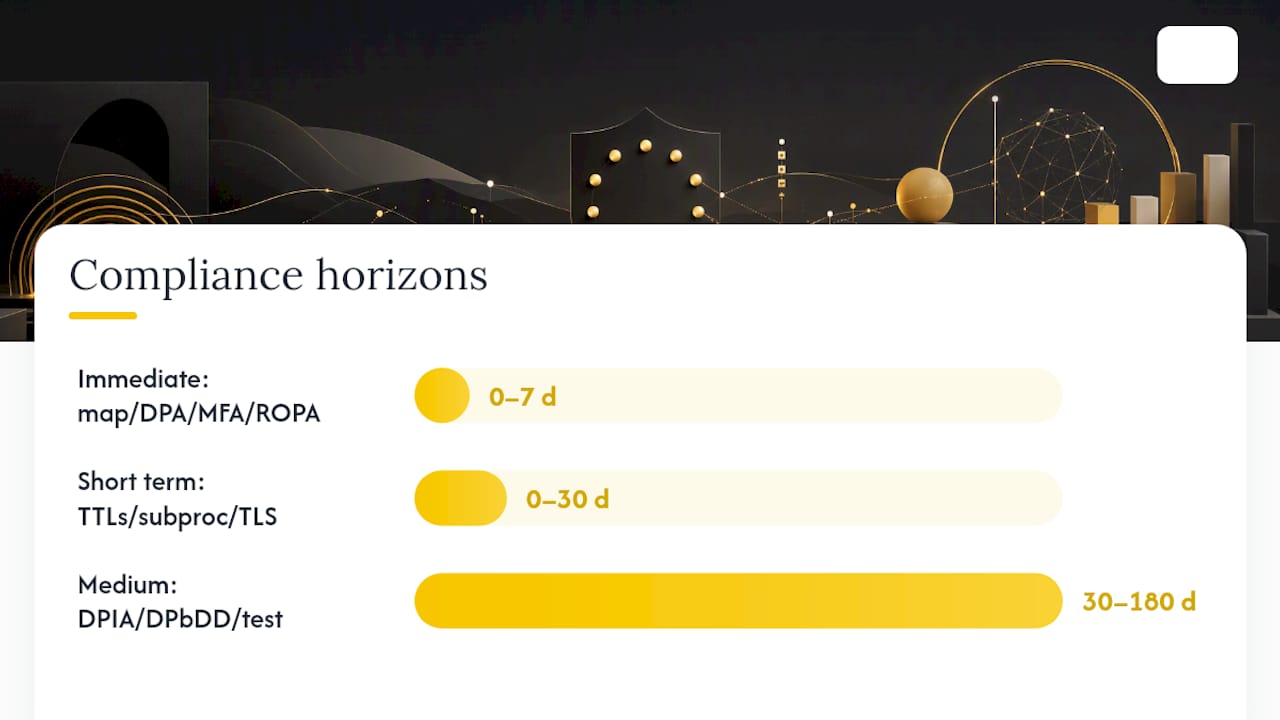
Short term, 0 to 30 days: set retention TTLs on your highest-risk data categories, build your sub-processor inventory, and confirm TLS and at-rest encryption are actually on, not just assumed to be.
Medium term, 30 to 180 days: run DPIAs on any feature that triggers them, embed DPbDD checkpoints into your normal sprint process, and schedule your first penetration test.
| Horizon | Core tasks | Owner |
|---|---|---|
| 0–7 days | Role mapping, DPA published, MFA enabled, draft ROPA | Founder / CTO |
| 0–30 days | Retention TTLs set, sub-processor list built, TLS/encryption confirmed | Engineering lead |
| 30–180 days | DPIAs completed, DPbDD in SDLC, pentest scheduled | Compliance owner / engineering |
Treat this table as your first three sprint tickets, not a someday list.
How I Deliver GDPR-Ready Fixes in Weeks, Not Months
In a fixed-price engagement, I inventory your data flows, fix the technical gaps (encryption, access control, logging hygiene), hand over DPA and retention templates, and set up automated deletion jobs, all inside two to four weeks. Scope gets frozen at kickoff, so you know the deliverable before work starts. One name is on the contract, every line of code is written by me, and you own it from the first commit. For the deeper technical build-out, see my security requirements plan for PMs and security leads.
Does GDPR Cover Minors' Data on Your SaaS Platform?
GDPR sets a default digital consent age of 16 for children using online services, though individual EU member states can lower that threshold to as young as 13, and several have done exactly that. If your SaaS product is accessible to minors, whether directly or because a B2B customer's end users include employees under 18, you need age verification proportionate to the actual risk, not a checkbox that just asks "are you over 18?" and trusts the answer.
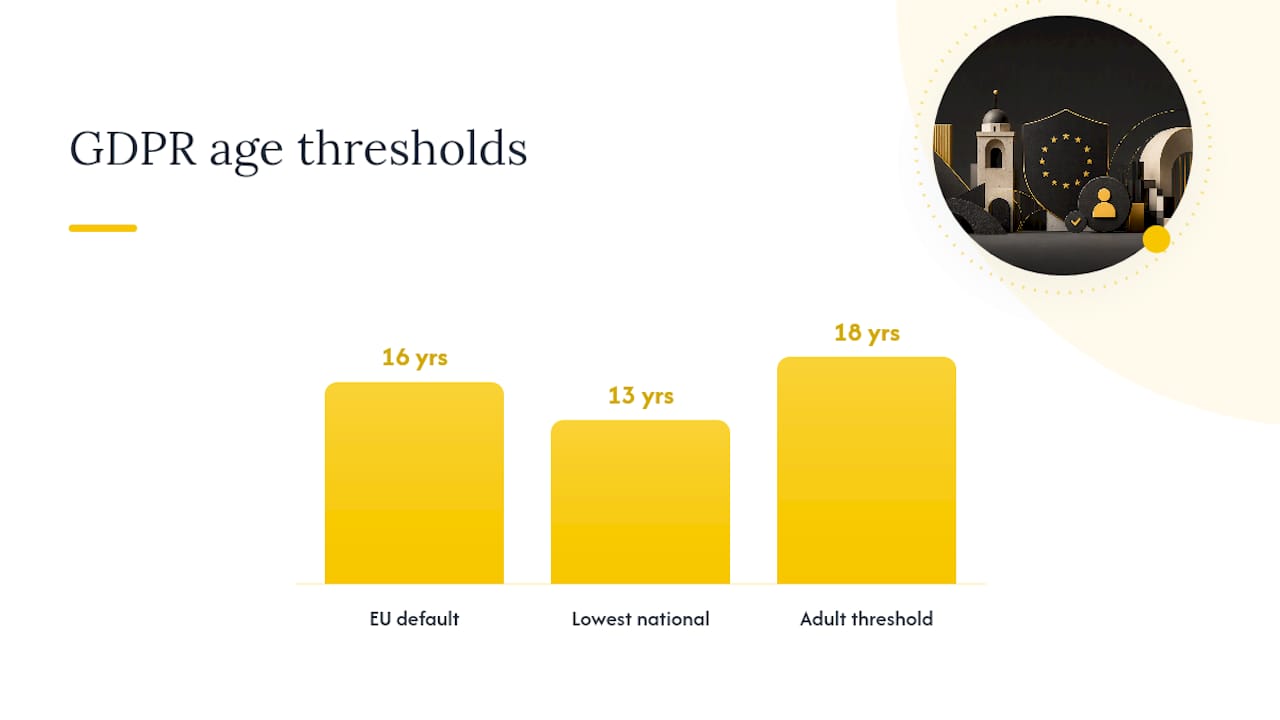
Where a child is below the applicable age threshold, you need verifiable parental consent before processing their data, and "verifiable" is doing real work in that sentence. A single unconfirmed checkbox during signup generally won't satisfy a regulator reviewing the flow after the fact.
Practical steps that hold up under scrutiny:
- Design onboarding flows that flag likely-underage users based on stated birth date, not just self-reported age.
- Apply data minimization more aggressively for any account flagged as belonging to a minor. Skip behavioral tracking and targeted marketing entirely for that segment.
- Avoid using minors' data for profiling or automated decision-making, since that combination draws heightened regulatory attention.
- Document your age-assurance method in your ROPA and privacy notice, even if the honest answer is "self-declared birth date, reviewed manually on flag."
If your platform is B2C and marketed toward education, gaming, or family use, this isn't a peripheral concern. It's usually the first thing a regulator or enterprise security reviewer asks about, and a vague answer here reads as a red flag disproportionate to almost anything else on the list.
Do You Need a Data Protection Officer for Your SaaS Company?
You're required to appoint a Data Protection Officer if your core activities involve large-scale, regular, and systematic monitoring of individuals, or large-scale processing of special category data. Most early-stage SaaS companies don't cross that threshold yet, but the line moves faster than founders expect once a product scales past a few hundred thousand users or starts handling health, biometric, or financial data at volume.
Even when appointment isn't mandatory, someone still has to own the function. In a five-person startup, that's usually the founder or CTO wearing a compliance hat part-time, and that's a legitimate answer as long as it's documented, not assumed. The DPO's core duties: monitor compliance, advise on DPIAs, act as the contact point for the supervisory authority, and serve as an accessible contact for data subjects with concerns.
A few things matter regardless of company size:
- The DPO role needs independence from decisions about the "how" of processing. A founder who is also the sole product decision maker faces a real conflict here, and it's worth naming that tension rather than pretending it doesn't exist.
- Once you do appoint a DPO, formally or informally, publish their contact details in your privacy notice.
- Reassess the mandatory-appointment threshold every time you launch a feature involving profiling, biometrics, or health data. That's usually the moment the calculus changes.
Outsourced or fractional DPO arrangements are common at this stage and entirely acceptable under the regulation, as long as the person has real authority to flag issues rather than just a title.
How Does GDPR Change Your SaaS Marketing and CRM Setup?
Marketing is where GDPR violations happen fastest and get noticed first, usually because a prospect notices an unsubscribe link that doesn't work or a lead form with no privacy notice attached.
Every marketing email to an EU contact needs a lawful basis, and for cold outreach or newsletter sign-ups, that basis is almost always consent, not legitimate interest. Consent has to be specific (not bundled into a generic "I agree to terms" checkbox), freely given, and as easy to withdraw as it was to grant. A pre-checked newsletter box during signup doesn't meet that bar.
CRM and marketing automation platforms (HubSpot, Salesforce, and similar tools) often sync contact data across multiple integrations: ad platforms, enrichment services, chat widgets. Each of those is a sub-processor, and each needs to appear on your public sub-processor list. Data enrichment tools that scrape or purchase third-party contact data create particular exposure, since the individual never consented to your company having their information in the first place.
Practical fixes that hold up:
- Separate your marketing consent database from your product user database, so withdrawing marketing consent doesn't touch account functionality.
- Audit every CRM integration for what data it syncs and why, then remove syncs nobody actually uses.
- Build a working unsubscribe and data-deletion path that actually removes the contact from every connected tool, not just the primary CRM.
Marketing teams optimizing for growth sometimes treat consent as a conversion obstacle rather than a legal requirement, which is exactly the mindset that produces the messiest CRM cleanup projects later.
Why Most GDPR Advice for SaaS Misses the Point
Most GDPR content aimed at SaaS founders reads like a law firm's checklist: correct, thorough, and almost useless for someone who has to actually build the thing. The gap isn't legal knowledge. It's translation, turning "implement appropriate technical measures" into a specific pull request.
The conventional advice treats compliance as a one-time audit you pass and move on from. That's backwards. Retention jobs fail silently. Sub-processor lists go stale the moment you add a new analytics tool. A DPIA written for a feature that shipped eight months ago doesn't cover the version you shipped last week. Compliance decays by default unless someone rebuilds it into the engineering process itself, the way DPbDD guidance actually intends.
If you're a founder reading this with a half-built product, don't start with the ROPA template. Start with the data map: what personal data actually flows through your system, who touches it, where it's stored. Everything else, the DPA language, the retention schedule, the DPIA triggers, falls out of that map cleanly. Skip the map and you'll spend months writing documentation that describes a system you don't fully understand yet.
— Hanad Kubat
Get a Fixed-Price GDPR Fix Instead of a DIY Compliance Sprint
Hanad Kubat is the alternative to hiring a compliance consultancy or burning your own sprint cycles on GDPR cleanup: one senior engineer, one fixed price, and you own every line of code from the first commit. The engagement covers a full data inventory, the technical fixes that actually matter (encryption, access control, log scrubbing), a DPA and retention schedule template built for your stack, and automated deletion jobs that don't rely on someone remembering to run a script. Scope gets frozen at kickoff, so there are no surprise invoices halfway through. This isn't a subscription or a retainer disguised as a project. It's a deliverable, built in weeks, not months, by the same person who signs the contract. If your platform has customer data flowing through half a dozen tools and no clear owner for any of it, book a fixed-price engagement and get the inventory and fixes started this month.
Sources
- GDPR Data Processing Agreement: What to Include
- Guidelines on Data Protection by Design and by Default (EDPB)
- Software development with Data Protection by Design and by Default | Datatilsynet
FAQ
Is GDPR Compliance Mandatory in the USA?
GDPR itself isn't US law, but it applies to any US company processing personal data of people located in the EU, regardless of where the company is based.
What Are the 7 GDPR Principles?
Article 5 lists lawfulness/fairness/transparency, purpose limitation, data minimization, accuracy, storage limitation, integrity and confidentiality, and accountability as the core principles governing all processing.
Does GDPR Apply to US Customers?
GDPR applies based on the data subject's location, not their nationality or the vendor's location, so US customers themselves aren't covered unless they're physically in the EU when the processing occurs; EU-based customers of a US SaaS product are covered.
Is There a US Equivalent to GDPR?
The US has no single federal equivalent; instead it has sector-specific laws like HIPAA and state-level laws like the California Consumer Privacy Act, none of which replicate GDPR's scope, and a SaaS company serving EU users must comply with GDPR directly.
How Long Does GDPR Compliance Take for a Small SaaS Company?
Immediate priorities like role mapping, a published DPA, and MFA can be handled in about a week; full readiness, including DPIAs and automated retention, typically takes 30 to 180 days depending on product complexity.