
A freelance resume packages your client work as formal professional experience. List a clear title, a business name, continuous dates, three to five outcome-driven bullets per marquee project, and a portfolio link. That's the whole game. Recruiters and applicant tracking systems both need to read your freelance history the same way they'd read a full-time job: one title, one date range, one block of results, not a scattered list of gigs that looks like you can't hold down work.
Before you touch formatting or fonts, run through this checklist:
- Professional title that names your role, not just "Freelancer" (e.g., "Freelance Brand Designer")
- Business name or "Self-Employed" paired with that title
- Continuous date range covering your full freelance period, not per-project dates
- Three to five outcome bullets with numbers attached (revenue, retention, speed, scale)
- One portfolio link placed in your header, not buried at the bottom
A freelance resume works when a recruiter can tell, in the time it takes to glance at the page, that you ran a business and delivered measurable results. Everything else is decoration.
Open your resume file right now and rewrite your header with a title and a business name. That single change fixes the most common mistake freelancers make before a recruiter reads a single bullet.
Key Takeaways
A freelance resume works when it treats self-employment as one continuous job with grouped, quantified results and a working portfolio link, not a scattered list of past clients.
| Point | Details |
|---|---|
| Set one title and business name | Replace a bare "Freelancer" label with a specific title plus "Self-Employed" or your business name. |
| Group projects under one entry | Use one continuous date range with sub-bullets, rather than a separate entry per client. |
| Quantify your top three results | Rewrite your strongest bullets using action verb, scope, and a measurable number. |
| Add a portfolio link to the header | Place one clickable link at the top of the page, not buried near the bottom. |
| Match the format to your history | Chronological for continuous work, functional for many short contracts, hybrid for a mix. |
| Save as an ATS-friendly PDF | Use a single-column layout, standard fonts, and a clear file name before sending. |
| Pick based on scenario | Many short contracts favor a functional layout; one long client favors chronological; a mix favors hybrid. |
Table of Contents
- How does a freelance resume differ from a regular resume?
- What sections belong on a freelance resume?
- How do you list freelance experience on a resume?
- Should you use a chronological, functional, or hybrid resume format?
- How do you write resume bullets that quantify freelance results?
- What are the ATS rules for a freelance resume?
- Where can you find freelance resume templates?
- Should you write 'Freelance' or 'Self-Employed' on your resume?
- What do recruiters actually look for in a freelance resume?
- What I look for when I review a freelance resume
- Sources
- FAQ
How does a freelance resume differ from a regular resume?
A freelance resume covers the same ground as a standard one. Contact info, a summary, skills, experience, education. The difference is how you frame the "experience" section. On a traditional resume, one job equals one entry. On a freelance CV, you're often condensing 10, 20, or 50 client engagements into a shape that doesn't look like job-hopping.
Recruiters scanning a traditional resume expect steady employer names and clean date ranges. Freelance work tends to look fragmented if you list every client as its own line item. That's why Indeed's career guide on freelance resumes recommends treating self-employment as formal experience: give it one job title, one business name (or "Self-Employed"), one continuous date range, and outcome-focused bullets underneath.
Grouping matters for two audiences at once. ATS software parses resumes by looking for consistent structure. A dozen fragmented one-line entries with different date ranges confuses the parser and can cause it to misread your work history entirely. Human reviewers face a similar problem: too many entries reads as noise, not experience. ResumeGeni's guide on listing freelance work found that a single-entry format with sub-client bullets parses more reliably across ATS platforms than fragmented per-client entries, and it avoids signaling job-hopping to a human reader.
The moment you stop listing "Client A, Client B, Client C" as separate jobs and start listing "Freelance Consultant, Self-Employed, 2021 to Present" with bullets underneath, your resume stops reading like a scattered gig list and starts reading like a career.
So which document should you actually send: a one-page curated resume, or a longer portfolio-style document? Use the one-page version for any initial application, always. Save the longer format, with full client lists, screenshots, and detailed case studies, for when a hiring manager specifically asks for more depth or when you're sending a portfolio link alongside the resume. A one-page resume gets read. A five-page client history gets skimmed for ten seconds and set aside.
What sections belong on a freelance resume?
Structure beats decoration. Here's the section-by-section blueprint, in order.
Header. Full name, phone, email, city and state (or "Remote"), and one clickable portfolio link. Put the portfolio URL in the header, not in a footer or a separate "links" section near the bottom. Recruiters who don't scroll past the top third never see it otherwise.
Professional title and summary. Use a specific title, like "Freelance Content Strategist" or "Independent Full-Stack Developer," not the bare word "Freelancer." Follow it with one to three sentences that name your specialty, your typical client type, and one headline result. Upwork's guidance on listing freelance work recommends modeling this summary closely on the job description you're targeting and keeping it short enough to scan in seconds.
Skills. Split this into two lanes: technical or craft skills (the software, platforms, or methods you use) and business skills (client management, proposal writing, invoicing, project scoping). Full-time candidates rarely list the second lane. You should, because it proves you've run something end to end.
Experience. This is where most freelancers get it wrong, and it's the section detailed in the next part of this guide. Job title, business name or "Self-Employed," one continuous date range, then three to five bullets.

Portfolio. If your work is visual, technical, or writing-based, a dedicated one-line portfolio callout under your experience section (or just the header link) does the job. Don't paste screenshots into the resume itself.
Education, certifications, testimonials. Include education if it's relevant or recent; omit it if you're ten-plus years into your freelance practice and it adds nothing. Certifications belong in a short line, not a full section, unless you're in a field (like PMP for project management or a specific dev certification) where the credential itself gets you past a filter. Client testimonials work best as a single short quote under a marquee project, not as a separate wall of praise. One line, attributed, tied to a specific outcome.
Pro Tip: If your skills section and your bullets don't share at least a few identical keywords, you're making the ATS work harder than it needs to. Pull three to five phrases straight from the job posting and make sure they show up in both places.
How do you list freelance experience on a resume?
Three formats work, depending on how your client history actually looks.
- Single-entry grouped format. One job title, one business name, one date range, with sub-bullets covering your best-known clients or projects underneath. This is the default choice for most freelancers, especially anyone with more than three or four clients over the years.
- Per-client entry format. Give each client its own line, with its own dates, only when you've worked with a small number of well-known or highly relevant clients over a long period. If you've had two major retainer clients across three years each, listing them separately can actually strengthen the resume.
- Hybrid format. List your one or two marquee clients as separate short entries, then group everything else under a single "Additional Freelance Projects" line. This works well for freelancers who have one flagship engagement and a long tail of smaller gigs.
Here's what each looks like in practice:
- Freelance UX Designer, Self-Employed — Jan 2021 to Present. Delivered end-to-end product design for 14 SaaS clients; redesigned onboarding flow for a project management platform, cutting new-user drop-off by 22% within two months of launch.
- Freelance Copywriter, Self-Employed — Mar 2020 to Present. Wrote conversion-focused landing pages and email sequences for e-commerce brands; one campaign for a DTC skincare client generated a 31% lift in email-driven revenue over a single quarter.
- Independent Backend Developer, Self-Employed — Jun 2019 to Present. Built and maintained REST APIs for six client platforms; migrated a legacy billing system for a subscription-based client, reducing monthly processing errors by 40%.
Notice the pattern: title, business status, one date range, then a bullet that names the work and a number that proves it mattered.
Should you use a chronological, functional, or hybrid resume format?
The right format depends on your work history, not your preference. If you've held continuous long-term projects, or your freelance work sits alongside full-time roles in a clean sequence, chronological format works fine and reads the most naturally to both ATS and human reviewers. If you've bounced through many short contracts with no clear continuity, a functional format, organized by skill category instead of date, can hide the fragmentation. If you're mixing both, a hybrid format groups your freelance history under one entry while still presenting it chronologically alongside other jobs.
ResumeWorded's guidance on freelance resume formats frames the decision this way: chronological suits continuous long-term projects or a mix of full-time and freelance roles, functional suits many short-term projects or a career pivot, and hybrid suits freelancers straddling both situations.
| Format | Best for | ATS and recruiter impression |
|---|---|---|
| Chronological | Continuous freelance work or a mix of full-time and freelance roles | Parses cleanly; reads as a stable, traceable career path |
| Functional | Many short-term contracts or a career change into a new field | Groups skills well but can raise questions about employment gaps |
| Hybrid | One or two long-term clients plus a scattering of smaller projects | Balances continuity with skill-based grouping; works for most freelancers |
Quick decision rule: if you can draw a straight, unbroken line through your freelance years, go chronological. If your history looks like scattered dots with no clear thread, go functional. If you've got one anchor client and a pile of smaller work around it, go hybrid.
How do you write resume bullets that quantify freelance results?
Use one formula for every bullet: action verb, plus the task, plus the scope or context, plus a measurable result. Skip this formula and you end up with duty descriptions instead of achievements, and duty descriptions don't move the needle with anyone scanning a resume in seconds.
Action verbs that work well for freelancers: Managed, Negotiated, Scaled, Implemented, Delivered, Migrated, Redesigned, Automated, Reduced, Increased.
Here's the formula applied across three freelance disciplines:
- Marketing: Managed paid social campaigns for four e-commerce clients, scaling monthly ad spend from $2,000 to $18,000 while holding customer acquisition cost flat.
- Design: Redesigned checkout flow for a mid-size retail client, reducing cart abandonment by 17% across a six-week testing window.
- Engineering: Migrated a client's monolithic app to a microservices architecture, cutting average page load time from 3.2 seconds to 900 milliseconds.
WriteCV's freelancer resume example shows the same principle at the portfolio level: aggregating metrics like total clients served, revenue generated, or retention rate makes freelance work legible to both a hiring manager and an ATS scan, because it turns a pile of separate gigs into one coherent story with numbers attached.
A bullet that says "wrote content for clients" tells a recruiter nothing they couldn't guess. A bullet that says "wrote 40 blog posts that drove a 28% increase in organic traffic over four months" tells them exactly what you're capable of repeating for their company.
To convert a duty into an achievement, ask one question for every bullet you write: what changed because I did this? If you can't answer with a number, a percentage, or a concrete before-and-after, keep working on the sentence until you can.
What are the ATS rules for a freelance resume?
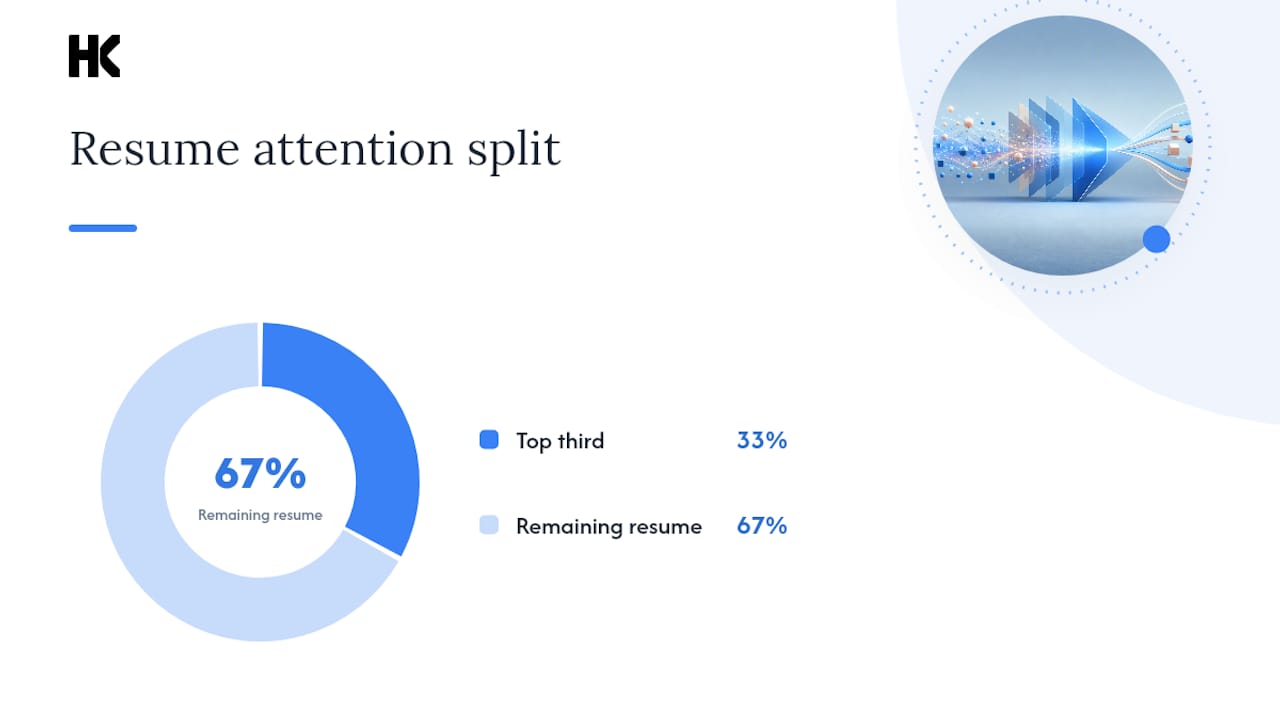
Recruiters spend very little time on a first pass, and ResumeGenius's research on resume scanning confirms that hiring managers look for clear signals fast, which is why the top third of your resume carries the most weight. This is sometimes called the seven-second rule: whatever a recruiter sees in that window, your title, your top bullet, your most recent client, decides whether they keep reading. If your strongest number isn't visible without scrolling, move it up.
Statistic to keep in mind: single-entry formats with standard headers and consistent date formatting parse more reliably across major ATS platforms than fragmented per-client entries, according to Hiring Lab's research on ATS parsing. Fragmented formatting is one of the more common reasons a freelance resume gets misread before a human ever opens it.
A few rules keep your file readable by both machines and people:
- File type: Save as a PDF unless the job posting specifically requests a Word document; PDFs preserve formatting across systems.
- Layout: Use a single-column layout. Multi-column templates and text boxes confuse many ATS parsers, which read left to right, top to bottom.
- Fonts: Stick to standard fonts (Arial, Calibri, Georgia) at 10 to 12 points. Decorative fonts can render as garbled text after parsing.
- Keywords: Pull key phrases straight from the job posting and place them in your title, your skills list, and at least one or two bullets. If the posting says "client retention," your resume should say "client retention," not "customer loyalty."
- File name: Name your file clearly, like "FirstName_LastName_Resume.pdf," not "Resume_final_v3.pdf." A clean file name is a small detail that recruiters do notice.
- Final check: Open the PDF on a different device before sending, and confirm your portfolio link is clickable, not just visible as text.
For a deeper look at how filters weed out resumes before a human ever sees them, JobAlign's breakdown of recruiter filters covers the mechanics in more detail than most guides bother to.
Where can you find freelance resume templates?
Not every template is safe for ATS, and picking the wrong one can undo everything else you've done right. Canva's freelance resume template library offers both categories: single-column, minimal-styling templates built for ATS compatibility, and design-forward layouts with columns, icons, and color blocking meant for creative fields where a hiring manager is judging visual sense as part of the application itself.
The rule of thumb: use an ATS-safe, single-column template for corporate, agency, or tech applications where a parser reads your resume first. Save design-forward templates for creative roles, art direction, illustration, or design portfolios, where the client or employer is explicitly evaluating your visual instincts through the resume itself.
For portfolio hosting, a dedicated link matters more than the platform you choose. Whether you use a personal site, Behance, Dribbble, or a simple PDF case study deck, link one destination in your header and curate what's on the other end. For design and creative roles, lead with visuals and finished work. For writing roles, lead with published pieces and measurable outcomes tied to them. For engineering roles, lead with a GitHub profile or a short case study explaining architecture decisions and results, not just a code repository with no context.
Should you write 'Freelance' or 'Self-Employed' on your resume?
The label you choose changes how the whole entry reads, so pick deliberately instead of defaulting to whatever feels casual.
"Freelance [Role]" works best when you want to emphasize the specific work you do (Freelance Copywriter, Freelance Web Developer) and you're applying somewhere that values specialization over business structure.
"Independent Consultant" signals a higher-level, strategy-oriented practice, useful if your freelance work leaned toward advising rather than executing, or if you're targeting corporate or agency roles that expect consultant-level positioning.
An LLC or business name works when you've formally incorporated and the name itself carries some recognition or adds legitimacy, particularly for anyone who has hired subcontractors or built something resembling a small agency.
| Label | Best fit | Why it works |
|---|---|---|
| Freelance [Role] | Specialized creative or technical work, applying to startups or agencies | Reads as focused expertise; matches how most job postings phrase the role |
| Independent Consultant | Strategy or advisory work, applying to corporate roles | Signals higher-level positioning and business judgment |
| LLC or business name | Formal business structure, especially with subcontractors | Adds legitimacy and shows you've built something beyond a single-person gig |
Whatever label you pick, use one continuous date range for the whole freelance period rather than breaking it into project-by-project spans. A single "2020 to Present" line reads as stability. Ten separate three-month ranges read as instability, even when the underlying work was steady the entire time.
Context changes the calculus, too. Startups tend to respond well to "Freelance [Role]" because they're hiring for a specific skill set fast. Agencies often prefer "Independent Consultant" if you're pitching strategic or client-facing work. Corporate hiring managers, especially in more traditional industries, sometimes respond best to an LLC or business name because it signals you've operated with some formal structure, not just picked up occasional gigs.
What do recruiters actually look for in a freelance resume?
Recruiters aren't hunting for reasons to reject a freelance resume, but fragmented client lists make their job harder, and a harder job usually means a faster "no." What triggers a skip is usually the same pattern: a dozen short entries with overlapping or unclear dates, no visible metrics, and no sense of what actually got delivered. What reassures a recruiter is the opposite: one continuous date range, aggregated results, and a clear sense of scope.
The freelancers who get called back aren't the ones with the longest client list. They're the ones whose resume answers, in ten seconds, what problem they solve and what number proves they solved it.
A grouping template you can copy directly: [Title], [Business Name or Self-Employed] — [Start Date] to Present. Underneath, three to five bullets, each following the action-verb-plus-result formula from earlier. If you've worked with recognizable brands, name one or two by title only ("worked with a Fortune 500 retail client") if a nondisclosure agreement prevents naming them directly, or name them outright if you can.
Pro Tip: If you're deciding what makes page one and what gets cut, prioritize recency and relevance over prestige. A smaller project from last month that maps directly to the job description will outperform a bigger, older project that doesn't, almost every time a hiring manager compares the two.
What I look for when I review a freelance resume
I read freelance resumes the way I read a project brief: I want to know what problem someone solved, how fast, and what changed as a result. Clarity beats volume every time. A resume with three tightly framed projects and real numbers attached tells me more in fifteen seconds than a resume with twelve vague client mentions tells me in two minutes.
The pattern I see most often with freelancers who get overlooked isn't a skills gap. It's a framing gap. They've done strong work, but they've presented it as a list of gigs instead of a track record. When I'm evaluating someone for a technical consulting engagement, the resumes that stand out are the ones where I can see, in one section, exactly what got built, what changed as a result, and where I can go to verify it myself.
That last part matters more than people think. A portfolio link that leads somewhere specific, not a generic landing page, does more work than another paragraph of self-description. If you're an engineer or product person trying to show what shipping something real looks like, the kind of outcome framing used in SaaS MVP project breakdowns is a useful model: name the constraint, name the build, name the result.
Sources
- Freelancing resume — Indeed Career Guide
- How to List Freelance Work on Resume: Complete Guide (2026) — ResumeGeni
- How to List Freelance Work on a Resume — Upwork Resources
- Freelancer Resume Example (2026) | WriteCV
FAQ
What is the seven-second rule for resumes?
The seven-second rule refers to how little time a recruiter typically spends scanning a resume before deciding whether to keep reading, which is why your title, dates, and top result need to be visible without scrolling.
How do I add freelance work to my resume?
List it like a job: one clear title, your business name or "Self-Employed," one continuous date range, and three to five bullets that quantify your results, with a portfolio link in your header.
Should I write 'freelance' or 'self-employed' on my resume?
Use "Freelance [Role]" when you want to highlight a specific specialty, and "Self-Employed" or an LLC name when you want to emphasize business structure or formality; both are acceptable as long as you pair the label with one continuous date range.
How do I handle gaps between freelance projects?
Use one continuous date range covering your full freelance period instead of separate ranges per project, since gaps between individual contracts are normal and don't need to be listed as breaks.
Should I list every client I've worked with?
No. Curate three to five projects that map closely to the job you're applying for, and group smaller or less relevant work under a single aggregated bullet or line.