
TL;DR:
- The best strategy combines a startup idea generator with a workspace app to organize ideas effectively. Solo founders should focus on tools like IdeaBuddy for validation and Notion for organizing, choosing others based on their stage and needs. Most founders benefit from using separate apps for discovery, validation, and organization, ensuring data privacy and exportability.
The best overall approach is to pair a dedicated startup idea generator with a workspace app for organization. For most solo founders, that means IdeaBuddy for structured validation, Notion for organizing and iterating, and either the Entrepreneurs Business Ideas iOS app or StartUp Ideas: 1000+ ideas on Android for quick discovery on the go.
Three things make this shortlist credible: all five tools offer a free tier, at least three include built-in templates (lean canvas or business plan), and two of the AI-assisted generators include validation experiments alongside the idea output.
Table of Contents
- How do the top business ideas apps compare?
- What each app actually does — and when to use it
- How do you choose the right app for your stage?
- What does an effective workflow look like in practice?
- When does building a custom idea-management app make sense?
- Key Takeaways
- What most founders get wrong about idea apps
- Fixed-price MVP development as an alternative to DIY tools
- Primary sources and further reading
- FAQ
How do the top business ideas apps compare?
| App | Best For | Primary Strengths | Platforms | Free Tier | Collaboration & Export | Privacy / Data Ownership |
|---|---|---|---|---|---|---|
| Entrepreneurs Business Ideas | Solo mobile capture | Idea capture, organization | iOS | Yes | Limited export | Standard App Store policy |
| StartUp Ideas: 1000+ ideas | Discovery on Android | Large idea bank, templates | Android | Yes | Limited | Standard Play Store policy |
| IdeaBuddy | Structured validation | Lean canvas, business plan, scoring | iOS, Android, Web | Yes (limited) | PDF/CSV export, team sharing | GDPR-aware, user owns data |
| Notion | Organizing & iterating | Templates, databases, AI features | iOS, Android, Web | Yes (generous) | PDF, CSV, Markdown, API | User owns data; Zapier/Slack |
| Trello | Visual idea pipeline | Kanban boards, Power-Ups | iOS, Android, Web | Yes | CSV export, Zapier | User owns data; Atlassian |
| Evernote | Capture & search | Notes, web clipper, tagging | iOS, Android, Web | Yes (limited) | PDF, HTML export | User owns data |
| MindMeister | Visual brainstorming | Mind maps, collaboration | iOS, Android, Web | Yes (3 maps) | PDF, PNG, OPML | GDPR-compliant, EU servers |
Quick selection pointers:
- Best solo capture on mobile: — Entrepreneurs Business Ideas (iOS) or StartUp Ideas (Android) for frictionless idea logging anywhere.
What each app actually does — and when to use it
Entrepreneurs Business Ideas
Available on the App Store, this app focuses on one thing: getting ideas out of your head and into a structured format fast. It covers capture and basic organization, which makes it a natural first stop for founders who think on their phones. The free tier is functional, though export options are thin. If your workflow ends at "capture and revisit later," it does the job without friction.
StartUp Ideas: 1000+ ideas
The Google Play version positions itself as a curated idea bank rather than a blank canvas. You browse categories, filter by industry, and save concepts that resonate. It is less about organizing your own thinking and more about sparking it. Useful at the very start of a search, less useful once you have a direction and need to validate.
IdeaBuddy
IdeaBuddy is the most complete business concept planner in this list for a solo founder who wants structure without hiring a consultant. It walks you through idea scoring, a lean canvas, a business plan outline, and a financial projection tool. The free tier is limited to one idea, but the paid plan is priced for early-stage budgets. Export to PDF and CSV is available, and the platform is GDPR-aware with clear data ownership terms.
Notion
Notion is not a startup idea generator. It is a workspace that becomes whatever you build inside it. The value here is flexibility: you can set up an idea database with custom fields (market size, validation status, priority score), link it to a project board, and share it with a co-founder in minutes. The free tier is genuinely generous. Notion's Zapier integration and native API mean it connects to nearly every tool in a typical founder stack. The tradeoff is setup time — you get out what you put in.
Trello
Trello works best as a visual pipeline for ideas moving through stages: raw idea, researched, validated, parked. Each card holds notes, attachments, and checklists. Power-Ups add Slack notifications, Google Drive attachments, and calendar views. For a small team that already uses Atlassian products, Trello slots in naturally. For a solo founder, it can feel like more board management than the idea volume warrants.
Evernote
Evernote's strength is capture speed and search. The web clipper grabs competitor pages, articles, and market research in one click. Tags and notebooks keep things organized. Where it falls short for idea validation is that it has no built-in scoring, no lean canvas, and no structured template for moving from idea to experiment. Think of it as the best inbox for raw material, not the place where ideas get tested.
MindMeister
MindMeister handles the messy early phase when an idea is still a cluster of related concepts rather than a defined problem. Visual mind maps let you branch out from a core theme, link related ideas, and share the map with collaborators in real time. The free tier caps you at three maps, which is tight if you are actively exploring multiple directions. Export to PDF and PNG works well for sharing with advisors or investors. For GDPR-conscious founders, MindMeister runs on EU servers.
Pro Tip: Connect MindMeister or Notion to Google Workspace via Zapier so that every new idea card or mind map node automatically creates a row in a shared Google Sheet. That sheet becomes your master idea log with timestamps, which is useful when you need to show an investor or co-founder the evolution of your thinking.
How do you choose the right app for your stage?
The decision comes down to three variables: where you are in the process, how many people are involved, and what you need the app to do after the idea is captured.
A founder at the "I have no idea what to build" stage needs a discovery tool first. The StartNew AI startup idea generator links ideas directly to target market segments and a launch plan, which cuts the gap between inspiration and direction. Free.ai's startup idea generator goes one step further by outputting a validation experiment alongside the idea, so you can test before you commit. Market-data tools like IdeaMine analyze App Store reviews at scale to surface opportunity scores, and GenerateIdeas.app grades ideas from "cold iron" to "white gold" based on real market signals. These are not apps you use every day; they are research tools you run before picking a direction.
Once you have a direction, the question shifts to organization and validation. Ask these questions before committing to any app:
- Does it connect to your existing stack? Zapier, Slack, and Google Drive integrations matter when your workflow spans multiple tools. Google Workspace covers collaboration, storage, and AI features that pair well with any idea-management tool.
Red flags: no export option, no privacy policy, no validation features, and a free tier that disappears after 14 days with no warning. Any app that cannot tell you where your data lives is not suitable for storing proprietary ideas.
What does an effective workflow look like in practice?
The fastest path from idea to validated hypothesis is: capture everything, filter ruthlessly, run one cheap experiment. Here is how that plays out in practice.
Capture phase. Log every idea immediately, in whatever app is open. Voice notes in Evernote, a quick card in Trello, a row in a Notion database. The format matters less than the habit. Tag each entry with a category (market, problem, solution) so you can filter later. Aim for 20–30 raw ideas before you start cutting.
Validation phase. Pick your top three ideas and run a one-page landing test for each. A simple page describing the product with an email signup costs nothing and takes a few hours. Pair it with five customer interviews (30 minutes each) to test the problem, not the solution. Tools like Free.ai and GenerateIdeas.app can suggest validation experiments tied to the idea's category. A fake-door test (a "buy now" button that leads to a waitlist) gives you pricing signal without building anything. For B2B SaaS validation specifically, the bar is higher: you want at least one letter of intent before writing code.
Prioritization phase. Score each idea on three axes: problem severity (1–5), market size (1–5), and your unfair advantage (1–5). Total score out of 15. Anything below 9 parks. Anything above 12 moves to a 7-day sprint.
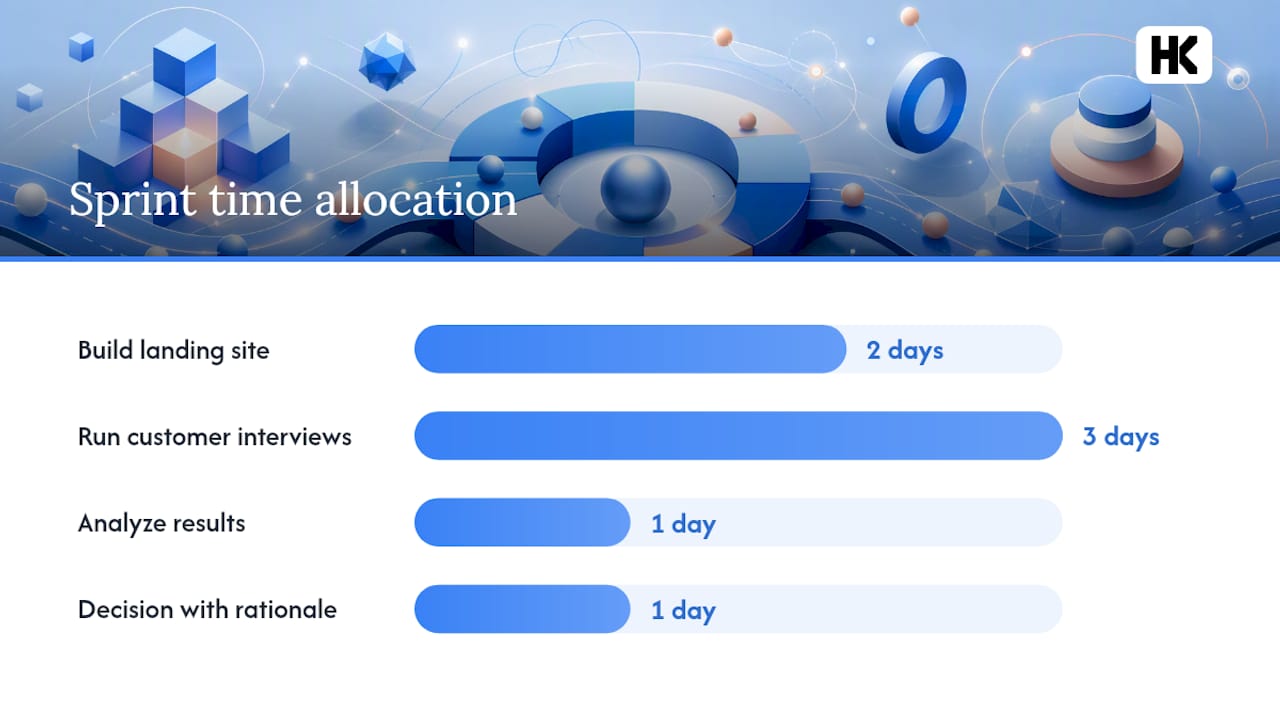
7-day validation sprint:
- Days 1–2: Build a one-page landing site and set up analytics.
- Days 3–5: Run five customer interviews; record key objections.
- Day 6: Analyze signup rate and interview themes.
- Day 7: Go/no-go decision with a written one-paragraph rationale.
This sprint costs almost nothing and tells you more than six months of internal debate.
When does building a custom idea-management app make sense?
Build custom when off-the-shelf tools cannot match your workflow, your IP capture requirements, or your compliance constraints. That is the one-line rule. For most founders at the idea stage, it does not make sense yet.
The cases where it does: you are capturing proprietary research that cannot live on a US-based SaaS server under standard terms (GDPR or EU AI Act compliance requirements); your team has a unique scoring model or integration need that no existing tool supports; or you are building an idea-management product itself and need to own the architecture.
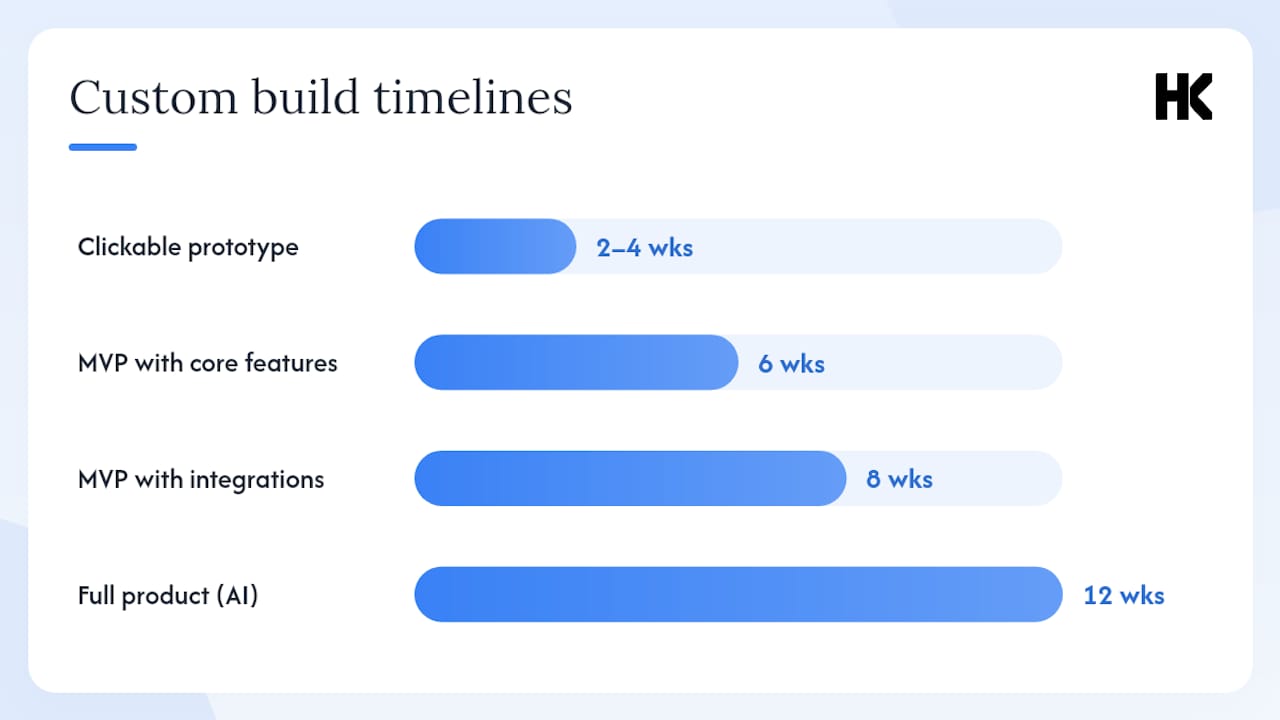
Realistic cost and timeline bands for a custom build are shown below.
| Scope | Timeline | Typical Deliverables |
|---|---|---|
| Clickable prototype | 2–4 weeks | Wireframes, user flows, validated UX |
| MVP with core features | 6 weeks | Auth, idea capture, basic scoring, export |
| MVP with integrations | 8 weeks | Above + Zapier/API, team collaboration, PDF export |
| Full product with AI features | 12 weeks | Above + LLM-assisted scoring, RAG, production monitoring |
Before you scope a build, work through this checklist:
- What is the data model? (How are ideas structured, tagged, and related?)
- What export formats are required from day one?
- Does the app need to comply with GDPR or the EU AI Act?
- Who owns the data, and where does it reside?
- What integrations are non-negotiable at launch vs. post-launch?
When interviewing an engineer, ask specifically about export-first design, GDPR data residency, and whether they have shipped AI features in production. Founders who bring in a technical partner early consistently scope tighter and ship faster than those who spec the product alone.
Pro Tip: Design for export before you design for features. An idea-management app that cannot export its data in a standard format (CSV, JSON, PDF) creates lock-in that costs you later. Build the export endpoint in week one, not week twelve.
Key Takeaways
The single most effective approach is to use a discovery generator to find direction, a structured validator like IdeaBuddy to test it, and a workspace tool like Notion to organize and share the work.
| Point | Details |
|---|---|
| Start with a generator | Use IdeaMine or GenerateIdeas.app to surface ideas grounded in real market data before committing to one direction. |
| Validate before you build | Run a 7-day sprint: landing page, five interviews, go/no-go decision on day seven. |
| Match the app to your stage | Solo discovery: Entrepreneurs Business Ideas or StartUp Ideas. Structured validation: IdeaBuddy. Team organization: Notion or Trello. |
| Check data ownership first | Read the terms before storing proprietary ideas in any cloud app; confirm export formats and data residency. |
| Hanadkubat for custom builds | When off-the-shelf tools hit compliance or workflow limits, Hanadkubat delivers fixed-price MVPs in 6–12 weeks from €18,000. |
What most founders get wrong about idea apps
The popular advice is to pick one app and stick with it. That sounds tidy, but it misses how idea development actually works. Discovery, validation, and organization are three different cognitive modes, and no single app handles all three well. IdeaBuddy is excellent for structured validation but weak for raw capture. Evernote is fast for capture but has no scoring. Notion is flexible for organization but requires setup before it is useful.
The smarter approach is a two-app stack: one for capture and discovery (mobile-first, frictionless), one for validation and organization (structured, exportable). Most founders already do this intuitively; the mistake is not acknowledging it and ending up with five apps and no system.
There is also a tendency to over-invest in the idea-management layer before validating anything. A founder who spends two weeks perfecting their Notion database before talking to a single customer has optimized the wrong thing. The app is infrastructure for thinking, not a substitute for it. Five customer interviews will tell you more than any scoring rubric built in isolation.
One more thing: EU and GDPR-conscious founders should treat data residency as a first-class requirement, not an afterthought. Several of the tools in this list store data on US servers by default. MindMeister and IdeaBuddy both offer GDPR-compliant options. For anything proprietary, check the terms before you paste your first idea.
Fixed-price MVP development as an alternative to DIY tools
When the apps in this list hit their ceiling — compliance requirements, unique workflow, or you are ready to build the product itself — Hanadkubat delivers fixed-price SaaS MVPs in 6–12 weeks, starting from €18,000, with no hourly billing and no junior team between you and the engineer writing the code.
The engineering pedigree behind this comes from BMW, Deutsche Bahn, and Bundesrechenzentrum Austria. Hanad has shipped his own SaaS products end-to-end and works directly with non-technical founders and B2B SaaS teams across the US and DACH region. Strategy sprints to scope and validate ideas before building start at €1,500 — a concrete way to test whether your idea is worth a full build before committing the budget.
If you are at the stage where a spreadsheet or a Notion database is no longer enough, see the full service details at hanadkubat.com and book a scoping call.
Primary sources and further reading
- Entrepreneurs Business Ideas - App Store - Apple
- StartUp Ideas : 1000+ ideas - Apps on Google Play
- Startup Idea Generator - AI-Powered Ideas from Concept to Launch Plan
- Free AI Startup Idea Generator | Free.ai
- IdeaMine - Stop Guessing What to Build
- GenerateIdeas.app: AI App Idea Generator & Validator | Find Profitable Ideas with Real Market Data
- 50+ Mobile App Business Ideas to Launch in 2026 (AI, ...)
- Zoho One | The Operating System for Business
- Small Business Collaboration Software and Tools | Google Workspace
FAQ
Which app is best for capturing business ideas?
For mobile capture, the Entrepreneurs Business Ideas app (iOS) and StartUp Ideas (Android) are the fastest options. For structured capture with validation built in, IdeaBuddy covers both.
What is the best app for starting a business?
IdeaBuddy is the strongest single tool for moving from idea to business plan, with lean canvas templates, scoring, and PDF export. Pair it with Notion for ongoing organization and team sharing.
What type of business is least likely to fail?
Service businesses with low overhead and a clear, recurring customer need tend to show the most durability. B2B SaaS products solving a specific workflow problem for a defined industry also carry lower failure rates than consumer apps, largely because the buyer has a measurable ROI to justify the purchase.
When should a founder build a custom idea-management app?
Build custom when compliance requirements (GDPR, EU AI Act), proprietary data models, or unique integration needs make off-the-shelf tools unworkable. For most early-stage founders, a two-app stack handles everything until the product itself is validated.