

Most enterprise AI processing clears the "likely to result in high risk" bar under GDPR Article 35, so the honest default is: assume you need an AI DPIA until screening proves otherwise. The immediate move is a short screening pass, a documented conversation with your DPO, and a written record of the outcome either way. Everything below walks through the screening criteria, the step-by-step process, the risk families specific to AI, and a checklist you can copy straight into your own template.
TL;DR:
- Most AI systems handling personal data likely require a full DPIA under GDPR, especially if they profile, make decisions, or process special categories of data.
- Risk criteria from national authorities, such as model development, dataset scale, or data about vulnerable groups, can trigger DPIA requirements even with a single strong factor.
- An AI-specific DPIA must address opacity, model drift, and emergent behaviors beyond traditional data flow assessments to be effective and compliant.
- Thorough documentation, including model architecture, data provenance, bias metrics, monitoring plans, and risk mitigation owners, is essential for defending AI DPIAs.
- Continuous re-validation is crucial after retraining, data source changes, or provider updates to ensure ongoing compliance and risk management.
Table of Contents
- When Is an AI DPIA Required?
- Why Generic DPIA Templates Miss AI-Specific Risk
- The Step-by-Step AI DPIA Process
- AI-Specific Risk Families: Model, Data, Deployment, Legal
- Mitigations That Actually Hold Up for AI Systems
- Mapping the AI DPIA to EU AI Act Obligations
- What to Put in an AI DPIA Checklist or Template
- Governance, Sign-Off, and Prior Consultation
- Keeping the DPIA a Living Document
- Author Perspective: What Actually Matters for Small Teams
- How I Can Help: Fixed-Price AI DPIA and Delivery
- Sources
- FAQ
When Is an AI DPIA Required?
GDPR Article 35 sets the trigger: a DPIA is mandatory when processing is "likely to result in a high risk to the rights and freedoms of natural persons." Most AI systems that touch personal data, especially anything involving profiling, automated decisions, or large-scale inference, land inside that definition without much argument. The Irish Data Protection Commission's guidance frames this plainly: if you're not sure, the safer assumption is that you need one.
National authorities give you sharper tools than the regulation text alone. The Dutch DPA (Autoriteit Persoonsgegevens) lists nine risk criteria drawn from the old WP29 guidance, and meeting two or more of them typically obliges a DPIA. The CNIL goes further for AI specifically, treating model development and large-scale training datasets as standalone triggers regardless of how many other criteria apply.
Run your screening against these questions before you do anything else:
- Does the system use special category data (health, biometric, sexual orientation, political opinion) at any pipeline stage, including training?
- Does it make or materially inform decisions about individuals, especially ones with legal or significant effects (hiring, credit, pricing, access to services)?
- Does it profile people at scale, or combine datasets from multiple sources?
- Does it process data about vulnerable groups, or use novel technology (which most generative AI still is, from a regulatory maturity standpoint)?
- Is the processing opaque to the people affected, meaning they cannot reasonably anticipate what happens to their data?
Hit two or more, and you're past the threshold the Dutch DPA describes. Even a single strong criterion, like training on special category data, is often enough on its own for an AI system.
The record-keeping part matters as much as the analysis. Document the screening outcome even when you conclude a full DPIA isn't required. Regulators increasingly expect to see the reasoning, not just the final answer, and an undocumented "we decided we were fine" is close to worthless if a data subject complaint or an audit ever arrives.
Why Generic DPIA Templates Miss AI-Specific Risk
A DPIA template built for a CRM rollout asks reasonable questions: what data, what purpose, what retention period, what security controls. None of that captures what actually goes wrong with AI systems.
Three gaps show up repeatedly:
- Opacity. A logistic regression model can be explained in a sentence. A fine-tuned language model or a retrieval-augmented pipeline often can't be explained at all, even by the team that built it, which breaks the standard "describe the processing" field.
- Drift. Traditional processing stays static once deployed. Model behavior shifts as it's retrained, as the underlying provider updates a foundation model, or as a RAG index gets new documents. A DPIA written for a snapshot in time goes stale fast.
- Emergent behavior. Large language models sometimes produce outputs (hallucinated facts about real people, leaked training data fragments) that no static risk checklist anticipates, because the risk didn't exist in the system design; it emerged from the model itself.
A checklist-only DPIA that never engages with these mechanics reads, to an auditor or a regulator, as evidence the organization didn't understand what it built. That's a weaker position than having no DPIA at all in some enforcement contexts, because it shows the gap between paperwork and actual comprehension. The practical consequence: your DPIA needs a section that describes model behavior in plain language, not just data flows and legal bases.
The Step-by-Step AI DPIA Process
The ICO's staged methodology gives you the skeleton. Adapting it for AI means adding detail at each stage that a generic DPIA would skip entirely.
- Screen and scope. Apply the criteria above, decide whether a full DPIA is required, and write down the reasoning either way.
- Identify stakeholders and map data flows. Bring in the DPO early, and involve whoever owns the model, the data pipeline, and the product decision to deploy it. Map every stage: data collection, preprocessing, training or fine-tuning, inference, and any retrieval step feeding a prompt.
- Describe the system. Document model architecture (foundation model, fine-tune, RAG layer, agentic chaining), training and inference data sources, and how outputs feed back into decisions affecting people.
- Assess necessity and proportionality. State the purpose plainly, then ask whether a less invasive method (a smaller model, a rules-based system, human review without automation) could achieve it. Regulators look for evidence you considered alternatives, not just that you picked the flashiest option.
- Identify and prioritize risks. Work through the risk families below, rank by likelihood and severity, and note which risks are residual after planned mitigations.
- Plan mitigations and get sign-off. Assign an owner to each mitigation, get documented DPO advice, and record the final decision, including any disagreement between the DPO and the business owner.
Pro Tip: Do the data-flow mapping before you write a single word of the risk section. Most weak AI DPIAs skip straight to "we use AI, here are the risks" without ever documenting what actually happens to the data between collection and output. The EDPB's guidance on LLM data flows is a useful reference for how granular that mapping should get, especially for RAG systems where a document retrieved at inference time can carry personal data the model was never trained on.
Treat step 4 as more than a formality. "Necessity and proportionality" is where a lot of AI DPIAs get thin, because teams assume the AI system is obviously justified by business value. Regulators don't accept that framing. Write down what a non-AI alternative would have looked like, and why it was rejected. That single paragraph often does more to protect the organization than the entire risk-mitigation table.
AI-Specific Risk Families: Model, Data, Deployment, Legal
A defensible AI DPIA works through four cumulative risk families rather than a single generic risk score. Skipping any one of them leaves an obvious gap an auditor will find.
Model risk covers bias in outputs, hallucination (confident but false statements, sometimes about real, identifiable people), weak explainability, and vulnerability to adversarial prompts designed to extract training data or bypass guardrails. Test for these directly rather than trusting a vendor's marketing claim about "fairness."
Data risk covers provenance (where did the training data come from, and did the organization that collected it have a lawful basis to pass it on), the presence of special category data, retention periods for both training data and inference logs, and whether the lawful basis for the original collection actually covers AI training as a purpose.
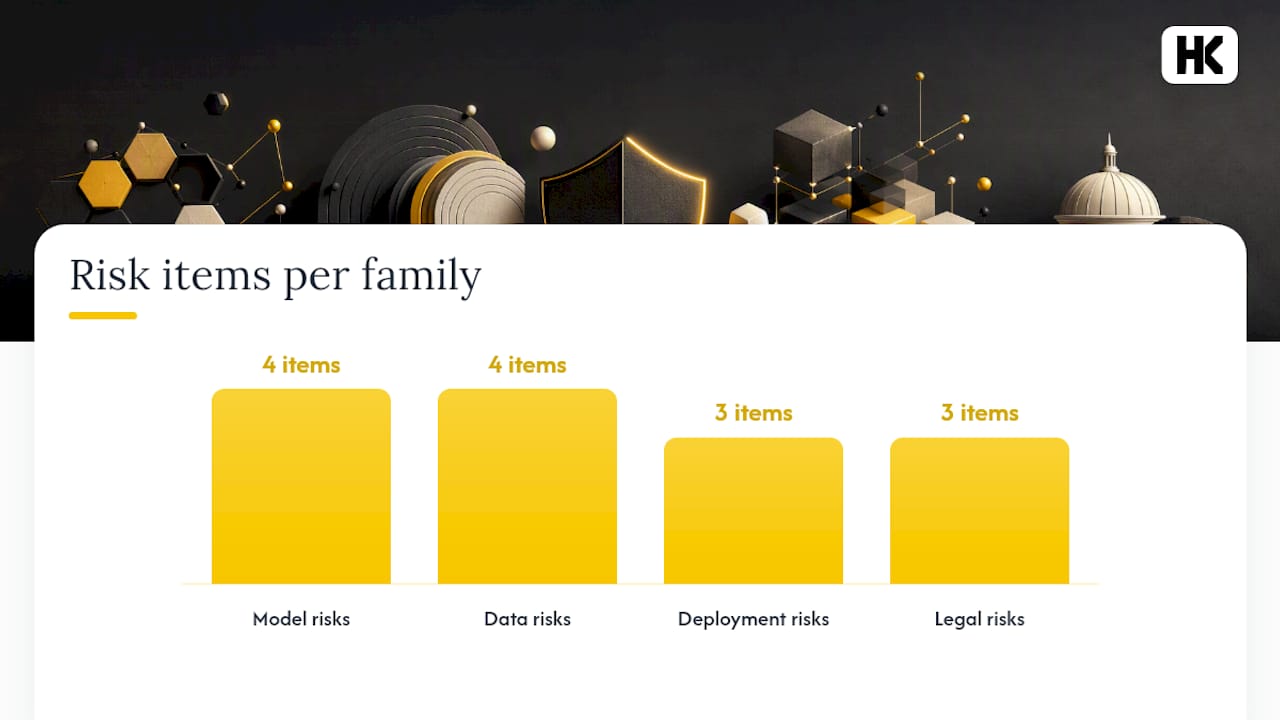
Deployment risk covers human oversight (is there a real human in the loop, or a rubber stamp), redress mechanisms (can a person challenge a decision the AI made), and ongoing monitoring once the system is live rather than just at launch.
Legal risk covers international transfers (many foundation model providers process data outside the EU/EEA) and the growing overlap with EU AI Act obligations, which layer additional documentation and risk-management duties on top of GDPR.
- Model: bias, hallucination, explainability, adversarial robustness
- Data: provenance, special categories, retention, lawful basis for AI use specifically
- Deployment: human oversight quality, redress paths, live monitoring
- Legal: cross-border transfers, AI Act interaction, vendor contract terms
The EDPB's LLM-specific guidance walks through concrete mitigations for several of these, particularly around training data memorization and prompt injection risks that don't have a clean equivalent in traditional processing.
Mitigations That Actually Hold Up for AI Systems
Generic security controls (encryption, access logging) still matter, but they don't touch the risks that are specific to how AI models behave. The mitigation plan needs three layers.
Technical controls: input filters that catch attempts to extract training data or inject malicious prompts, anonymization or pseudonymization applied before data reaches training or fine-tuning, explainability tooling appropriate to the model type, and continuous output monitoring rather than a one-time pre-launch test.
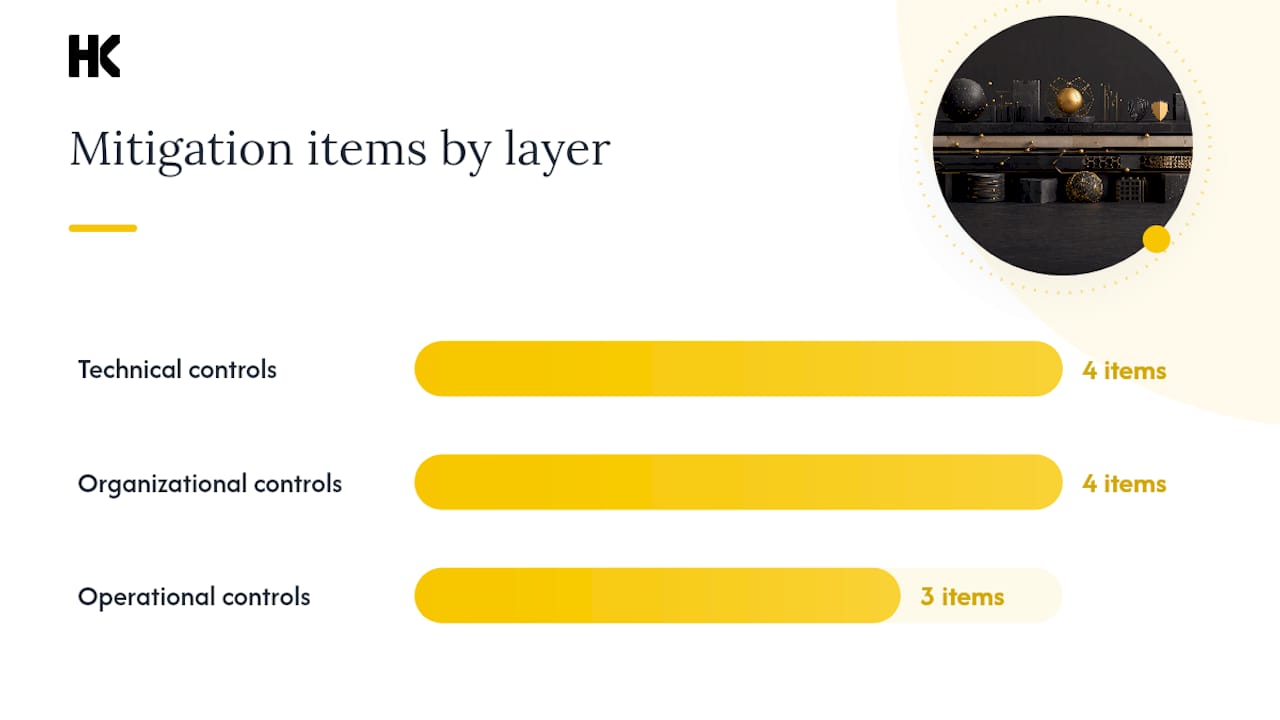
Organizational controls: a human-in-the-loop requirement (HHI) for any decision with a legal or significant effect, tiered access control so not every engineer can query production data, vendor contract clauses that specify data use limits and deletion obligations, and a testing regimen that runs before every material model or prompt change, not just at initial launch.
Operational controls: retrain gates that require a documented risk review before any new training run goes live, an incident playbook specific to model failures (a hallucination that caused harm, a bias finding, a data leak through a prompt), and logging detailed enough to reconstruct what a model did and why after the fact.
- Input filtering and anonymization before training or fine-tuning
- Human-in-the-loop sign-off for high-stakes automated decisions
- Vendor clauses covering data use, retention, and deletion
- Retrain gates tied to a documented risk review
- Incident playbook specific to model failure modes, not generic security incidents
Pro Tip: If you're running a vendor-supplied model rather than training your own, the contract clauses matter as much as any technical control you build. A vendor risk assessment that pins down data retention and deletion terms in writing closes a gap most AI DPIAs leave open by default.
Mapping the AI DPIA to EU AI Act Obligations
Running a DPIA and a separate AI Act conformity assessment as two disconnected exercises wastes effort neither team has to spare. Many organizations now produce one extended DPIA that covers both, since the underlying documentation overlaps substantially.
Risk management, data quality checks, and documentation requirements under the AI Act map cleanly onto sections a DPIA already covers: your risk identification stage doubles as AI Act risk management evidence, and your data provenance fields feed directly into AI Act data governance documentation. My own breakdown of EU AI Act compliance steps goes into more detail on where the two frameworks line up.
Where they don't overlap: the AI Act's annex-level technical documentation for high-risk systems goes deeper than a standard DPIA on model architecture specifics, testing protocols, and conformity evidence. Budget separate time for that annex rather than assuming your DPIA sections will stretch to cover it.
- Risk management → DPIA risk identification section
- Data governance and quality → DPIA data provenance fields
- Technical documentation (annex-level) → needs dedicated AI Act work beyond the DPIA
- Cross-reference your Article 30 processing records against the AI Act technical file so both documents tell the same story
What to Put in an AI DPIA Checklist or Template
Every AI DPIA needs the standard mandatory fields plus a set of AI-specific entries most templates don't include by default.
Standard fields: project metadata (owner, date, review cycle), documented DPO advice with a timestamp, a plain-language description of the processing, and a full data flow map from collection through output.
AI-specific fields: model architecture and type, training data provenance and lawful basis, fairness or bias metrics and how often they're checked, an explainability summary written for a non-technical reader, and a monitoring plan naming who reviews outputs and how often.
- Project metadata and DPO advice, with reasons recorded if the business diverges from that advice
- System and data flow description, including any RAG or third-party model component
- Necessity and proportionality analysis with alternatives considered
- Risk register scored across all four risk families
- Mitigation plan with named owners
- Sign-off record and prior consultation decision
- Retain evidence of each fairness metric run, not just the final pass/fail
- Flag any residual high risk that survives mitigation for prior consultation review
Governance, Sign-Off, and Prior Consultation
Documented DPO advice is not optional once you have a DPO. Record what the DPO recommended, and if the business proceeds differently, write down why. That gap between advice and decision is exactly what a regulator asks to see first.
Article 36 requires prior consultation with the supervisory authority when a DPIA concludes that residual risk stays high even after mitigations. Timelines vary by authority, but expect weeks rather than days, so build that into your launch schedule rather than discovering it the week before go-live.
- Store DPO advice, the final decision, and the reasoning gap between them in one governance record
- Trigger prior consultation only when mitigated risk stays high, not for every AI project
- Keep the consultation outcome and any DPA correspondence with the DPIA itself, not in a separate email thread
Keeping the DPIA a Living Document
Treat re-validation as event-driven, not just calendar-driven: a model retrain, a new data source, or a provider swap should each trigger a fresh look, on top of a routine review (commonly annual).
- Retrain, new training data, or provider change: re-validate before deployment
- Keep bias audit logs, performance metrics, and incident reports as standing artifacts
- Tie each monitoring output back to the DPIA's review section so the document reflects current reality, not launch-day assumptions
Author Perspective: What Actually Matters for Small Teams
Early-stage teams don't need a fifty-page DPIA. They need a screening decision, a written risk register, and one monitoring habit that actually runs. Skip the theater and put your effort into evidence: a documented decision on why a risk is acceptable beats a beautifully formatted template nobody revisits.
Single-author accountability matters more here than people expect. When one person owns the code and the compliance story together, there's no gap where "the vendor said it was fine" replaces an actual answer. That's the same discipline that makes code maintainable during a handover: one name, one clear record, nothing hidden behind a slide deck.
The common failure I see isn't missing paperwork. It's a DPIA nobody has opened since launch day.
— Hanad Kubat
How I Can Help: Fixed-Price AI DPIA and Delivery
I offer an alternative to a compliance consultancy retainer for teams that need a defensible AI DPIA without hiring a firm for months: fixed price, fixed scope, single accountable engineer service. I build the DPIA alongside the actual system, mapping data flows, model architecture, and risk mitigations against the real codebase, not a slide deck describing it secondhand. That means the documentation matches what's actually running in production, and the remediation roadmap that follows is something the next engineer can pick up without guessing what a previous consultant meant.
The output is scoped at kickoff: a DPIA, an implementation roadmap for the mitigations that matter, and minimal remediation where the current system falls short. No hourly billing, no surprise invoices partway through. If you want a straight answer on scope and cost for your project, check what a fixed-price engagement looks like.
Sources
Keep these close when you write or defend a DPIA. The ICO's DPIA guidance gives the clearest staged methodology. The EDPB's LLM risk guidance covers mitigations specific to language models. The CNIL's DPIA guidance and the Dutch DPA's AI rules offer national-level detail on triggers and scope worth citing directly in your own records. For structured data risks feeding into training pipelines, the free structured-data audit tool is a quick way to spot exposure points before they reach a model.
This article is general information, not a substitute for advice from a qualified lawyer. Consult a qualified legal professional about your own circumstances before acting on anything here.
- Data Protection Commission (Ireland) — DPIA guidance
- ICO — How do we do a DPIA?
- CNIL — Carrying out a data protection impact assessment if necessary
FAQ
What Does DPIA Stand For?
DPIA stands for Data Protection Impact Assessment, a structured process required under GDPR Article 35 to identify and mitigate privacy risks before processing begins.
Is a DPIA a Legal Requirement?
Yes, under GDPR Article 35, a DPIA is mandatory whenever processing is likely to result in a high risk to individuals' rights, and most enterprise AI systems meet that threshold.
Is ChatGPT GDPR-Compliant?
Whether a specific deployment is compliant depends on how an organization configures data retention, training opt-outs, and international transfer safeguards, not on the underlying model alone; each deployment needs its own DPIA and risk analysis rather than relying on a vendor's general compliance claims.
How Long Does an AI DPIA Take to Complete?
Timelines vary by system complexity, but a screening decision can take days, while a full AI DPIA with stakeholder consultation and DPO sign-off typically takes several weeks, especially when prior consultation with a supervisory authority is triggered.