
TL;DR:
- Most startups fail because they build the wrong thing with full confidence, not due to slow code or limited budgets. Product discovery reduces risk by turning fuzzy ideas into testable assumptions before development begins, ensuring teams build what users actually want. Continuous discovery fosters evidence-based decision-making, improves product-market fit, and creates a collaborative approach that separates 'product work' from 'project work'.
Most founders believe speed is the ultimate edge. Ship fast, iterate fast, win fast. But that intuition quietly bankrupts more startups than slow development ever did. The real culprit is not slow code or small budgets. It is building the wrong thing with full confidence. Product discovery's role is to reduce the risk of building the wrong thing by turning unclear startup ideas into testable assumptions before committing significant engineering time. This article breaks down what product discovery actually is, why it sits at the foundation of every successful early-stage build, and how to use it when working with a technical partner.
Table of Contents
- Why product discovery matters before you build
- The four key risks product discovery addresses
- Continuous product discovery: cadence and real-world practice
- How discovery separates 'product work' from 'project work'
- Navigating edge cases and scope tradeoffs in discovery
- What most founders miss about product discovery
- How we help founders nail product discovery
- Frequently asked questions
Key Takeaways
| Point | Details |
|---|---|
| Discover before building | Product discovery reduces the risk of wasted effort by validating key assumptions before significant engineering begins. |
| Focus on key risks | Tackle value, usability, feasibility, and viability risks systematically rather than guessing or over-engineering. |
| Make discovery continuous | High-performing teams prioritize weekly user input and rapid testing, increasing confidence and reducing post-launch pivots. |
| Distinguish product vs project work | Understand what to build before rushing to deliver—your technical partner should embrace discovery, not just coding. |
| Prioritize learning over scope | Use simple prototypes to validate what matters, not perfectionist scope that slows you down. |
Why product discovery matters before you build
Product discovery, in plain language, is the structured work you do before writing production code. It is the phase where you figure out whether a problem is real, whether your solution actually fits that problem, and whether anyone will pay for it. It is not a brainstorming session. It is not a slide deck exercise. It is disciplined, evidence-gathering work that shapes every technical decision that follows.
Most non-technical founders get this wrong in one specific way. They conflate activity with progress. They see every week without a shipped feature as a week wasted. So they push their technical partner to start building immediately. That pressure feels justified. In reality, it often locks in the wrong architecture, wrong feature set, and wrong user flow months before the first real user ever touches the product.
Here is the danger of that mindset. The complete guide to product discovery makes the case clearly: discovery reduces the risk of building the wrong thing by converting fuzzy startup ideas into testable assumptions. Without that conversion step, every line of code is a bet placed without data.
Discovery as a concept breaks down into four simple activities:
- Talking to real users about real problems they experience today
- Generating potential solutions without committing to any single one
- Prototyping and testing those solutions before full development begins
- Using what you learn to refine or redirect your technical roadmap
"Don't just ship. Discover what matters." The teams that internalize this do not just build faster. They build the right thing the first time, which is exponentially more valuable than raw speed.
The practical difference becomes visible when you compare two early-stage teams. One team jumps straight into development with a backlog of assumed features. The other spends three weeks on targeted discovery before writing a single line of code. After six months, the first team has a polished product that nobody wants. The second team has a leaner, rougher build that real users actually pay for. Discovery is not the slow path. It is the shortcut to a working business.
Understanding the product validation process is closely tied to discovery. Validation is the specific act of confirming that your assumptions match reality. Discovery is the broader discipline that makes validation possible.
The four key risks product discovery addresses
With discovery's purpose established, zoom in on the four specific risks it reduces. These are not abstract categories. Each one maps to a real failure mode that kills startups every year. Missing even one is enough to sink an otherwise promising product.
Value risk is the most common. This is the risk that your product does not actually solve a problem people care about enough to pay for or change behavior over. Founders often assume demand based on personal experience or anecdotal feedback from friends. Neither is reliable. Value risk goes unresolved when teams skip user interviews and jump straight to wireframes.

Usability risk is subtler. Your product might solve a real problem, but if users cannot figure out how to use it without hand-holding, they churn. This risk shows up in onboarding flows, navigation structures, and feature placement. It is rarely obvious until real users try to navigate the product on their own.
Feasibility risk is the technical one. Can this actually be built within your budget, time, and tech stack? Founders without engineering backgrounds often underestimate how technically complex certain features are. A good technical partner surfaces feasibility risk early so you are not three months in before discovering that the core feature requires an integration that costs six figures per year.
Viability risk is about the business model. Even if users love the product and it can be built, does it generate enough revenue to sustain a company? Discovery uncovers viability risk through pricing experiments, revenue model testing, and channel validation.
Discovery reduces value, usability, feasibility, and viability risk before you commit your development budget. Here is a clear comparison of what happens with and without it:
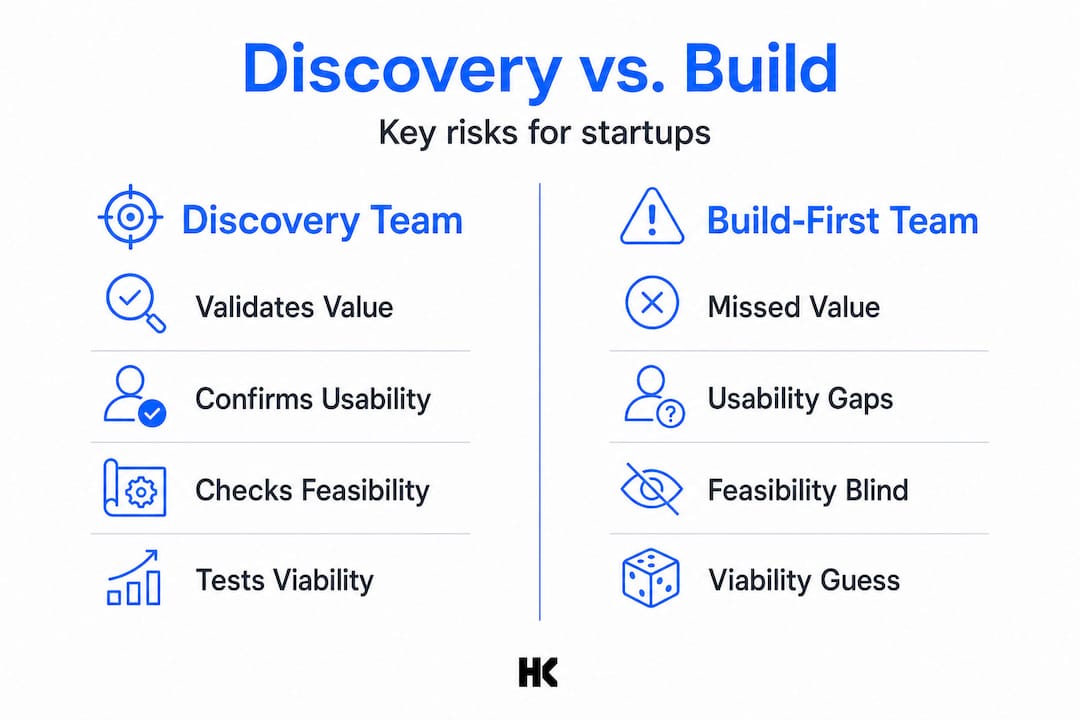
| Risk type | Discovery-driven team | Build-first team |
|---|---|---|
| Value | Validates demand through user interviews before building | Builds based on assumptions; discovers mismatch post-launch |
| Usability | Tests flows with prototypes; adjusts before engineering begins | Discovers UX issues after users churn |
| Feasibility | Technical partner flags complexity early; scope is calibrated | Engineering surprises surface mid-sprint; budget balloons |
| Viability | Tests pricing and model with MVT (minimum viable tests) | Builds full product before testing revenue model |
See the pattern? Build-first teams spend their budget finding out what discovery would have told them for free.
Pro Tip: Do not try to eliminate every risk at once. Identify your single biggest assumption, the one that, if wrong, collapses your entire business, and test that first. Then move to the next. Trying to address all four risks simultaneously leads to analysis paralysis, which is just a slower version of not discovering anything. Check these validation steps to sequence your discovery work properly.
Continuous product discovery: cadence and real-world practice
Understanding the risks is important. Applying discovery as a living, ongoing process is what actually separates high-performing teams from the rest. Discovery is not a one-time research phase you complete before development starts. It is a discipline you maintain throughout the life of the product.
The 2026 State of Product Discovery report puts hard numbers to this. Continuous discovery teams report 2.4 times fewer post-launch pivots and 31% higher confidence in their roadmap decisions. Yet only 28% of product managers have two or more substantive customer conversations per week. That gap is enormous. Most teams know they should talk to users regularly. Very few actually do it consistently.
Here is a data snapshot of how often product teams engage with real users:
| Conversation frequency | % of product teams |
|---|---|
| 2+ per week | 28% |
| 1 per week | 19% |
| A few times per month | 31% |
| Monthly or less | 22% |
The teams in the top row build products that users actually want. The teams in the bottom two rows are largely guessing. The data is uncomfortable because it means that the majority of product teams are operating on stale assumptions most of the time.
For a non-technical founder working with a technical partner, continuous discovery changes the nature of your collaboration. Instead of handing over a fixed requirements document and waiting for delivery, you and your partner are running small experiments together, updating your understanding of the user, and adjusting scope based on what you learn. This is slower in the short term. It is dramatically faster in terms of reaching product-market fit.
Here is how to start continuous discovery if you are brand new to it:
- Block two hours per week for user conversations. No agenda other than understanding your user's current problems and workflows. Do not pitch your product. Listen.
- After each conversation, write down one assumption that was confirmed and one that was challenged. Share both with your technical partner. These feed directly into build decisions.
- Run at least one small test each sprint. This could be a clickable prototype, a landing page variant, or a manual simulation of a feature. The goal is to replace assumption with evidence before committing dev time.
The discipline of continuous discovery also keeps lean product creation from becoming a buzzword. Lean is only possible when you have a real feedback loop. Without regular user contact, "lean" just means "building less stuff" rather than "building the right stuff." There is a huge difference. These best practices for non-technical founders give you a solid operational framework for making discovery a weekly habit rather than an occasional exercise.
How discovery separates 'product work' from 'project work'
Now that continuous discovery is clear, address how it shapes your collaboration with technical partners. There is a distinction that most founders never hear about, and missing it creates massive friction in any technical partnership.
Product work is figuring out what to build and why. Project work is the actual delivery, the design, code, testing, and deployment. Both are necessary. But they require completely different modes of thinking, and they should not happen simultaneously without structure.
Marty Cagan, one of the most influential product thinkers in the industry, frames this clearly. "Discovery separates product work from project work" in a way that matters critically when non-technical founders need a technical partner. The partner's job is to help uncover the right problem and solution first, not just ship faster. This reframes what a good technical partner actually does.
A technical partner who only ships fast is a contractor. A technical partner who engages in discovery with you is a co-founder without equity. The difference is not just about relationship type. It is about outcomes. A contractor builds what you specify. A discovery-oriented partner challenges your specifications before committing to them.
Here is what that looks like in practice:
- You describe a feature you want. A project-mode partner starts estimating dev hours immediately.
- A discovery-mode partner asks: "What user behavior are we trying to change with this feature? What happens if we test the assumption behind it first?"
- That single question can save weeks of development time and thousands of euros.
"A technical partner who ships code without asking hard questions first is costing you more than their invoice suggests."
This is why the importance of technical partners goes beyond technical execution. The right partner brings a product mindset to every conversation. They push back on scope when the discovery work is incomplete. They insist on validation before implementation, not because they are slow, but because they have seen what happens when teams skip that step. Explore how technical consulting for founders bridges the gap between product thinking and technical execution.
Pro Tip: When evaluating a technical partner, do not judge them only by their portfolio or tech stack. Ask them: "Tell me about a time you pushed back on a client's feature request." If they cannot answer that question, they are a contractor, not a partner. You want someone who treats discovery as professional discipline, not an inconvenience.
Navigating edge cases and scope tradeoffs in discovery
Once you understand the value of separating discovery and delivery, you will run into a specific practical trap. It is called edge case obsession, and it kills more MVPs than technical debt ever will.
Here is how it happens. You start discovery. You map out your core user flow. Then someone in the room asks: "But what about users who do X?" Then someone else asks about Y. Then Z. Before long, your "discovery phase" has become an exhaustive requirements catalog that takes longer to write than the product would take to build.
Teams must balance completeness with learning speed, using structured discovery and prototype tests rather than trying to enumerate every edge case before any release. That balance is hard to maintain under the pressure of perfectionism. But perfectionism at this stage is just fear wearing a productive disguise.
The smarter approach looks like this:
- Identify your core happy path. This is the most common scenario for your most important user. Build and test this first, fully, before touching anything else.
- Use prototypes, not specifications, to surface real edge cases. Real users doing real tasks in a prototype reveal edge cases that no planning session ever will. And they reveal them much faster.
- Categorize edge cases by frequency and impact. An edge case that affects 2% of users and causes mild confusion is not the same as one that affects 40% of users and breaks their workflow. Only the second one belongs in your MVP scope.
- Use post-launch support data to inform future scope. What are users actually asking for? What errors are they hitting? Real behavior data is a better edge case detector than any brainstorming session.
"Shipping something imperfect that users can react to is worth more than perfecting something no one has touched yet."
This is where startup product strategy gets real. Strategy is not about planning everything. It is about deciding what not to build right now. Every edge case you deprioritize is a decision, not an oversight. Make that decision consciously, with data, and move on.
The discipline of scoping down is uncomfortable for founders who feel responsible for every potential user scenario. But lean product development only works when you trust that shipping a focused, tested core feature is more valuable than shipping a bloated, untested feature set. Discovery gives you the confidence to make those scope calls because you know which assumptions you have already validated and which ones are still untested bets.
What most founders miss about product discovery
Here is the uncomfortable truth I have come to after building products for BMW, Deutsche Bahn, and IBM, and then building my own SaaS products from scratch. Most founders treat product discovery like a prerequisite they need to pass before getting to the "real work." They see it as a tax on engineering time. Get through the interviews, do the prototype, check the box, now let's build.
That mindset misses the entire point.
Product discovery is not a one-time test you pass. It is an organizational learning engine. When you run discovery consistently, something shifts beyond just your product decisions. Your entire team starts operating from evidence instead of opinion. Arguments about features stop being about who has the loudest voice or the most confidence. They become conversations about what the data says. That shift is worth more than any individual feature decision.
The best technical partners I have seen, and the standard I hold myself to, treat discovery as an ongoing muscle. Not something you do at the start of an engagement and then abandon. Not a deliverable. A habit. Every sprint, every user conversation, every experiment result either confirms or challenges what you think you know. That feedback loop is the actual engine of startup progress.
There is also an emotional dimension that nobody talks about. Founders who skip discovery make product decisions from a place of anxiety. They are always wondering whether they built the right thing. That uncertainty leaks into every team conversation, every investor meeting, every pricing discussion. Founders who maintain continuous discovery make decisions from a place of evidence-backed confidence. They still face uncertainty. But they know what they know, and they know what they do not know yet. That distinction is massive.
Redefine what progress means for your startup. Progress is not lines of code shipped. Progress is assumptions replaced with evidence. Progress is a user interview that flips your understanding of a core feature. Progress is a prototype test that saves you eight weeks of development time. If you want to track this properly, start with this step-by-step validation guide to build your discovery practice from the ground up.
The founders who win are not the ones who shipped fastest. They are the ones who learned fastest and built confidence in their decisions before committing to them.
How we help founders nail product discovery
If this article has made one thing clear, it is that product discovery is not optional. It is the difference between building a product users love and building one that teaches you an expensive lesson.
At hanadkubat.com, I work directly with non-technical founders who are done hypothesizing and ready to build something real. Before writing a single line of code, we run a structured discovery process together, mapping your riskiest assumptions, running fast prototype tests, and confirming what the product actually needs to be. No agency overhead. No project manager playing telephone. You work directly with a senior engineer who has built products at Fortune 500 scale and shipped his own SaaS from zero. If you are ready to move from idea to validated, production-ready product, let's talk about what your discovery process should look like before we touch the tech stack.
Frequently asked questions
What does product discovery look like for super early-stage founders?
Product discovery for early founders means talking to real users weekly, testing assumptions quickly with simple prototypes, and adjusting plans based on actual feedback. The 2026 State of Product Discovery report shows only 28% of product managers have two or more customer conversations per week, which means simply maintaining that cadence puts you ahead of the majority.
Can I skip product discovery if I already know the market?
Even with deep market experience, skipping discovery risks building features your specific users do not actually want. Product discovery's role is to turn opinions, including experienced ones, into evidence before you invest heavily in engineering time.
How do I know if my technical partner is good at discovery?
A strong technical partner pushes back on feature requests before estimating them, insists on validating assumptions with real users, and is transparent about what is still unknown. As Cagan's product model makes clear, the partner's job is to uncover the right problem first, not just ship code faster.
Should discovery cover every edge case before launch?
No. Founders should prioritize the biggest risks first and use actual post-launch data to decide which edge cases are worth building for later. Trying to enumerate every edge case before release slows learning without meaningfully improving outcomes.