

TL;DR:
- A proof of concept is a small-scale experiment that tests the technical feasibility of an idea before investing significant resources.
- It delivers evidence, not a product, and must be carefully scoped to avoid shifting into prototype development.
A proof of concept (PoC) is a focused, small-scale experiment that tests whether a specific idea is technically feasible before any significant resources are committed. The goal is not to build a product. The goal is to answer one question: can this actually work? Teams that run a PoC early catch fatal flaws before they become expensive mistakes. That single discipline separates projects that ship from projects that stall.
What is proof of concept in software development?
A proof of concept is a small-scale, focused experiment designed to validate the technical feasibility of a specific idea or method before significant investment. In software development, that typically means writing just enough code to confirm that a given approach is viable. It is not a demo. It is not a pitch deck. It is a technical verdict.
Three terms get confused constantly in product teams: PoC, prototype, and MVP. Each serves a different purpose.
- Proof of concept: Answers "can this work technically?" Scope is narrow. Code is disposable.
- Prototype: Answers "how should this look and feel?" Demonstrates design and usability to stakeholders.
- Minimum viable product (MVP): Answers "will real users pay for this?" A market-ready version with enough features to test demand.
Using the wrong approach at the wrong stage causes inefficiency and confusion. A team that skips the PoC and builds a prototype is spending design budget on an idea that may not be technically possible. A team that treats a PoC as an MVP is shipping unfinished, untested code to real users.
A software PoC can take many forms: a short script testing API throughput, a database query measuring latency under load, or a small integration confirming that two systems can exchange data in the required format. The deliverable is evidence, not a product. That evidence can be code, a document, a recorded test run, or a presentation of results.

What are the key steps in conducting a proof of concept?
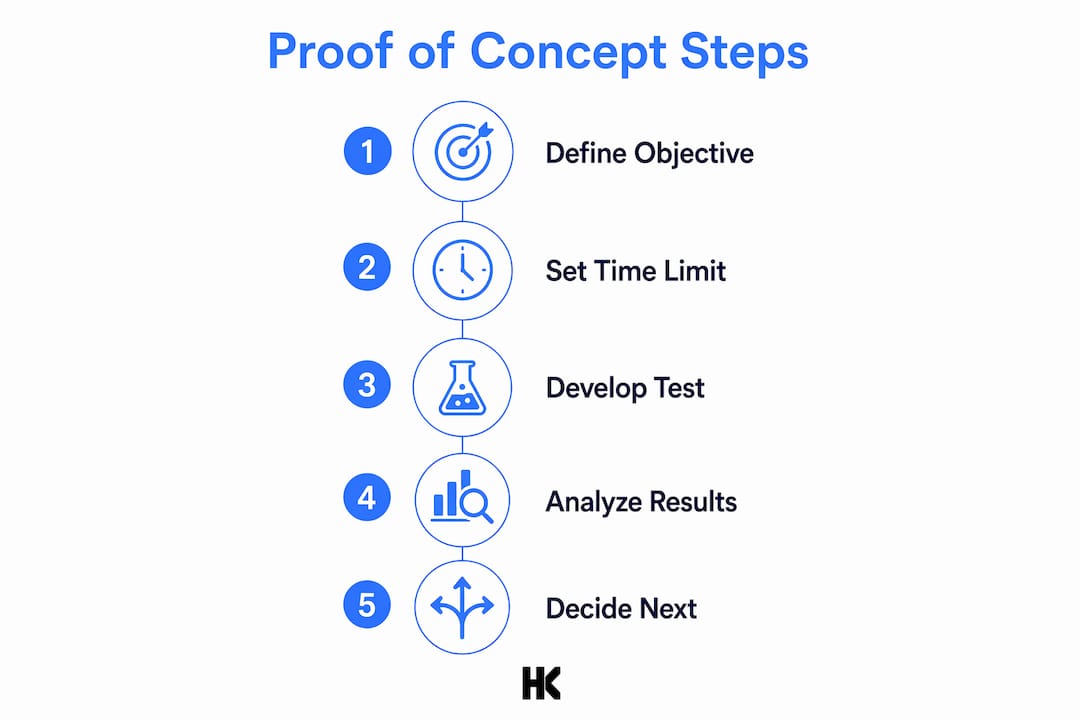
The standard PoC process involves five phases: defining the problem, identifying success criteria, selecting the technical approach, executing the experiment, and documenting results. Each phase is distinct. Skipping one collapses the whole structure.
- Define the problem. State the specific technical question the PoC must answer. "Can our system process 10,000 concurrent API requests without exceeding a 200ms response time?" is a good problem definition. "Can we build a good API?" is not.
- Set success criteria. Decide what a passing result looks like before writing a single line of code. US General Services Administration guidelines emphasize clear output criteria to produce valid and defensible PoC results. Criteria defined after the fact are not criteria. They are rationalizations.
- Select the technical approach. Choose the method, tools, and architecture you will test. Keep this narrow. The PoC tests one approach, not all possible approaches.
- Execute the experiment. Build only what is needed to answer the question. Resist adding features. Resist polishing the code. This is a throwaway test.
- Document the results. Record what happened against the predefined criteria. Proper documentation provides objective evidence for stakeholder review and supports confident go/no-go decisions.
Pro Tip: Set a hard time limit before you start. If the PoC is not complete in one to two weeks, the scope is too large. Shrink the question, not the timeline.
Scope control is the hardest part of running a PoC. The moment a team starts adding error handling, logging, and a user interface, the PoC has become a prototype. That shift defeats the purpose of the experiment entirely.
What are common types and examples of proof of concept projects?
Not all PoCs are the same. The distinction between a "steel thread" PoC and a "proof of technology" PoC profoundly affects project outcomes in complex engineering work.
| PoC type | What it tests | When to use it |
|---|---|---|
| Steel thread | Full technology stack, end to end | When integration across multiple systems is the core risk |
| Proof of technology | A single component or library | When one specific tool or protocol is unproven |
| Feasibility study | Business and technical viability combined | When both cost and technical risk are unknown |
Choosing the wrong type is a common cause of wasted effort. A team testing a single machine learning model in isolation (proof of technology) will not learn whether that model can actually integrate with their existing data pipeline. That requires a steel thread.
Common software PoC examples include:
- Testing whether a third-party payment API can handle the required transaction volume
- Confirming that a chosen database engine supports the query patterns the product needs
- Verifying that a real-time data sync between two SaaS platforms is technically possible
- Running a small language model inference test to check latency and cost per query before committing to a full AI feature build
For non-technical founders, a PoC does not always require code. A product development guide for non-technical teams can help clarify which technical questions need engineering validation and which can be answered through research or vendor conversations.
What practical benefits and limitations does a proof of concept provide?
A PoC reduces the risk of building technically unfeasible or unprofitable software products. That is its primary value. Teams that skip this step often discover fundamental technical blockers after months of development, when the cost of changing direction is far higher.
The benefits are concrete:
- Early failure detection. A PoC surfaces blockers in days, not months.
- Objective stakeholder decisions. Results are evidence, not opinion. Stakeholders can say yes or no based on data.
- Avoiding sunk cost fallacy. Engineering leadership values PoC equally for disproving bad ideas as for confirming good ones. Killing a project after a two-week PoC is a win, not a failure.
- Focused team effort. A well-scoped PoC keeps engineers working on the highest-risk question instead of building features that may never ship.
The limitations are equally real. A PoC is not a full product test. It tests one specific condition, often under ideal circumstances. A positive PoC result does not guarantee that the full system will perform the same way at scale, under real user load, or with production data.
A PoC that confirms feasibility under controlled conditions can create false confidence. The question it answers is narrow by design. Teams must resist treating a passing PoC as proof that the entire product will work.
False negatives are also possible. A poorly designed PoC can reject a viable idea because the test itself was flawed. This is why success criteria must be defined before execution, not after.
How to integrate proof of concept into your product development lifecycle
A PoC belongs at the very beginning of the development lifecycle, before prototype work and well before MVP development. Its job is to clear the path. If the PoC fails, the team avoids spending months building something that cannot work. If it passes, the team moves forward with confidence.
The PoC also plays a direct role in funding and stakeholder approval. Investors and internal decision-makers respond to evidence. A documented PoC result is far more persuasive than a slide deck. It shows that the team has already tested the hardest part of the idea and knows it is buildable.
Alignment with the broader product lifecycle requires discipline. The PoC must stay isolated from the prototype phase. Once a PoC passes, the code is typically discarded. The disposable experiment principle is not optional. Code complexity during a PoC often signals that the team has crossed into prototype territory, which defeats the experiment's purpose.
Pro Tip: After a successful PoC, write a one-page summary of what was tested, what passed, and what remains unknown. That document becomes the foundation for your prototype brief and keeps the next phase honest.
For teams moving from PoC to MVP, the MVP validation checklist at Hanadkubat covers the market viability questions that a technical PoC cannot answer. Technical feasibility and market fit are separate problems that require separate tests.
Key Takeaways
A proof of concept is the fastest, cheapest way to confirm technical feasibility before committing engineering resources to a full build.
| Point | Details |
|---|---|
| PoC tests feasibility only | A PoC answers one technical question. It is not a prototype or a market test. |
| Define success criteria first | Set measurable pass/fail criteria before writing any code to prevent scope creep. |
| Treat it as disposable | PoC code is throwaway. If complexity grows, the experiment has become a prototype. |
| Two PoC types serve different needs | Use a steel thread for cross-stack validation; use a proof of technology for component-level tests. |
| Documentation drives decisions | Record results against predefined criteria so stakeholders can make confident go/no-go calls. |
The mistake I see most often with PoCs
Most teams I work with understand the concept of a PoC. They struggle with the discipline it requires. The most common mistake is not skipping the PoC entirely. It is letting the PoC quietly become a prototype without anyone noticing.
It starts with good intentions. The engineer adds a bit of error handling "just to make it cleaner." Then a basic UI appears "so stakeholders can see it." Then someone asks for a second feature to be tested at the same time. Three weeks later, the team has a fragile, half-built prototype that nobody wants to throw away because too much work has gone into it. That is the sunk cost fallacy in action, and the PoC was supposed to prevent exactly that.
The fix is structural, not motivational. Set a time box before you start. Write the success criteria on a shared document that everyone can see. Agree in advance that the code will be deleted when the test is done. Those three constraints keep the experiment honest.
At Hanadkubat, the strategy sprint (€1,500) exists precisely for this moment. Before a client commits to a full MVP build, we scope the highest-risk technical questions and design a PoC that answers them in days. That work has saved clients from building the wrong thing more times than I can count. The goal is always to find out what does not work as early and as cheaply as possible.
— Hanad
Validate your idea before you build
Running a PoC is the right first move. But knowing what to test, how to scope it, and when to stop requires experience with real product development.
Hanadkubat works with non-technical founders and early-stage SaaS teams across the DACH region and internationally. The strategy sprint at €1,500 is a fixed-price engagement that scopes your idea, identifies the highest-risk technical assumptions, and defines a PoC that gives you a clear answer fast. No months-long discovery process. No vague deliverables. If you are at the stage where you need to know whether your idea is buildable before spending serious money, the SaaS MVP development services at Hanadkubat are the right next step.
FAQ
What is the definition of a proof of concept?
A proof of concept is a small-scale experiment that tests whether a specific idea is technically feasible before significant resources are invested. Its purpose is to produce a clear pass or fail result against predefined criteria.
How does a PoC differ from a prototype?
A PoC tests technical feasibility. A prototype demonstrates design and usability. The PoC comes first and its code is typically discarded once the question is answered.
What does a software proof of concept look like?
A software PoC is typically a short script, integration test, or isolated code module that answers one specific technical question, such as whether an API can handle required load or whether two systems can exchange data in the needed format.
How long should a proof of concept take?
A well-scoped PoC should take one to two weeks. If it takes longer, the scope is too broad and the experiment has likely crossed into prototype territory.
When should a team skip the PoC and go straight to an MVP?
A team can skip the PoC when the core technical approach is already proven and the primary unknown is market demand rather than feasibility. In that case, moving directly to MVP validation is the faster path to a real answer.