

TL;DR:
- Consulting provides strategic guidance and technical execution for early SaaS MVPs.
- It helps avoid costly architectural mistakes and manages technical risk.
- Growing market demand is driven by digital transformation, compliance, and high engineer salaries.
Most non-technical SaaS founders assume the fastest path to launch is hiring a freelance developer and getting out of their way. That instinct is understandable. But it skips the single most important variable: knowing what to build before you build it. Consulting is not a luxury reserved for funded startups with a VP of Engineering already on payroll. It is the mechanism that turns a product idea into a working, scalable system without the six-month rebuild that so many early founders quietly suffer through. This guide breaks down what SaaS consulting actually involves, why it outperforms the alternatives, and what the data says about where the market is heading.
Table of Contents
- Understanding the consulting landscape in SaaS
- What consultants actually do: From technical strategy to MVP launch
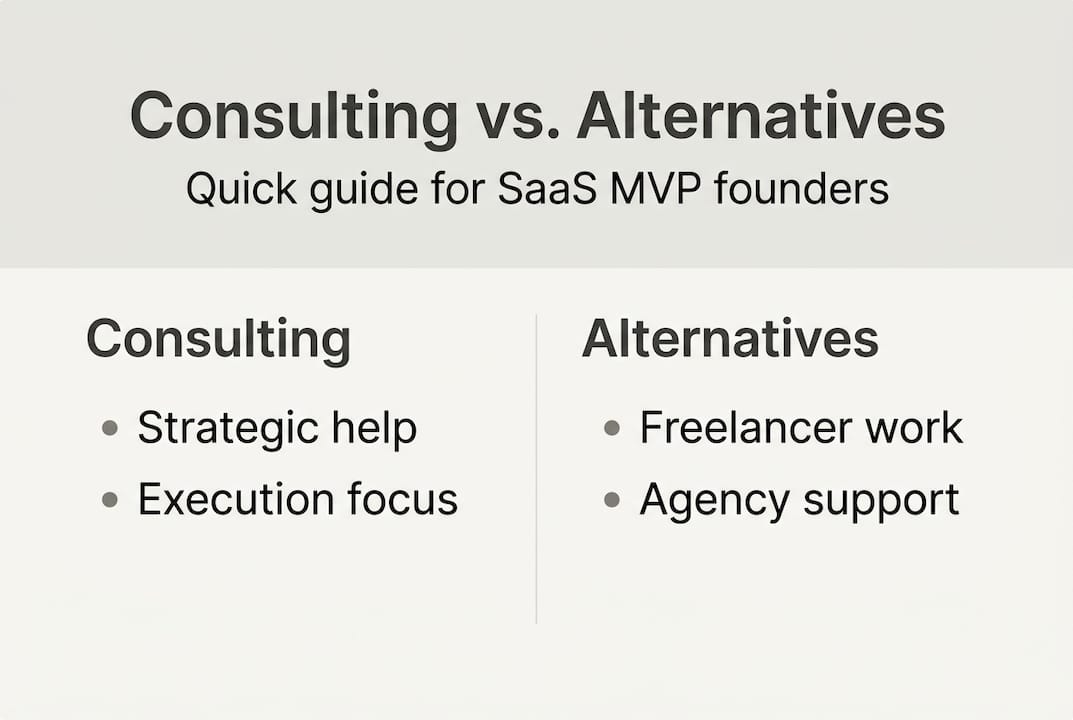
- Consulting vs. alternatives: Weighing your options
- Current trends: Why consulting demand in SaaS keeps growing
- Consulting for SaaS: What most founders underestimate
- Ready to accelerate your SaaS with expert consulting?
- Frequently asked questions
Key Takeaways
| Point | Details |
|---|---|
| Consultants enable clarity | A good SaaS consultant builds both your technical vision and your MVP, reducing early-stage confusion. |
| More than code | Consultants deliver strategic leadership, not just software—crucial for non-technical founders. |
| Better decisions, faster launches | Founders who work with consultants typically avoid costly missteps and ship production-ready MVPs in less time. |
| Market demand is rising | The SaaS consulting market continues to grow, reflecting its value for fast-moving startups. |
Understanding the consulting landscape in SaaS
Let's begin by clarifying what consulting really involves in the SaaS world, and how it differs from other types of services founders might consider.
The word "consultant" gets used loosely. In the SaaS context, a consultant is someone who provides both strategic direction and technical execution, not just one or the other. That distinction matters enormously for non-technical founders who often cannot evaluate technical trade-offs on their own. As one honest breakdown puts it, consulting offers strategy and execution while freelancers are mostly execution-focused. That gap in strategic input is exactly where early MVPs fall apart.
So what does the broader landscape look like? Here is a direct comparison:
| Option | Strategy | Execution | Accountability | Best for |
|---|---|---|---|---|
| Consultant | Yes | Yes | High | Non-technical founders, complex MVPs |
| Freelancer | No | Yes | Low | Defined, scoped tasks |
| Agency | Sometimes | Yes | Medium | Larger budgets, brand work |
| AI-assisted build | No | Partial | None | Prototypes, demos |
Freelancers are great when you know exactly what you need built. The problem is most early-stage founders do not know that. You might think you need a dashboard when what you actually need is a data pipeline that makes the dashboard possible. A consultant catches that before a single line of code is written.
Agencies sit in a middle ground. They bring teams, which sounds good, but it also means project managers, handoffs, and communication overhead that slows things down. AI-assisted builds have their place, but they produce prototypes, not production-ready systems.
A few things consulting gives you that nothing else does:
- A technical roadmap tailored to your business goals
- Architecture decisions made before they become expensive mistakes
- A single accountable person who understands both the business and the code
If you are still deciding whether you even need a web app or a mobile product, working through web vs mobile for SaaS early with a consultant saves weeks of misdirection. And before any code starts, validating your SaaS idea with someone who has shipped products before is worth more than any wireframe tool.
"The gap between a great idea and a working SaaS product is not talent. It's the strategic clarity to build the right thing in the right order."
What consultants actually do: From technical strategy to MVP launch
Now that we've mapped the consulting landscape, let's see what specific roles a SaaS consultant plays to get your MVP shipped.
The work a consultant does is not glamorous. It is methodical, and it starts well before anyone opens a code editor. Here is how the process typically unfolds:
- Discovery and scoping — The consultant digs into your idea, your users, and your constraints. This is where feature lists get cut down to what actually matters for launch.
- Technical roadmap — A sequenced plan of what gets built, in what order, using what tools. This is the document that prevents scope creep from destroying your timeline.
- Architecture design — Decisions about your database, your API structure, your authentication layer. Get these wrong early and you pay for it forever. The importance of MVP architecture cannot be overstated here.
- Build and iteration — The consultant writes the code or directly supervises it. Either way, they own the output and stay accountable to the roadmap.
- Launch preparation — Environment setup, deployment pipelines, monitoring. The gap between "it works on my machine" and "it works for 500 users" is exactly what this step covers. A solid resource on launching a SaaS app explains what this actually requires in practice.
One of the most underappreciated roles a consultant plays is risk mitigation. Consulting reduces MVP risks by combining technical strategy with hands-on execution, which means the person making architectural decisions is the same person living with the consequences of those decisions.
Pro Tip: Avoid using generic boilerplate SaaS templates as your starting architecture. They look fast at first, but they bake in assumptions about your product that may conflict with how your users actually behave. A consultant customizes the foundation so you are not fighting your own codebase six months in.
Technical debt is real and it accumulates fast. Every shortcut taken during the build phase is a future sprint that does not go toward new features. Consultants are trained to spot these traps and avoid them before they are buried in your product.
Consulting vs. alternatives: Weighing your options
It's equally important to see how consulting stacks up against alternatives so you can choose the path that fits your vision, budget, and timeline.
The honest answer is that each option works in the right context. The mistake founders make is choosing based on upfront cost rather than total cost of outcome.
| Scenario | Best option | Why |
|---|---|---|
| First MVP, non-technical founder | Consultant | Strategy plus execution, no knowledge gaps |
| You know exactly what to build | Freelancer | Faster, cheaper for scoped tasks |
| Large team, brand-heavy product | Agency | Bandwidth and specialization |
| Demo or internal prototype | AI-assisted | Speed over quality |
Freelancers can pose quality risks when there is no oversight layer, and consultants address that by combining delivery with accountability. This is the distinction the consultant vs freelancer comparison makes clearly.
One risk that does not get discussed enough is technical lock-in. When you use a "build vs. buy" shortcut, like an off-the-shelf SaaS framework or no-code tool for something that needs to scale, you often inherit that tool's limitations permanently. Migrating away from a bad foundation is expensive and disruptive.
Here is what to watch for when evaluating your options:
- Does this person or team understand your business model, not just the tech?
- Who is accountable when something breaks post-launch?
- Can this approach support the core SaaS features your users will actually need on day one?
For early-stage founders with limited runway, the goal is not the cheapest option. It is the option that delivers a working product with the fewest expensive surprises. Consulting, done right, consistently wins that comparison.
Current trends: Why consulting demand in SaaS keeps growing
To understand where the market is heading and why consulting is becoming indispensable, let's look at recent trends and data.
The consulting market is not slowing down. Consultancy services are projected to grow at 5.7% CAGR through 2033, driven by digital transformation pressure across every industry. That growth is not just big enterprise contracts. A meaningful share of it comes from early-stage tech companies that need senior expertise without the overhead of a full-time hire.
In Europe specifically, SaaS founders face an interesting pressure: competitive global markets, strict data regulations like GDPR, and a talent pool that is expensive to access at the senior level. Consulting becomes a practical solution because it provides senior-level judgment without the full-time salary commitment.
| Trend | Impact on founders |
|---|---|
| Digital transformation pressure | Faster MVP timelines, higher quality bar |
| GDPR and compliance complexity | Need for architecture that is compliant from day one |
| Rising senior engineer salaries | Consulting as a cost-effective alternative |
| AI tool proliferation | Increased demand for humans who can evaluate AI output |
Here is the statistic that should stop you cold: most SaaS MVPs fail not because of poor marketing, but because of poor technical roadmaps. They ship a product that cannot scale, cannot integrate, or was built on assumptions that were never pressure-tested. Consulting is the mechanism that pressure-tests those assumptions before they cost you real money.
If your goal is a fast MVP launch, speed without direction is just expensive thrashing. And if you want to stay current on SaaS MVP trends heading into 2026, the pattern is consistent: the founders who ship well are the ones who invested in strategic clarity before the first sprint.
Consulting for SaaS: What most founders underestimate
With data and options in view, here's the perspective most early SaaS founders miss until it is almost too late.
The biggest myth I see repeated is that strategy can wait until after the MVP is built. The reasoning goes: ship fast, learn fast, then fix the architecture once you have real users. That sounds logical. In practice, it is how you end up six months in with a system that cannot handle a second customer tier, a third-party integration you promised, or a pricing model change.
Consulting bridges what I call the "unknown unknowns" gap. You do not know what you do not know about your own product until someone with pattern recognition from building ten similar systems tells you. That is not something you can Google your way around.
The founders who avoid the expensive rebuilds are the ones who treated consulting as an investment in the foundation, not a cost to minimize. Even a single session to stress-test your architecture decisions before build can prevent months of painful refactoring later.
A decision as seemingly simple as web or mobile can shape your entire technical roadmap. Getting that wrong on your own, without someone who has seen both paths play out, is an avoidable risk.
Ready to accelerate your SaaS with expert consulting?
If you're ready to move from idea to execution, here's how to get expert help.
Building a SaaS product as a non-technical founder is hard enough without also having to figure out architecture, tech stack choices, and launch infrastructure on your own. The data is clear, the case is made, and the founders who move fastest are the ones who pair sharp business vision with someone who can execute at a senior engineering level.
At hanadkubat.com, you get exactly that: Fortune 500 engineering discipline applied at founder speed. No agency overhead, no project managers in the middle, no guesswork. Just a senior engineer who has built his own SaaS products and knows how to get yours to market in 4 to 12 weeks. If your MVP needs to be right the first time, this is where to start.
Frequently asked questions
How is SaaS consulting different from hiring a freelancer or agency?
Consultants provide strategy and execution while freelancers typically focus only on development tasks and agencies often introduce team overhead with less tailored direction.
What does a SaaS consultant typically deliver to early-stage founders?
Expect a technical roadmap, architecture recommendations, and direct contribution to building a working MVP. Consultants provide technical leadership from concept through launch.
Is consulting really necessary if I use boilerplate SaaS frameworks?
Boilerplate solutions introduce technical lock-in that can constrain your product as it grows. Consulting helps you evaluate whether a template fits your use case before you are committed to it.
How fast can I expect to launch with a consultant's help?
Many early-stage SaaS founders go from idea to working MVP in under 90 days when working with an experienced consultant, depending on scope and complexity.
Why is SaaS consulting demand rising in 2026?
Digital transformation and fast-moving markets require specialized expertise quickly. Consultancy services are projected to grow at 5.7% CAGR through 2033, reflecting how critical this expertise has become.
Recommended
- SaaS MVP: Launch fast without a technical co-founder | HK
- MVP trends for 2026: build winning SaaS products faster | HK
- Mobile app development for SaaS founders: ship faster in 2026 | HK
- Lean product creation guide: fast-track your SaaS MVP | HK
- App marketing tips to boost visibility and conversions in 2026 – AppScreenKit