

A realistic MVP costs $20,000 to $150,000, depending on complexity, with the most straightforward SaaS builds landing between $30,000 and $60,000. The one rule that matters more than the number itself: never commit more than 30 to 40% of your available capital to the build, so you still have runway left for the part that actually determines survival, getting real users to use the thing. This breakdown, by Hanad Kubat, shows where that money goes.
TL;DR:
- Most MVPs cost between $15,000 and $60,000 based on complexity, with simple SaaS builds typically falling under $30,000.
- The average MVP budget should allocate no more than 30 to 40 percent of available capital to ensure sufficient runway for user validation.
- Adding a second user role, real-time features, or multiple third-party integrations can increase costs by 15 to 20 percent or more, especially beyond the standard tier.
- The budget is fairly evenly split across discovery, design, frontend, backend, QA, DevOps, management, and launch, with backend and frontend consuming over half.
- Building on a web platform is usually more cost-effective than native app development unless native features are essential for core functionality or validation.
Table of Contents
- What Determines Your MVP Cost Breakdown?
- How Is an MVP Budget Split Across Categories?
- Which Team Model Gives You the Best Rate?
- Does Your Platform Choice Change the Price?
- What Hidden Costs Catch Founders Off Guard?
- How Do You Calculate Your MVP Budget?
- Where Can You Cut Cost Without Losing the Validation?
- How Long Should Each Build Phase Take?
- What Are Hanad Kubat's Rules for Delivering an MVP?
- What the Cost Data Actually Tells You
- Get a Fixed-Price MVP Built in Weeks, Not Months
- Sources
- FAQ
What Determines Your MVP Cost Breakdown?
Your MVP falls into one of five cost bands, and the band is set less by how "big" your idea feels and more by how many systems have to talk to each other correctly on day one.
Simple MVP: $15,000 to $30,000, 4 to 8 weeks. A single core workflow, one user type, basic auth, no third-party integrations beyond maybe email. Think a booking form, a simple directory, a content tool with one clear job.
Standard MVP: $30,000 to $60,000, 6 to 10 weeks. Multiple user roles, a payment integration, a handful of screens that need to work together, some data that persists and gets queried in useful ways. This is where most funded first products live.
Complex MVP: Real-time features (chat, live updates), marketplace dynamics with two-sided matching, or workflows that touch several external services at once, typically requiring several months. Hour estimates for this tier typically run 250 to 400 hours, nearly double a lean SaaS build.
AI-native MVP: $80,000 to $130,000, 10 to 16 weeks. Anything with a retrieval pipeline, a custom model layer, or agentic behavior. AI features alone add 40 to 80% on top of an equivalent traditional feature, because you're paying for the pipeline, the monitoring, and the inference bill, not just the interface.
Enterprise-grade MVP: $130,000 and up, 14 to 20 weeks. Multi-tenant architecture, SSO, audit logging, compliance documentation baked in from the start. Building enterprise-grade features too early is often unnecessary and can be an expensive mistake.
A few things push a project up a tier that founders don't expect:
- Adding a second user role (admin plus customer) usually adds 15 to 20% to frontend and backend hours.
- Any real-time feature, chat, live notifications, live dashboards, adds complexity disproportionate to how it looks in a mockup.
- Every third-party integration beyond the first one (payments) adds testing and error-handling time, not just setup time.
- Wanting "AI" without a clear use case for it inflates cost without adding validation value.
Quick self-classification check: count your user roles, count your external integrations, and ask whether anything needs to happen in real time. Zero to one of each, you're simple. Two of each, you're standard. Three or more, or anything AI-driven, you're complex or above.
How Is an MVP Budget Split Across Categories?
Every dollar in an MVP budget goes into eight buckets, and the percentage split holds fairly steady whether you're spending $30,000 or $130,000. Here's the typical allocation:
| Category | Share of Budget | What It Buys |
|---|---|---|
| Discovery | 8 to 12% | Scoping, requirements, technical planning |
| Design | 10 to 15% | UI/UX, wireframes, design system |
| Frontend | 20 to 30% | User-facing screens and interactions |
| Backend | 25 to 30% | Data, business logic, APIs |
| QA | 8 to 12% | Testing, bug fixing, edge cases |
| DevOps | 5 to 8% | Deployment, CI/CD, infrastructure setup |
| Project management | 8 to 10% | Coordination, communication, tracking |
| Launch | 3 to 5% | Final deployment, monitoring setup |
Pro Tip: When a vendor quote skips discovery entirely, treat that as a warning sign, not a discount. Skipping the scoping phase is the single most common way founders end up with a rebuild six months later.
Run those percentages against an $80,000 mid-range MVP and the picture gets concrete fast: roughly $8,000 to $9,600 for discovery, $10,000 to $12,000 for design, $18,400 to $24,000 for frontend, $20,000 to $24,000 for backend, $7,200 to $9,600 for QA, $4,000 to $6,400 for DevOps, $6,400 to $8,000 for project management, and $2,400 to $4,000 for launch.
QA is the line item founders cut first and regret most. An MVP with broken auth or a payment flow that fails silently doesn't just look bad, it kills the validation you're trying to run. If a real user can't sign up or can't pay, you've spent your whole budget without learning anything.
Founders who budget $0 for maintenance are usually the ones calling six months later asking why the app broke overnight.
Which Team Model Gives You the Best Rate?
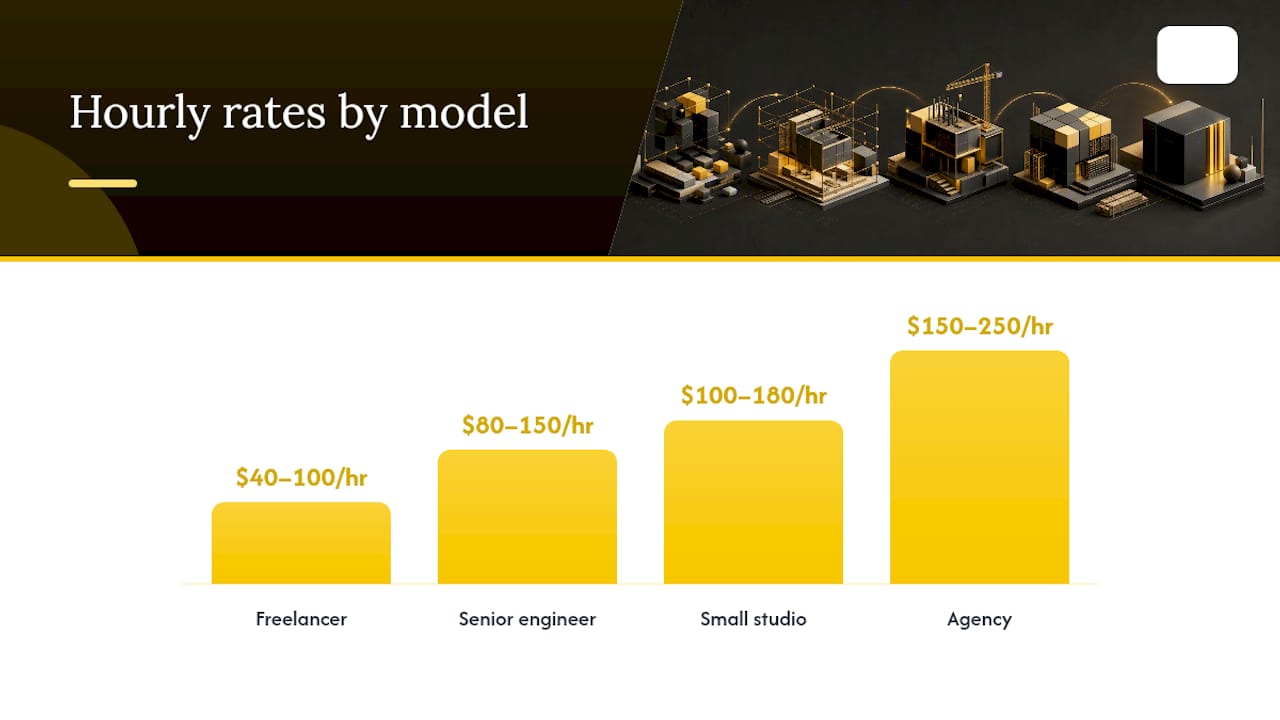
Comparing quotes across freelancers, studios, and agencies only works once you convert every proposal into implied hours, because the sticker price hides wildly different rates underneath.
A freelancer might quote $35,000 for your MVP at a $70 hourly rate, implying 500 hours. An agency might quote $55,000 for the exact same scope at a $150 hourly rate, implying only 367 hours, less time, higher cost per hour. Neither number tells you anything on its own. Agency pricing for identical scoped work commonly runs 40 to 60% higher than an offshore or independent build, mostly because you're paying for account managers and overhead layers that never touch your code.
Here's roughly how the models stack up:
- Freelancer: $40 to $100/hour. Lowest overhead, but availability and reliability vary widely, and you're one person's schedule away from a delay.
- Independent senior engineer: $80 to $150/hour or fixed-price equivalent. No management layer, one person accountable for the whole build, but capacity is limited to what one skilled person can do.
- Small studio: $100 to $180/hour. More bandwidth than a solo freelancer, some project management included, still a relatively thin overhead layer.
- Agency: $150 to $250/hour. Full project management, design, and QA teams, but multiple people touch your code and communication runs through layers.
On contracts: fixed price works when scope is genuinely locked and you want budget certainty, which is most true MVPs. Time and materials makes sense when you're still discovering the scope as you build, common in R&D-heavy AI work. A hybrid, fixed price for a defined core with T&M for stretch features, splits the risk sensibly on projects with one clear must-have and a few nice-to-haves.
Pro Tip: Ask every vendor for their hours-per-feature breakdown before you compare prices. A quote that can't tell you how many hours went into the login flow versus the dashboard is a quote you can't actually evaluate.
Does Your Platform Choice Change the Price?
Platform choice moves your budget more than almost any other single decision, and it's the one founders get wrong most often by defaulting to "we need an app."
A responsive web app generally offers the most cost-effective way to test a product hypothesis, requiring only a single codebase and avoiding app store review delays. Native iOS or Android development significantly increases frontend costs due to separate codebases and additional app store submission time. Cross-platform frameworks offer a compromise, enabling one codebase for multiple platforms at a cost that is higher than web but below native app development.
My default advice: start on web unless your core value proposition genuinely requires native features (camera-heavy apps, offline-first tools, push-notification-dependent products). Most B2B SaaS ideas don't need native at all for validation.
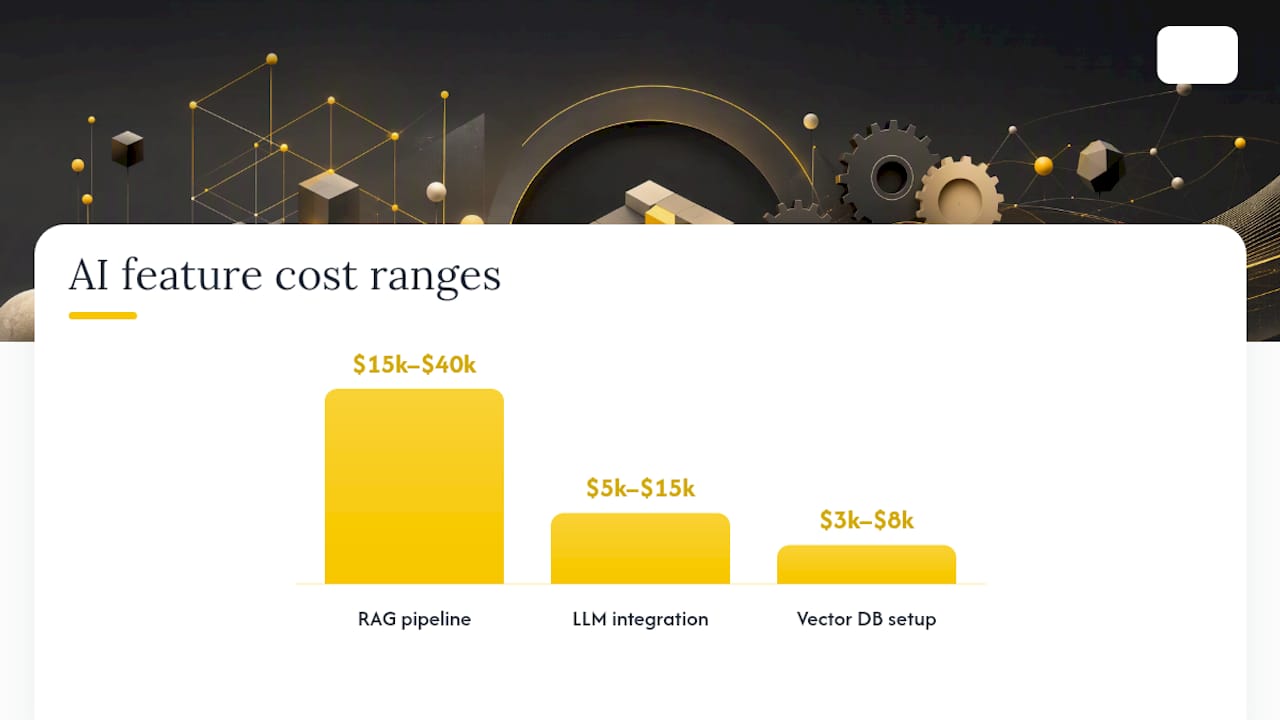
AI features carry their own cost structure entirely separate from the platform question. A RAG pipeline runs $15,000 to $40,000 on its own; LLM integration adds $5,000 to $15,000; vector database setup adds another $3,000 to $8,000. None of that includes the ongoing inference bill, which scales with usage and needs monitoring from day one, not added later as an afterthought.
Common integrations carry their own quick estimates worth knowing before you scope:
- Payments (Stripe or similar): 20 to 40 hours for a standard checkout flow, more if you need subscriptions and dunning logic.
- Single sign-on: 15 to 30 hours, more if you support multiple providers (Google, Microsoft, Apple).
- Maps or location services: 10 to 25 hours depending on how deeply location data feeds your core logic.
Each integration also carries ongoing cost, usage-based API fees that show up on your monthly bill long after launch, which is why the next section matters as much as this one.
What Hidden Costs Catch Founders Off Guard?
The single most underestimated line item in any MVP budget is the infrastructure and integration tax, typically 25 to 35% on top of your raw feature-hours estimate. This covers the work that never shows up on a feature list: error handling, edge cases, CI/CD pipelines, deployment scripting. Founders who estimate purely from a feature checklist consistently underbudget by this exact margin.
Beyond the build itself, a handful of recurring costs start the day you launch and never stop; understanding pricing and packages can help founders plan these ongoing expenses effectively.
- Hosting: $50 to $500 per month for a standard MVP, climbing fast with traffic or heavy data storage.
- LLM inference: highly variable, often $100 to $2,000+ per month depending on usage volume and which model you're calling.
- Monitoring and error tracking: $0 to $200 per month for basic tooling, more at scale.
- Third-party API fees: payments processors, email services, SMS providers, each with its own usage-based pricing that adds up quietly.
If your product touches AI decision-making in any regulated context, budget separately for documentation and risk management. The EU AI Act's Article 50 sets out transparency obligations that founders building AI features for EU users need to plan for from the start, not retrofit after a compliance review flags it. That's not a large line item at MVP stage, but it's one that costs far more to add later than to plan for now.
How Do You Calculate Your MVP Budget?
The formula is simple enough to run on a napkin, and it gets you within a reasonable range of most agency quotes:
- Count your core features. A true MVP has 5 to 8 features, not 20. If you're past 8, you're not scoping an MVP anymore.
- Estimate hours per feature conservatively. Lean SaaS builds run 150 to 250 hours total; marketplaces or real-time features push that to 250 to 400 hours.
- Multiply hours by your chosen team rate. This gives you raw build cost.
- Add 25 to 35% for infrastructure and integration tax. This covers the invisible work described above.
- Add a QA and maintenance reserve of roughly 15 to 20% of the total so far.
Here's a worked example for a standard SaaS MVP: five core features (signup, dashboard, one main workflow, payments, basic settings), estimated at 220 hours, at a $100/hour blended rate.
| Step | Calculation | Running Total |
|---|---|---|
| Base build (220 hrs × $100) | $20,000 to $150,000 | $20,000 to $150,000 |
| Infrastructure tax (30%) | $20,000 to $150,000 × 0.30 | $30,000 to $60,000 |
| QA and maintenance reserve (18%) | $30,000 to $60,000 × 0.18 | $30,000 to $60,000 |
That lands at roughly $34,000, squarely inside the standard tier and close to what most independent senior engineers or small studios would quote for the same scope. The sensitivity worth noticing: shift the hourly rate from $100 to $150 (a studio or agency rate) and the same math lands closer to $50,000, without a single feature changing.
Use this formula to sanity-check any vendor quote you receive. If a proposal comes in at double what your own hours-times-rate math produces, ask for the hours-per-feature breakdown before you sign anything.
Where Can You Cut Cost Without Losing the Validation?
Some cuts save money and cost you almost nothing in learning. Others save money now and cost you a full rebuild in six months. Knowing which is which is the entire skill.
Safe places to cut:
- No-code or low-code for the true edges of your product, an admin panel, an internal reporting view, anything users never touch directly.
- Cross-platform instead of native, ships to both app stores from one codebase, at real but smaller cost than building twice.
- Defer features that don't test your core hypothesis. If you're validating whether people will pay for a workflow tool, you don't need social login, dark mode, or a referral system in version one.
- Discovery-first approach. Spending a few days clarifying scope before writing code almost always saves multiples of that cost later.
The problem isn't building fast and rough. It's not knowing you did, and trying to scale a prototype that was never meant to hold real users.
Pro Tip: Never cut corners on authentication, payments, or QA for your single core flow. These are the three places where a bug doesn't just annoy a user, it ends the test entirely, because the user can't get past the front door.
What never to skimp on beyond those three: basic error handling on anything that touches money or user data, and a real staging environment before production. Both are cheap relative to the cost of a payment bug discovered by an actual paying customer.
How Long Should Each Build Phase Take?
Timeline tracks cost almost exactly, because both are driven by the same underlying variable: feature count and integration complexity.
- Discovery and planning: 1 to 2 weeks. Scope gets locked, technical decisions get made, and acceptance criteria get written down before any code exists.
- Design: 1 to 2 weeks, often running partly in parallel with the tail end of discovery. Output is a clickable design system covering every core screen.
- Core build: 4 to 8 weeks depending on tier, simple MVPs on the low end, complex or AI-native builds on the high end. This is where features get built and connected to real data.
- QA and hardening: 1 to 2 weeks. Edge cases, error states, and the parts that only surface once someone tries to break the app on purpose.
- Launch and handover: 1 week. Deployment, monitoring setup, and documentation so whoever maintains the app next isn't starting from zero.
That puts a simple MVP at roughly 8 weeks total and a complex or AI-native build closer to 14 to 16 weeks.
Compression is possible but has a cost of its own. Squeezing delivery into 8 weeks for a build that would normally take 12 requires a tighter scope, senior-only engineers, and zero complex integrations, and it usually costs more per hour, not less, because you're paying for concentrated senior time instead of a mixed-seniority team spread across a longer calendar.
The rule of thumb: parallel work (design running alongside late discovery) saves real calendar time at no cost penalty. Adding more junior developers to hit a deadline rarely does, and often adds coordination overhead that erases the time it was meant to save.
What Are Hanad Kubat's Rules for Delivering an MVP?
I build fixed price, fixed scope, one name on the contract. Here's what that means in practice, and why I structure it this way.
The price is fixed before I write a line of code, and the scope is frozen at kickoff. No surprise invoices halfway through. If new scope comes up mid-build, it becomes a separate conversation, not a silent addition to the bill.
You own the code from the first commit. Not on final payment, not on project close, from the first commit. If I disappear tomorrow, you have a working repository any competent engineer can pick up.
Typical builds run two to four weeks, not months. That's possible because there's no project-manager layer translating between you and the person writing the code, and no juniors learning on your budget.
I do exactly three kinds of work. Rescue and rebuild: your Lovable, Bolt, v0, or Bubble prototype validated the idea and then hit a wall, it breaks under real users, or a security review would fail it on sight. The prototype becomes the spec, and I rebuild it as real, maintainable code. First real version: no code yet, maybe a Figma file. One core workflow gets built properly and handed over, not a clickable demo, a working thing real users can use. Internal tool or workflow app: your business runs one painful manual process, and I turn it into a tool your staff actually use.
Demos, not decks. If a vendor can't show you working progress before final payment, that's the question to ask before you sign, not after.
What the Cost Data Actually Tells You
The conventional MVP advice treats cost as a shopping problem: find the cheapest hourly rate, and you've solved the budget. That's backwards. The data here shows cost is a scoping problem first. A five-feature MVP at a senior rate almost always beats a twelve-feature MVP at a discount rate, because every extra feature multiplies QA time, integration risk, and the odds something breaks silently in front of your first real user.
Where most guides fall short is treating the infrastructure tax and the maintenance reserve as fine print. They're not. Together they can add 40 to 50% on top of a naive feature estimate, and skipping them is the single most reliable way a founder ends up asking for more money three months in.
If you take one thing from this: scope five to eight features you can defend individually, budget the tax and reserve honestly from day one, and spend your remaining capital on getting real users in front of the thing, not on features nobody asked for yet.
— Hanad Kubat
Get a Fixed-Price MVP Built in Weeks, Not Months
Every budgeting rule in this article assumes you're comparing quotes or estimating your own build. If you'd rather hand the whole thing to one senior engineer, that's Your app, a fixed-price build starting at €12,000, with turnaround measured in weeks, not months. No agency overhead, no project-manager layer between you and the code, no offshore markup padding the rate, and you own the repository from the first commit.
If you're not sure your scope is even right yet, start with The plan, a fixed-price audit from €1,500 that takes three to five days and gets credited against the build if you move forward. Before requesting a quote, send over your core workflow, your must-have integrations (payments, SSO, anything else), and any existing prototype or Figma file. That's enough for a real number, not a range.
Every line gets written by me, no juniors, and payments that clear, logins people trust, and hosting that holds up are the baseline, not the upsell. Reach out through Hanadkubat to start the conversation.
Sources
The cost bands, hour estimates, and budgeting rules in this guide draw on a handful of sources worth knowing if you want to dig deeper into any single number:
- MVP Development Cost In 2026: Complete Startup Guide — Enlightlab
- Cost to Build an MVP: Real Numbers by Scope — TimelineDigi
- MVP Estimation in 2026 — Estimate Cost Before You Ask — ProjectCostEstimator
FAQ
How much should an MVP cost?
Most MVPs cost between $20,000 and $150,000, with a typical standard SaaS build landing between $30,000 and $60,000. The right number for you depends on feature count, platform choice, and whether AI components are involved.
How much does it cost to create an MVP?
A simple MVP with one core workflow and no complex integrations typically costs $15,000 to $30,000. Add AI features, multiple user roles, or real-time functionality, and cost climbs into the $60,000 to $130,000 range.
What are the main cost categories in an MVP budget?
An MVP budget splits across discovery, design, frontend, backend, QA, DevOps, project management, and launch, with backend and frontend typically consuming over half the total. Discovery alone runs 8 to 12% and is the phase most often skipped, usually at the founder's cost later.
How much does Hanad Kubat's MVP build cost?
Hanad Kubat's fixed-price MVP builds, called Your app, start from €12,000, with rescue rebuilds of existing prototypes running €12,000 to €20,000. A fixed-price audit called The plan is available from €1,500 for founders who want a scoped estimate before committing to the full build.
What is the fastest realistic timeline for an MVP?
A simple MVP can realistically ship in 8 weeks, tight scope, senior engineers, no complex integrations, while complex or AI-native builds run 14 to 16 weeks. Compressing timelines further is possible but usually costs more per hour, not less.