
TL;DR:
- Lean startup methodology is a scientific, experiment-driven approach that tests assumptions quickly and learns from real user behavior. It replaces traditional long-term planning with rapid Build-Measure-Learn cycles centered around minimal experiments called MVPs.
Lean startup methodology is defined as a scientific, experiment-driven approach to building new businesses by testing assumptions quickly, learning from real user behavior, and iterating before committing large resources. Eric Ries formalized the framework in 2011, and it has since been adopted across accelerators and MBA programs worldwide as the standard way to validate business ideas. The core tools are the Build-Measure-Learn loop, the Minimum Viable Product (MVP), validated learning, and innovation accounting. Together, they replace the traditional model of writing long business plans and building full products before anyone has confirmed that customers actually want them.
What is lean startup methodology and its core principles?
Lean startup methodology is built on five interlocking principles, each designed to reduce uncertainty rather than ignore it.
- Entrepreneurs are everywhere. A startup is any organization working under conditions of extreme uncertainty. That includes teams inside large corporations, not just garage founders.
- Entrepreneurship is management. Building a startup requires a discipline suited to uncertainty. Gut instinct is not a management system.
- Validated learning. Every action should generate data that confirms or disproves a specific hypothesis. Opinions and assumptions do not count.
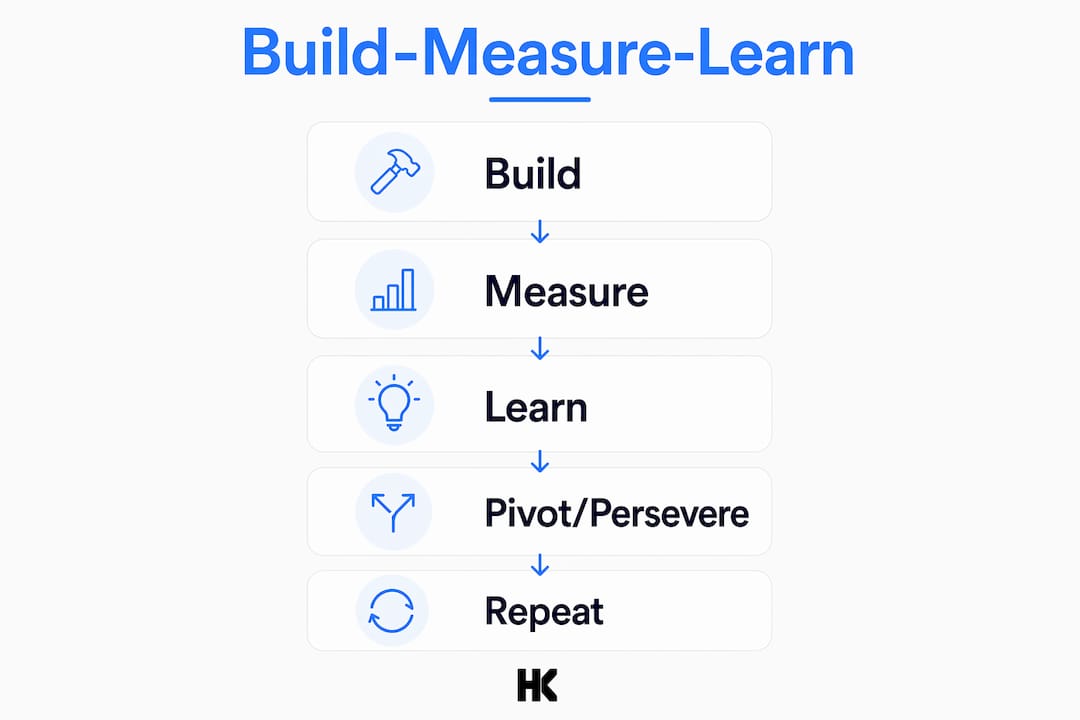
- Build-Measure-Learn. The core feedback loop. Build the smallest possible test, measure real user behavior, and learn whether your hypothesis holds.
- Innovation accounting. Actionable metrics like activation rate, retention, and conversion replace vanity metrics like total sign-ups or page views. Vanity metrics feel good but do not tell you whether your business model works.
The MVP sits at the center of these principles. MVP's primary function is validated learning, not to ship a polished product. It is the smallest experiment that can answer your riskiest question.
How does the Build-Measure-Learn loop work?
The Build-Measure-Learn loop is the engine of lean startup. Each cycle has three distinct steps, and the goal is to complete them as fast as possible.
- Build. Create the smallest artifact that tests one specific assumption. This is your MVP. It does not need to be software. Dropbox tested demand with a demo video before writing a single line of production code. Zappos tested whether people would buy shoes online by manually fulfilling orders from a local store.
- Measure. Collect data on actual user behavior, not opinions. Track what founders do, not what they say they will do. Surveys and interviews can produce false positives. Only real usage proves anything.
- Learn. Compare results against your predefined success criteria. Then make a binary decision: pivot or persevere.
Lean startup cycles should complete in days or weeks, not months. Speed is not just a nice-to-have. It is the primary metric for how well you are executing the methodology. Fast iterations compound learning over time, meaning each cycle makes the next one more valuable.
Pro Tip: Set your success threshold before you run the experiment. For example, decide that a landing page needs at least a 5% visitor-to-signup conversion to validate demand. Predefined thresholds prevent "testing limbo", where founders keep running experiments to avoid making a hard decision.

The pivot is what happens when the data says your hypothesis was wrong. A pivot is a structured course correction based on hard data, not a sign of failure. Smart founders treat it as a tool, not an admission of defeat.
What are common misconceptions founders have about lean startup?
Several misunderstandings consistently reduce the methodology's effectiveness. Knowing them in advance saves months of wasted effort.
- MVP does not mean half-finished. MVP is a learning instrument designed to answer one specific hypothesis. A half-built product answers nothing. The Dropbox video MVP was polished and professional. It just did not require building the actual product first.
- Endless testing is not lean. The worst outcome in lean startup is running experiment after experiment without ever committing to a pivot or persevere decision. Testing without decision-making is procrastination with a methodology label on it.
- Behavior outweighs opinion. Actual user usage and payment behavior is more reliable than any interview or survey. Founders who rely on "people said they loved it" are measuring the wrong thing.
- Pseudo-MVPs are a common trap. Many founders build a smaller version of their full product instead of a focused learning tool. The result is a product that costs real money to build but still does not answer the core question.
Pro Tip: Rank your business assumptions by risk and test the riskiest one first. If your entire business depends on whether customers will pay for a specific feature, that is your first experiment. Do not spend weeks validating secondary assumptions while the fatal one remains untested.
The pseudo-MVP mistake is especially common among technical founders. Building is comfortable. Testing is uncomfortable. Lean startup forces you to get uncomfortable early, which is exactly the point.
How to implement lean startup methodology in your startup
Applying lean startup effectively requires a specific sequence. Skipping steps produces the same waste the methodology is designed to prevent.
- Identify your riskiest assumption. Write down every belief your business model depends on. Which one, if wrong, kills the entire idea? Start there.
- Build the smallest possible MVP. Design an experiment that tests only that assumption. Resist the urge to add features. Every addition increases cost and muddies the data.
- Define success metrics before you build. Decide what result would confirm your hypothesis. Write it down. This is your decision rule.
- Measure actionable metrics. Track activation rate, retention, and conversion. These reflect real engagement. Ignore total visitors and raw sign-up counts unless they connect directly to your hypothesis.
- Make the pivot or persevere call. When the experiment ends, apply your predefined criteria. If the data validates the hypothesis, persevere and move to the next riskiest assumption. If it does not, pivot.
- Maintain a decision cadence. Set a fixed review date before each experiment starts. This prevents the cycle from drifting indefinitely.
For B2B SaaS founders specifically, the startup product strategy layer matters as much as the experiment design. You need to know which customer segment you are testing before you can design a meaningful MVP. Testing the wrong segment produces clean data about the wrong problem.
How does lean startup differ from traditional planning and agile development?
Lean startup replaces the traditional approach of writing detailed, static business plans before building anything. Traditional planning assumes you can predict customer behavior accurately enough to commit resources upfront. Lean startup treats every assumption in that plan as a hypothesis to be tested.
The Business Model Canvas, developed by Alexander Osterwalder, fits naturally with lean startup because it maps assumptions visually and makes them testable. Each box in the canvas is a hypothesis, not a fact.
| Dimension | Traditional planning | Lean startup |
|---|---|---|
| Starting point | Detailed business plan | Riskiest assumption |
| Core tool | Market research reports | MVP experiment |
| Decision basis | Projected financials | Validated user behavior |
| Response to failure | Plan revision | Structured pivot |
| Time to first learning | Months to years | Days to weeks |
Lean startup also has a specific relationship with Agile software development. Agile answers the question "how do we build software well?" Lean startup answers the prior question: "what should we build at all?" The two work together. Agile without lean startup can produce well-built software that nobody wants. Lean startup without Agile can produce validated ideas that take too long to ship.
For founders exploring lean product development in a SaaS context, the combination of lean startup principles with short Agile sprints produces the fastest path from idea to validated product. The benefits of lean startup include reduced waste, faster customer feedback, lower financial risk, and a much higher probability of building something people actually pay for. A well-designed brand and product experience also reinforces the credibility of your MVP, which matters when you are asking early customers to trust an unfinished product.
Key Takeaways
Lean startup methodology works because it replaces assumptions with tested evidence, forcing founders to learn what customers actually want before committing significant resources.
| Point | Details |
|---|---|
| Test riskiest assumptions first | Identify the belief that would kill your business if wrong, and test it before anything else. |
| MVP is a learning tool | Build the smallest experiment that answers one hypothesis, not a stripped-down version of your full product. |
| Behavior beats opinion | Measure actual user actions like activation and retention, not survey responses or stated intent. |
| Set thresholds before testing | Define success criteria before each experiment to prevent endless testing without a decision. |
| Pivot is a feature, not a failure | A data-driven pivot is the methodology working correctly. Treat it as a course correction, not a setback. |
Why most founders misuse lean startup (and what actually works)
I have watched founders treat lean startup as permission to ship something broken and call it an MVP. That is not the methodology. That is just low standards with a framework attached.
The real discipline is in the experiment design. Before I build anything, I write down the single assumption I am testing and the exact number that would confirm it. If I cannot write that sentence clearly, I am not ready to build. That constraint alone eliminates most of the waste I see in early-stage teams.
The other pattern I notice is emotional attachment to the original idea. Innovation accounting exists precisely to remove that emotion from the decision. When the data says pivot, founders who are attached to their original vision find reasons to keep persevering. The methodology has no room for that. The data is the decision.
Speed matters more than most founders realize. Completing one Build-Measure-Learn cycle per week versus one per month is not a 4x improvement. It compounds. After six months, the faster team has learned from 24 experiments. The slower team has learned from six. That gap in validated knowledge is almost impossible to close.
The founders who get the most from lean startup treat it as a mindset, not a checklist. They are genuinely curious about being wrong. Being wrong early is cheap. Being wrong after 18 months of building is expensive.
— Hanad
Building your first MVP with Hanadkubat
Knowing the lean startup principles is the straightforward part. Designing an MVP that actually tests your riskiest assumption, then building it fast enough to matter, is where most founders get stuck.
Hanadkubat works with early-stage SaaS founders and non-technical teams to scope, validate, and ship MVPs at fixed prices, starting from €18,000, delivered in 4–12 weeks. The process starts with a €1,500 strategy sprint that maps your riskiest assumptions and defines what the MVP needs to test before a single line of code is written. For founders who want to go deeper on the methodology before engaging, the Hanadkubat blog covers lean startup examples, B2B SaaS validation patterns, and product strategy in detail. Service details and pricing are at hanadkubat.com.
FAQ
What is lean startup methodology in simple terms?
Lean startup methodology is a process for building businesses by testing assumptions with small experiments instead of writing long plans and building full products upfront. The goal is to learn what customers actually want before spending significant time or money.
What is the difference between an MVP and a prototype?
A prototype tests whether something can be built. An MVP tests whether customers want it and will pay for it. The Dropbox demo video is a classic MVP: it validated demand without building the product at all.
How does lean startup relate to agile startup methodology?
Agile answers how to build software well. Lean startup answers what to build in the first place. Most successful product teams use both: lean startup to validate direction, Agile to execute quickly once direction is confirmed.
When should a startup pivot vs. persevere?
A startup should pivot when experiment data consistently fails to meet predefined success thresholds. Persevere when the data validates the core hypothesis. The decision should be made against criteria set before the experiment, not after reviewing the results.
What metrics should founders track in lean startup?
Founders should track actionable metrics like activation rate, retention, and conversion. Vanity metrics like total page views or raw sign-up counts do not reveal whether the business model works.