

GDPR data minimization means collecting only the personal data you actually need, using it only for the purpose you collected it for, and deleting it the moment that purpose ends. The legal basis is Article 5(1)(c): data must be "adequate, relevant and limited to what is necessary." In practice, this breaks into three duties: identify the minimum data a task requires, collect only that, and delete or anonymize it once it stops earning its place. The rest of this piece provides a checklist and the field-level rules that implement this principle practically.
TL;DR:
- Limit data collection to only what is strictly necessary for the specific purpose, and avoid adding fields that are not essential to avoid unnecessary risk.
- Set clear retention periods for each data category, enforce automatic deletion, and document the timelines in your privacy notice and record of processing activities.
- Require vendors and processors to adhere to purpose-specific data processing, include explicit retention and deletion obligations in contracts, and regularly audit compliance.
- Use techniques such as feature selection, data aggregation, and sampling to reduce personal data in machine learning models while maintaining performance.
- Address common mistakes like storing extra data in support tickets or marketing lists without automatic deletion triggers, which violate retention rules and increase data exposure.
Table of Contents
- What Does GDPR Data Minimization Actually Require?
- How Do You Implement Data Minimization Step by Step?
- How Long Can You Keep Personal Data Under GDPR?
- What Should You Require From Processors and Vendors?
- Which Data Minimization Techniques Work for ML and Analytics?
- What Are Common GDPR Data Minimization Mistakes?
- My Approach to Building GDPR-Safe Software
- Get a GDPR-Safe Build or Audit Done in Weeks
- Sources
- FAQ
What Does GDPR Data Minimization Actually Require?
Article 5(1)(c) of the GDPR states that personal data must be "adequate, relevant and limited to what is necessary in relation to the purposes for which they are processed." That's the whole legal text. Three words carry the weight: adequate (enough to do the job), relevant (connected to that specific job), and limited (nothing extra riding along for convenience).
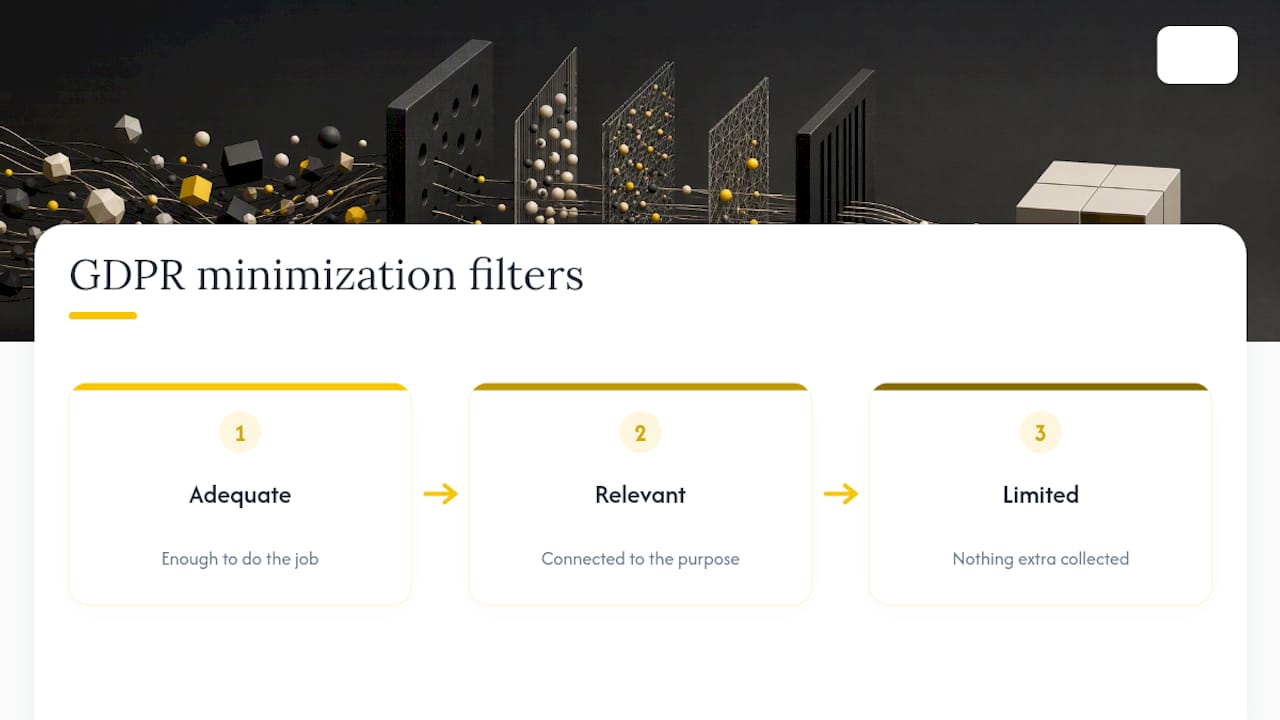
This principle doesn't live alone. It's tied directly to Article 5(1)(e), storage limitation, which says data can't be kept longer than the purpose requires. Collecting the right fields but keeping them forever is still a violation. The two principles work as a pair: minimize what you take in, then minimize how long you hold it.
GDPR recitals reinforce this with language on purpose limitation, transparency, and data protection by design and by default, meaning minimization should be built into your architecture, not patched on afterward. The official regulation text makes clear that regulators expect retention periods to be set in advance and reviewed periodically, not left open-ended because deleting things is inconvenient.
How Do You Implement Data Minimization Step by Step?
Turning the legal text into a working system takes five concrete moves. None of them require a legal team, just discipline at the point where you design a form or a database schema.
- Map purpose to field. For every piece of personal data you collect, write down why you need it. If you can't state a purpose in one sentence, don't collect it.
- Limit at the point of collection. Ask for a date range instead of a birthdate when you only need age verification. Store a hashed token instead of a raw ID when you only need to match records, not read them.
- Set and publish retention periods. Decide how long each data category lives and put it in your privacy notice, not just in an internal wiki nobody checks.
- Enforce need-to-know access. Not every employee or service needs to read every field. Access control and logging turn a policy into something enforceable.
- Automate deletion and review cycles. Manual deletion gets forgotten. Automated jobs and a live record of processing activities (RoPA) don't.
The ICO's practical guidance frames this the same way: identify the minimum amount of data needed, collect only that amount, and delete it once it's no longer necessary. That's operationally simpler than most compliance frameworks make it sound.
Pro Tip: Before adding any new field to a signup form or database table, ask "what breaks if this field doesn't exist?" If nothing breaks, don't add it.
How Long Can You Keep Personal Data Under GDPR?
Retention is where minimization quietly fails. Data collected lawfully becomes unlawful the moment it outlives its purpose, and that clock starts ticking the day you collect it, not the day someone notices the problem.
Set retention by category, not by system:
- Support verification data (ID scans, account recovery details): delete once the ticket resolves, typically days, not years.
- Marketing contact lists: define an inactivity window, such as 18 months with no engagement, then purge or re-permission.
- Analytics and product usage data: aggregate or anonymize after a fixed window instead of keeping raw event logs indefinitely.
Record every one of these periods in your RoPA and reflect them in your privacy notice, so the stated policy and the actual database behavior match. Enforce them with automated deletion jobs, a soft-delete-then-purge pattern, and deletion logs you can produce if a regulator asks. Logs matter because "we deleted it" without proof is not the same as compliance.
What Should You Require From Processors and Vendors?
Minimization obligations don't stop at your own database. Every vendor holding personal data on your behalf extends your exposure, and your data processing agreement (DPA) is the only lever you have over what they do with it.
- Require retention and deletion timetables written into the DPA itself, not left to the vendor's discretion.
- Limit vendors to purpose-specific processing and demand a current subprocessor list.
- Ask for deletion confirmation on request and build in audit rights, plus clear liability allocation if they mishandle data.
- Fold vendor checks into procurement and change control, so a new tool doesn't quietly expand your data footprint without review.
If you're integrating an AI vendor or LLM provider, the same logic applies with extra weight, since many of these tools weren't built with EU obligations in mind. A step-by-step checklist for reviewing AI vendor contracts is worth running before any prompt or document touches a third-party model. For infrastructure decisions specifically, five vendor questions on data residency catch problems before they're baked into your architecture.
Which Data Minimization Techniques Work for ML and Analytics?
Machine learning breaks the simple "collect less" rule into two separate questions: how much detail per record (vertical minimization) and how many records total (horizontal minimization). Both need answers.
- Vertical minimization: feature selection, aggregation, and generalization, stripping a birthdate down to an age bracket, or a location down to a region.
- Horizontal minimization: sampling, so you train on a representative subset rather than every record you can access.
- Differential privacy: protects model outputs from leaking training data, but it does not by itself satisfy minimization at the collection stage, since you still gathered the raw personal data first.
Research on ML data minimization techniques shows feature selection and generalization genuinely reduce the personal data surface, while differential privacy solves a different problem further down the pipeline. A systematic review of data minimization in machine learning found that practitioners consistently struggle to map these technical methods onto legal obligations, largely because nobody decided upfront which pipeline stage to minimize: collection, training, or inference. That decision changes everything downstream. Minimizing at collection protects you legally from day one; minimizing only at training leaves raw personal data sitting in storage regardless of what the model eventually sees.
Combining horizontal sampling with vertical pruning tends to preserve model performance while genuinely shrinking the personal data footprint, rather than treating minimization as a one time cleanup pass.
What Are Common GDPR Data Minimization Mistakes?
Most minimization failures aren't dramatic. They're small habits that compound.
- A support ticket includes a passport number for identity verification. Fix: delete the number immediately after verification and redact it from ticket archives promptly to prevent indefinite searchable retention.
- A marketing list holds contacts who are inactive for an extended period. Fix: define an inactivity rule and purge automatically instead of waiting for a complaint.
- A CRM field captures more data than necessary for sales, including phone, address, and job history for leads that never convert. Fix: reduce the fields captured at entry and add prompts that discourage over-collection.
The pattern behind all three is the same: nobody set a deletion trigger when the data first arrived. EU Commission guidance on GDPR principles treats these retention failures as minimization violations, not a separate category of mistake.
My Approach to Building GDPR-Safe Software
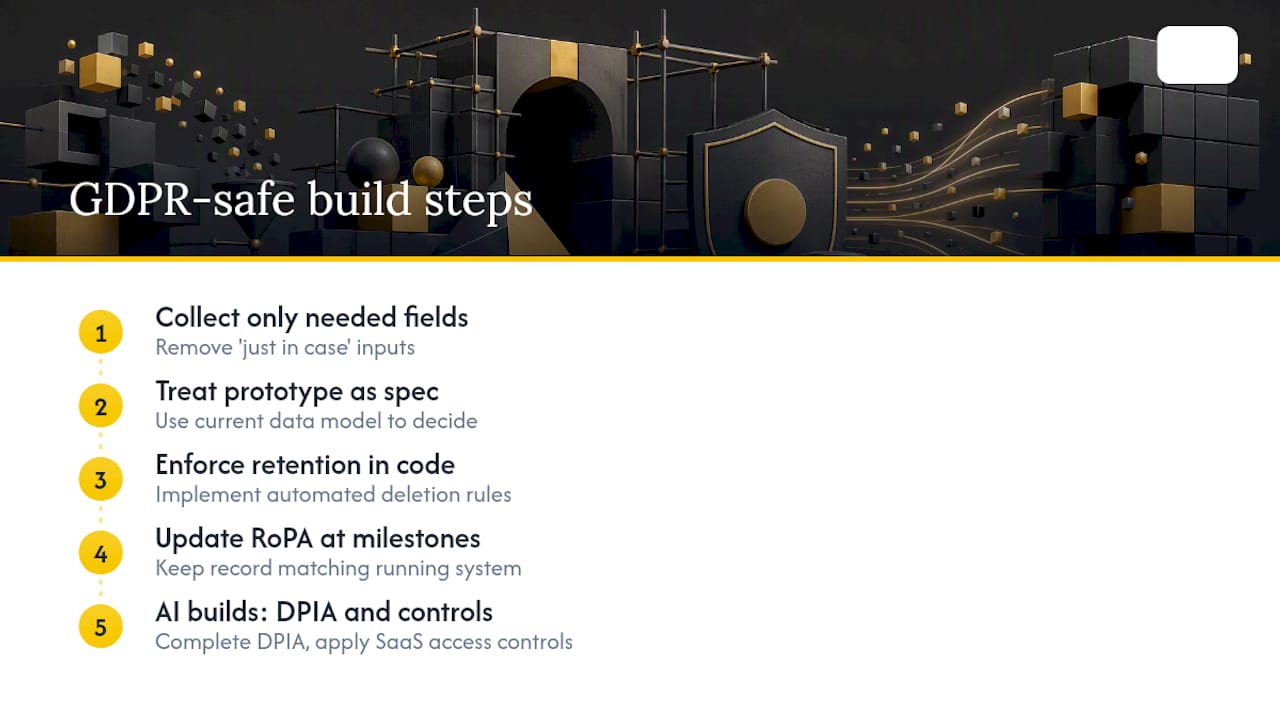
I don't collect "just in case" fields. If a form asks for something the workflow doesn't use yet, it comes out. The prototype is the spec: whatever data structure exists when I take over a rebuild tells me exactly what's actually necessary, and I cut the rest before writing new code.
Retention gets enforced in code, not in a policy document nobody reads. I update the RoPA at each build milestone, so the record matches the running system, not last quarter's intentions. For AI-integrated builds, the same DPIA fields I use for solo engineering work get filled in before a single prompt goes live, and access controls follow the pattern in a standard SaaS security checklist.
— Hanad Kubat
Get a GDPR-Safe Build or Audit Done in Weeks
Hanad Kubat is the alternative to hiring an agency to fix a prototype that's leaking data it never needed: one senior engineer, one contract, and code you own from the first commit. If your MVP was built on Lovable, Bolt, Replit, or similar tools and now needs a real data model with retention rules actually enforced, that rebuild runs €12,000 to €20,000, fixed price, no surprise invoices. If you're not sure where the exposure is, a Prototype Audit at €1,500 over three to five days finds it, and that cost gets credited against the build. Every line is written by me, no juniors, no offshore markup, no agency layer between you and the person shipping the code. Check current availability and get a fixed quote at Hanadkubat.
Sources
- Art. 5 GDPR – Principles relating to processing of personal data
- Principle (c): Data minimisation | ICO
- SoK: Data Minimization in Machine Learning
- Technical research on data minimization techniques for ML
FAQ
What Are the 7 GDPR Principles?
The GDPR sets out seven principles in Article 5: lawfulness, fairness and transparency, purpose limitation, data minimization, accuracy, storage limitation, integrity and confidentiality, and accountability.
Does the United States Have a GDPR Equivalent?
No single federal law matches the GDPR's scope. The U.S. relies on sector-specific rules like HIPAA for health data and state laws such as the California Consumer Privacy Act, none of which impose a uniform minimization duty nationwide.
What Is GDPR Data Minimization in Simple Terms?
It means collecting only the personal data you genuinely need for a stated purpose, and deleting it once that purpose is fulfilled, as required by Article 5(1)(c).
What Are the Legal Requirements for Data Minimization?
Data must be adequate, relevant, and limited to what's necessary for the stated purpose, tied to a defined retention period, and deleted or anonymized once that purpose ends, per Article 5(1)(c) and 5(1)(e).
When Should You Run a DPIA for Data Minimization Issues?
Run a Data Protection Impact Assessment when processing involves large-scale sensitive data, systematic monitoring, or new technology like AI that could pose high risk to individuals, and document the minimization steps taken as part of it.